Which option is right for you?
The amount you iron in one session and the finish you want should guide your choice first. The space you have available can then help you decide between appliances.
For several outfits each week
If you iron shirts, trousers or workwear on a board, compare a steam iron and a steam generator based on how much you iron in each session. UFC-Que Choisir recommends looking beyond steam output alone when assessing an iron.
For long ironing sessions
If you work through several piles of laundry, a steam generator with a continuous-fill system lets you add water without waiting for a pressurised boiler to cool down, as explained by the National Consumer Institute. Remember to allow space for its base, too.
For occasional touch-ups
If you mainly work on hanging clothes and would rather not get an ironing board out, consider a garment steamer. For sharp creases or a classic finish across your whole wardrobe, an iron and a steam generator are still the options to compare.
What should you check before choosing?
Start by choosing an appliance that suits your usual ironing session, then compare the models’ features against the finish, storage and maintenance you need.
Steam iron
Consider it: for a moderate amount of ironing on a board, when sharp creases and a smart finish on structured clothes matter.
Bear in mind: you hold the water tank along with the iron. Check how heavy it feels in your hand and whether you may need to pause to refill it.
Steam generator
Consider it: for long sessions or large amounts of laundry. UFC-Que Choisir describes it as suitable for ironing large quantities.
Bear in mind: its base needs more storage space. According to the National Consumer Institute, a pressurised boiler must cool down before it can be refilled, unlike a continuous-fill model.
Garment steamer
Consider it: for touch-ups on hanging clothes, rather than a full ironing session on a board.
Bear in mind: it won’t create the sharp creases you can achieve with an iron. With a handheld model, check how heavy it is to hold and how often it needs refilling.
| What to consider | What to check | What I need |
|---|
| Finish on clothes |
Compare results across several fabrics where comparable tests are available. Distinguish continuous steam output from the steam shot and the finish actually achieved: UFC-Que Choisir assesses these aspects separately in its test methods for irons and steam generators. |
My shirts or trousers need to keep sharp creases; I don’t want to choose based on a single steam figure. |
| Length of session |
Check the type and capacity of the water tank, as well as the heat-up time, in the model’s instructions. The National Consumer Institute distinguishes between continuous filling and refilling a pressurised boiler after it has cooled. |
When I have several piles waiting, I’d like to know whether I’ll need to stop to refill. |
| Handling and storage |
Check the weight of the part you hold and the dimensions of the whole appliance. For a steam generator, allow for the base; for a handheld garment steamer, consider the weight of the tank when full. |
I need to be able to use the appliance and then store it in the space I have available. |
| Maintenance |
Check the descaling instructions for the exact model and any guidance on the type of water to use. Also check which parts are available and whether the model can be repaired. |
With frequent use, I want to know what maintenance is involved before I buy. |
Which brands should you consider?
These examples can help you compare appliance types and their documentation. Always check the specifications for the exact model you’re interested in.
Calor / Tefal
If you’re considering a Tefal steam generator, the instructions and maintenance details for the exact model are a useful place to start.
- Tefal provides instructions and repair information for the EXPRESS ESSENTIAL SV6110E2 steam generator.
- Don’t assume that accessories or repair options for this model will apply to another one without checking its product details.
Philips
The Philips 5000 Series STH5020/40R1 handheld garment steamer is one option to consider for touch-ups on a hanger or flat surface.
- Philips states that this model heats up in 35 seconds; this is a specification provided by the brand.
- Check the weight and tank capacity if you plan to steam several clothes in a row.
SteamOne
SteamOne offers handheld and vertical garment steamers. The right style for you depends on how many clothes you need to steam and how much space you have.
- For the Stilys SY70SB vertical garment steamer, SteamOne states that it has a 1.2 L tank and a claimed run time of 60 minutes.
- These figures apply to the SY70SB only. They don’t indicate the run time of another model or the finish you’ll achieve on your fabrics.
A steam generator option on Joybuy
This option is for regular ironing on a board with a steam generator. The choice between an iron, steam generator and garment steamer will still depend on how much laundry you have, the finish you want and the space available.
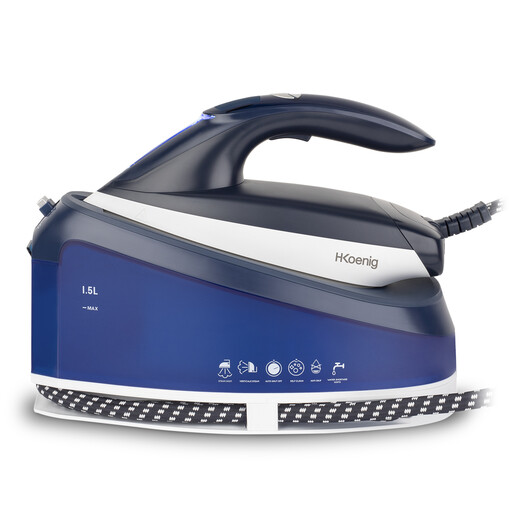 Image unavailable
Hkoenig V7 Steam Iron 8 Bar
This steam station is worth considering for regular ironing sessions on a board, if you have room to store its base. Before choosing the Hkoenig V7, check its instructions for the filling system, heat-up time, iron weight and anti-scale maintenance. The pressure stated in its name isn’t enough to predict the finish you’ll get on your fabrics.
View on Joybuy
Frequently asked questions
Can a garment steamer replace an iron for work clothes?
Not if you regularly need sharp creases or a classic finish on an ironing board. A garment steamer is better suited to touching up hanging clothes. If you need to iron your whole wardrobe, choose between an iron and a steam generator based on how much you iron in each session.
Which filling system should you choose for a steam generator?
For long sessions, continuous filling saves you the wait involved in refilling a pressurised boiler. The National Consumer Institute explains the difference between these two systems. Check the instructions for the model you’re considering, including its filling procedure and tank capacity.
Does higher steam output always mean a better finish?
No. Steam output alone doesn’t tell you how well an appliance will work on different fabrics. UFC-Que Choisir measures steam output and assesses crease removal separately in its tests for irons and steam generators. Where possible, compare results obtained using the same method.
What should you check to use a steam appliance safely?
Read the safety instructions for the model you choose, particularly those covering filling and handling steam. If you’re buying in France, the DGCCRF points out that the CE marking, where required, indicates the manufacturer’s commitment to meeting the applicable regulatory requirements. It is not a quality certification.
What should you do if an iron or steam generator breaks down?
First, check whether repairs are possible and which parts are available for your exact model. For small household appliances in France, ADEME also suggests donating or reselling an appliance, or taking it to an appropriate collection point when you no longer need it.


