
Livraison le jour même ou le lendemain

Qualité garantie

Débloquez vos offres de bienvenue: Livraison GRATUITE | Jusqu'à -80 % | 30 jours d'essai gratuits à JoyPlus
Téléchargez l'application
Long hair that stays damp, frizz after blow-drying, tired arms or an unusable diffuser: choosing an ionic hair dryer is not just about the number of watts displayed on the box. Some marketing claims should be treated with caution, especially when they promise drying that is “5 times faster” or a spectacular number of ions.
Before you reach the checkout, three common pitfalls are worth bearing in mind:
A high-speed hair dryer fitted with a brushless motor can generate a strong airflow with a comparatively moderate electrical output. However, models claiming 110 000 rpm should be compared across several criteria: motor speed, airflow or air velocity, noise level, power and available settings.
For example, the Laifen Neo claims a motor speed of 110 000 rpm and an airflow of 22 m/s. The NICEBAY DW-9041, meanwhile, claims 110 000 rpm and 23 m/s. These figures are useful when comparing technical specifications, but they cannot guarantee the same drying time for every hair type.
For thick or very long hair, look for:
A hair dryer with intelligent temperature control regularly measures the heat at the outlet to help limit excessive fluctuations. This feature does not eliminate the risks associated with heat: keep the appliance moving, choose a suitable temperature and avoid directing hot air too close to the scalp.
Fine, coloured or damaged hair will generally benefit from a warm setting and moderate airflow. Thick hair can often handle a stronger airflow, but the highest temperature is not essential at every stage of drying.
A negative-ion hair dryer is designed, according to manufacturers, to reduce static electricity and help tame unruly strands. The result also depends on ambient humidity, hair type, the brush used and styling products.
The choice of nozzle is often more revealing:
A model described as quiet should ideally display a decibel measurement. As a guide, the NICEBAY DW-9041 claims a noise level below 65 dB on its product page, while the Zhibai S1 indicates 56 dB. These figures still depend on the mode used and the measuring distance.
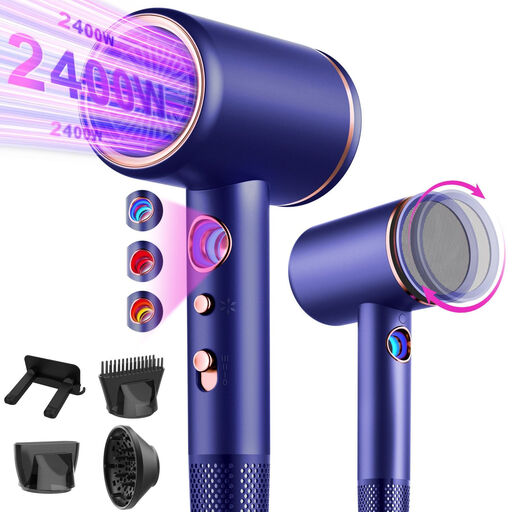
Why it suits this profile : A straightforward set-up that is easy to use regularly at home, with three temperature settings, an AC motor and several advertised accessories.
It does not rely solely on a promise of speed: the temperature settings and diffuser let you adapt it to different uses.
Advertised 2 400 W power, AC motor, three temperature settings and three accessories.
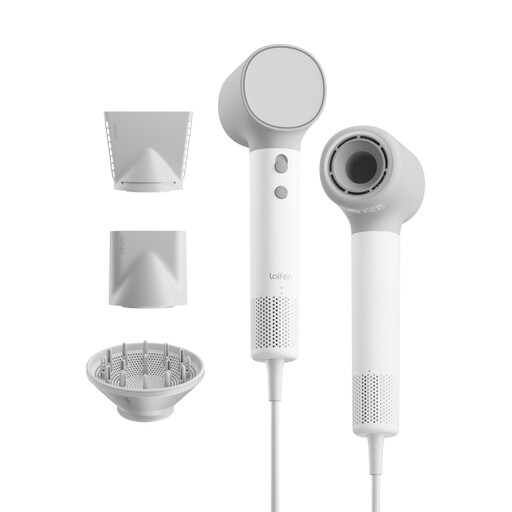
Why it suits this profile : With an advertised weight of 390 g and three nozzles, it is aimed at users who want to save time without compromising on handling or finish.
The product page highlights air velocity, adaptive temperature control and weight, rather than power alone.
Advertised 110 000 rpm, 22 m/s airflow, 390 g weight, three nozzles and a stated children’s mode.
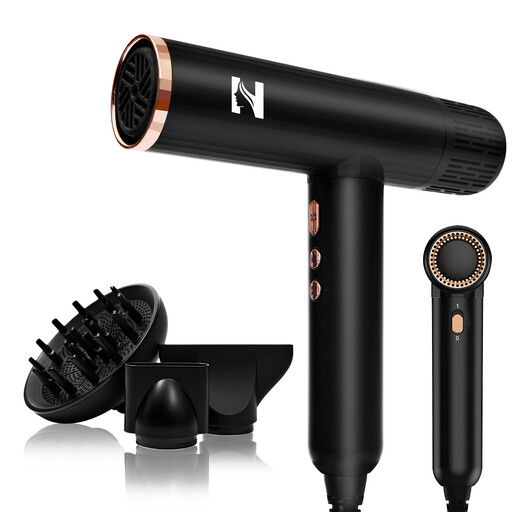
Why it suits this profile : Its diffuser and wide range of settings meet the needs of curly, long or thick hair, particularly with frequent use.
It combines a diffuser with four temperature settings and three speeds, so curls are not treated with a single airflow.
Motor advertised at 110 000 rpm, 23 m/s airflow, diffuser, 570 g weight and a noise level below 65 dB according to the product page.
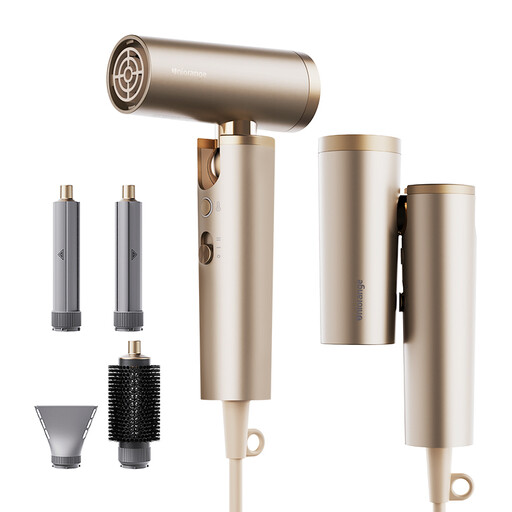
Why it suits this profile : Its foldable design, styling accessories and advertised dual voltage make it a practical companion for international travel.
Its compactness is not simply down to a small casing: the model claims a foldable design, removable filter and reverse-cleaning function.
Foldable design, advertised 100–240 V dual voltage, motor advertised at 110 000 rpm and four accessories.
We have put together a complete, real-time updated selection of products that meet these exacting criteria and European safety standards.
To maintain the performance of an anti-frizz hair dryer, first pat your hair dry with a towel without rubbing it, then start at a medium temperature. Hold the appliance at a distance and use the diffuser without crushing the curls. Clean the intake grille regularly: hair and dust can reduce the airflow and trigger the thermal safety cut-out.
Also check the voltage, plug and cable length. A dual-voltage model does not remove the need to check the setting before using it abroad. Never operate the appliance near a bath, a sink filled with water or a wet surface.
Manufacturers state that negative ions can reduce static electricity and help tame hair. The result varies depending on hair type and the conditions of use. This technology does not replace controlled heat or a suitable drying technique.
Between 1 500 and 2 000 W, a hair dryer can suit many household uses. Higher power may speed up drying, but always compare it with airflow, settings, weight and the thermal control system.
Lifespan depends on build quality, frequency of use and maintenance. Cleaning the filter regularly, keeping the grilles clear and storing the appliance without sharply bending the cable can help limit wear. If you notice unusual noise, a burning smell or overheating, stop using the appliance immediately.