
Livraison le jour même ou le lendemain

Qualité garantie

Débloquez vos offres de bienvenue: Livraison GRATUITE | Jusqu'à -80 % | 30 jours d'essai gratuits à JoyPlus
Téléchargez l'application
An interactive cat toy can add structure to the day for a cat that lives mainly indoors. But you need to choose a model that suits their temperament, your home and your routine. Between the promises of "unpredictable" movements, sounds designed to attract every cat and scented accessories, some marketing claims can push the essentials into the background.
Here are the main pitfalls to avoid and the criteria to consider before buying a manual or automatic cat toy.
A toy that moves or makes a sound might grab your cat's attention for a few minutes. That doesn't mean they'll stay interested day after day. The most effective models offer several ways to play: chasing, pouncing, nibbling, pushing or searching.
A stimulating cat toy should therefore match your cat's habits. A cat that loves chasing something along the floor won't necessarily react to a noisy ball. Conversely, an animal that enjoys playtime with their owner might prefer a cat fishing rod over a standalone device.
Feathers, ribbons, stitching and attachments take a real battering from claws and teeth. An accessory that comes loose can become dangerous if chewed or swallowed. The durability claimed by a brand never replaces regular inspection.
Before buying, check the join between the rod, the string and the moving part. For fabric toys, also examine the stitching and look out for any decorative elements that could be pulled off.
An automatic cat toy powered by batteries may need frequent replacements. A rechargeable model is more convenient day to day, but check the cable type, the advertised charging time and its resistance to moisture.
Noise level also deserves your attention. A noisy cat toy will amuse some animals, but it might irritate people who are sensitive to sound, especially in a small flat. The ability to turn off the sound or put the toy away after play is a real bonus.
There are generally three main categories:
A hunting toy for cats should offer movements that are irregular enough not to become predictable. For electronic models, choose a stable base and a clear, open space for movement.
Felt, corduroy or polyester feel nice to the touch, but they need regular inspection. For a toy designed to be chewed, look for strong stitching and a surface free from small parts that are easy to pull off.
Length matters too. A rod that's too short brings claws too close to your face and hands, whereas a rod around one metre long lets you play at a comfortable distance. The toy should be easy to store and never leave a string accessible when your cat is playing unsupervised.
For a USB-C rechargeable cat toy, check that the charging port isn't accessible during use and remove the cable before letting your cat play. Battery-operated toys should only be opened by an adult, with the compartment properly secured.
In the UK, check the product listing to identify the manufacturer, the responsible operator within the European Union and any usage warnings. For an electrical device, look out for information about power, battery and cleaning. No toy should be submerged unless it's explicitly designed for that.
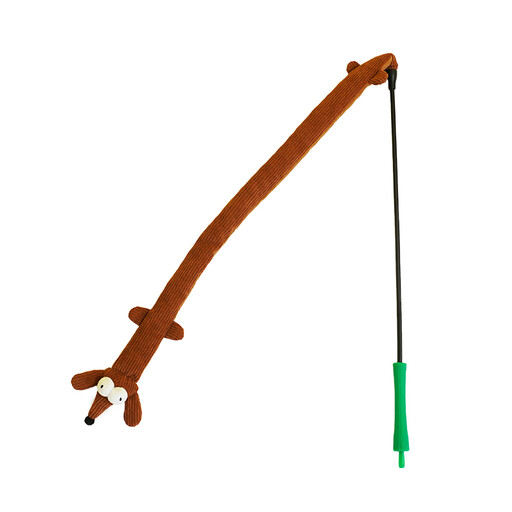
Why this choice suits this profile: This wand is ideal for owners who want to start with a simple toy, no batteries or settings required. It's perfect for short daily play sessions in the living room or bedroom.
Its manual operation avoids battery costs and lets you put the string away as soon as playtime is over.
Flexible rod, felt and corduroy accessory, integrated crinkle paper and dachshund design.

Why this choice suits this profile: This set is aimed at households looking for multiple characters and varied electronic movements to refresh indoor play sessions.
The three characters let you rotate toys and reduce boredom from a single accessory, while recharging avoids buying batteries regularly.
USB-C rechargeable, rolling movements, multi-layer fabrics and three ocean-inspired shapes.
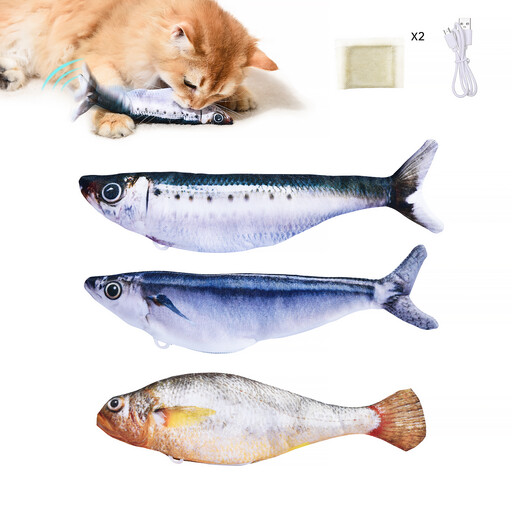
Why this choice suits this profile: This set of three fish is ideal for people who want to rotate toys or offer independent activity to an indoor cat particularly drawn to moving objects.
Movements vary across several modes, and tap activation stops the device running continuously.
Three fish, moving tail, catnip included and rechargeable battery with USB-C cable.
Start with a short session in a space cleared of fragile items and accessible cables. With a fishing rod, slide the accessory along the floor, pause now and then, and change direction regularly. Let your cat catch the toy sometimes: a hunting sequence shouldn't be constant frustration.
With an automatic model, place it on a flat surface and supervise the first few uses. Remove it as soon as a paw, claw or collar risks getting caught. Toys containing catnip, valerian or a silver vine ball for cats need checking more often, because they tend to get chewed.
Store rods, strings and small accessories after each session. Replace any frayed element, cracked casing or torn fabric immediately.
We've put together a comprehensive, real-time updated list of products that meet these strict selection criteria and European safety regulations.
It's best to follow the instructions and supervise the first few sessions. An automatic cat toy should be switched off as soon as it shows signs of wear, unusual noise or a loose part. Rotating with manual toys also helps avoid overly repetitive use.
It all depends on how often it's used, how hard your cat bites and the quality of the stitching or mechanism. Inspect the toy before each use. A rechargeable battery may gradually lose its charge, while a rod might need its string or accessory replacing.
No. Sensitivity to catnip, valerian and silver vine varies from one animal to another. Treat these as a sensory extra, not a guarantee of success. The toy's shape, its movements and how you present it remain the deciding factors.