
Livraison le jour même ou le lendemain

Qualité garantie

Débloquez vos offres de bienvenue: Livraison GRATUITE | Jusqu'à -80 % | 30 jours d'essai gratuits à JoyPlus
Téléchargez l'application
An interactive cat toy helps keep an indoor pet occupied, encourages them to move, and mimics certain hunting behaviours. However, not all models meet the same needs. A curious kitten, a highly active adult, or a feline left alone all day won't necessarily require the same level of stimulation.
Before buying, three common pitfalls keep cropping up:
The goal, therefore, isn't to accumulate accessories, but to find the right balance between activity, durability, maintenance, and lifestyle.
An automatic cat toy or an electronic cat toy can operate independently using a motion sensor, tap activation, or a motorised cycle. This is handy when you're away, but this type of accessory doesn't always replace a proper play session with your pet.
To keep things varied, you can combine:
Unpredictable movements, subtle sounds, and varied textures generally hold a cat's curiosity longer than a repetitive mechanism. However, every cat has its preferences: some are drawn to scents, others to movement or the sound of crinkling paper.
For regular use, check whether the toy runs on batteries or a rechargeable battery. A USB-C rechargeable cat toy can be convenient if you already have a compatible charger. Also look at the charging time, whether a cable is included in the box, and the manufacturer's recommendations.
A built-in battery requires a few precautions:
Battery-operated models, particularly some automatic circuits, can be good for occasional use. Remove the batteries if the toy is to be stored for a long period.
A toy that your cat chews should be inspected regularly. Polyester, felt, corduroy, sisal, and plastic each have different qualities and uses. A soft toy may be fine for pawing, but it's best not to leave it unsupervised if the stuffing or motor becomes accessible.
For a cat play circuit or scratching post, stability is paramount. Set it up on a flat, clear floor. A solid wooden base and a sisal surface allow you to combine several activities in a small space, while encouraging the cat to scratch away from your furniture.
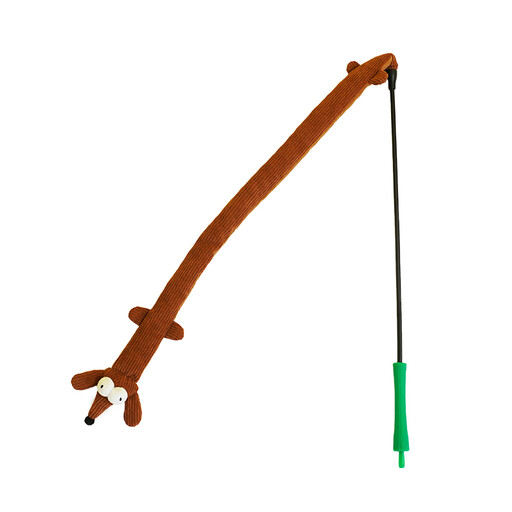
Why this choice suits this profile: This cat fishing rod lets you start shared play sessions simply, with no batteries or complicated assembly required.
Movement is controlled by the user, which avoids the monotony of an automatic cycle. Simply put the rod away after the session.
Flexible wand, felt and corduroy attachment, integrated crinkle paper.

Why this choice suits this profile: A household that likes to vary shapes and characters can rotate the three sea creatures across play sessions.
The three shapes and different movement modes offer more variety than a single accessory.
Set of three characters, multi-layer fabric, USB-C charging, and rolling movements.
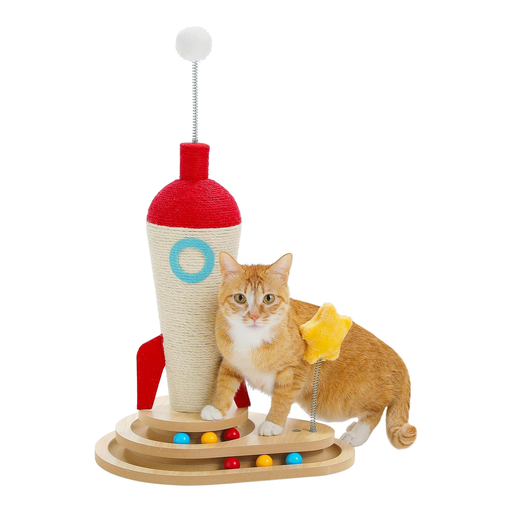
Why this choice suits this profile: This piece of furniture suits cats that alternate between scratching, chasing a ball, and exploring heights, especially in a flat.
It doesn't rely on a single electronic mechanism: a ball track, sisal, and wand offer multiple activities.
Stated dimensions of 40 × 30 × 63 cm, wooden base, natural sisal, and integrated balls.
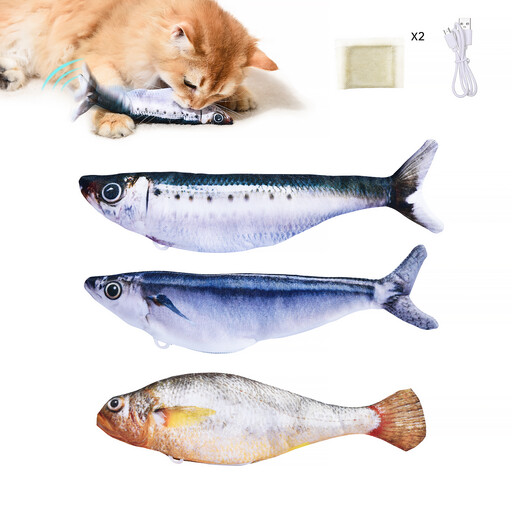
Why this choice suits this profile: The three soft fish can be offered separately to an indoor cat that enjoys movements resembling prey.
The stated movements vary randomly and activation can be done by tapping, rather than following a fixed sequence.
Set of three fish, catnip included, moving tail motor, and USB-C charging.
We've put together a comprehensive list, updated in real time, of products that meet these demanding selection criteria and European safety regulations.
This is not recommended without supervision. Always consult the instructions and inspect the product before each use. Toys equipped with string, small parts, soft fabric, or a motor should be put away when you leave the house. If your cat is left alone, opt for a rotation of controlled toys that are in perfect condition.
It all depends on the frequency of play sessions, the intensity of biting, and maintenance. Regularly check the seams, attachments, battery compartment, and moving parts. A cat chew toy or one containing catnip should be replaced as soon as the fabric tears or the stuffing becomes accessible.
Start by placing it in a quiet space without activating it immediately. Have a short session, then let your cat approach it at their own pace. A fishing rod, a ball, or a toy with catnip can help with this first discovery. Rotate the accessories and put away those not in use to keep your pet's interest over time.