You’re keeping your kitchen cabinet door
If the cabinet door and alignment with the surrounding units need to stay as they are, check how the door is fitted and how it moves when opened before comparing wash programmes.


To replace an integrated dishwasher, first choose an appliance that fits the cabinet space and is compatible with your cabinet door, plinth and door mechanism. Then compare the features that matter in everyday use. A fully integrated model has a cabinet door that conceals the appliance, while a semi-integrated model leaves its control panel visible. Consider a freestanding model only if your kitchen layout means you can do without an integrated appliance.
If the cabinet door and alignment with the surrounding units need to stay as they are, check how the door is fitted and how it moves when opened before comparing wash programmes.
A low plinth can affect your choice of door mechanism, while a tall cabinet space may call for a taller model. In either case, compare your cabinet measurements with the instructions for the model you’re considering.
Ask whether the installation includes fitting the cabinet door and making any necessary adjustments to the unit. Installation services may exclude alterations to the plumbing, electrics or cabinet door.
Choose this if: you want the cabinet door to conceal the appliance and its controls completely.
Bear in mind: the cabinet door must be suitable for fitting and opening with the new model’s mechanism.
Choose this if: you want an integrated appliance but are happy for its control panel to remain visible.
Bear in mind: the cabinet door won’t cover the whole front, but it must still be compatible.
Consider this: only if the space can accommodate an appliance without relying on the existing cabinet space or door.
What this means: the look of the kitchen unit and the installation requirements will change. This isn’t a straightforward swap for an integrated model.
| Priority | What to check | Depending on your needs |
|---|---|---|
| Cabinet space dimensions | Measure the internal width, height beneath the worktop and usable depth. Compare them with the installation diagram for the exact model, allowing for the space needed for connections. | I want to replace the appliance without changing its designated position in the kitchen. |
| Cabinet door and opening | Measure the plinth height and the cabinet door. Check its weight, fixings and the type of door mechanism the appliance allows: fixed or sliding. | The cabinet door needs to stay in place and open without hitting the plinth. Bosch explains the difference between the two door mechanisms in its installation advice; the instructions for your chosen model are what matter. |
| Installation and connections | Check access to the water supply, waste pipe and electricity supply. Ask whether the service includes removing the old appliance, fitting the cabinet door and any alterations to the unit or connections. | If I’m having the appliance installed, I want to know what’s included before arranging the work. For example, Darty states that its integrated installation service excludes alterations to cabinet doors and connections. |
| Everyday use | Once you’ve checked the fit, compare capacity, basket layout, and washing and drying performance. For energy, water and noise, use indicators measured on the same basis. | I want an appliance suited to my household’s dishes, rather than choosing based on its external dimensions alone. ADEME describes the energy label as a useful way to compare energy and water consumption, as well as noise. |
Two appliances with the same nominal width can have different heights. Insufficient depth can also make it difficult to connect the appliance.
Measure the cabinet space’s internal width, height and depth, along with the plinth, then check the installation diagram for the exact model.
Adjusting the unit, plinth or connections may require a separate service.
Fixed and sliding doors move the cabinet door in different ways. In particular, it may catch on a low plinth.
Check how the current door is fitted and compare its measurements with the template for the new model before drilling any holes.
Modifying or replacing the cabinet door, and fitting it, may involve extra work.
Connecting the appliance to existing services doesn’t necessarily include alterations to the plumbing, electrics or cabinet door. Darty excludes these alterations from its integrated installation service.
Ask for written confirmation of what’s included for removal, connections, the cabinet door, the plinth and any preparatory work.
According to UFC-Que Choisir, an integrated dishwasher is designed to fit in a dedicated cabinet space. Switching to a freestanding model won’t, by itself, solve questions about positioning and connections.
Before changing appliance type, check that the space is stable, consider the worktop and any visible sides, and make sure all three connections are accessible.
Bosch’s French range includes 45 cm and 60 cm integrated dishwashers, with standard-height and taller models.
Siemens distinguishes between models whose cabinet door conceals the controls completely and those with a visible control panel.
Electrolux offers fully integrated dishwashers for which the cabinet door needs to be supplied separately.
Whirlpool’s French range includes integrated appliances and models with sliding doors.
Miele offers under-worktop integrated dishwashers for existing kitchens.
These two 60 cm integrated models are worth considering if you’re replacing an appliance in a fitted kitchen. Their stated size doesn’t remove the need to check the cabinet space and cabinet door compatibility before buying.
 Image unavailable
If you’re keeping your fitted kitchen, compare this 60 cm integrated model with the dimensions of the cabinet space. It has a stated capacity of 13 place settings and an energy rating of B. Before reusing the cabinet door, check its measurements and fixings, and make sure the instructions allow for its door mechanism.
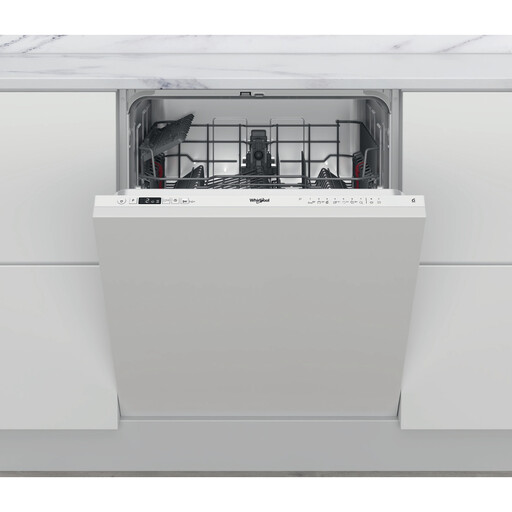 Image unavailable
If you’re replacing an integrated appliance in a fitted kitchen, compare this 60 cm model with the existing cabinet space. The product title states that it has 14 place settings, a white finish and an energy rating of E. Also check the plinth and the cabinet door fixing type in the installation instructions.
Measure the cabinet space’s internal width, height beneath the worktop and usable depth, as well as the plinth height. Note where the connections are and compare these measurements with the installation diagram for the exact model. The appliance’s nominal width alone isn’t enough.
Yes, if its dimensions, weight and fixings are suitable for the new model and it can open with its door mechanism. Check the cabinet door and plinth against the fitting instructions before drilling or ordering the appliance.
A dishwasher needs a water supply, a waste water outlet and an electricity supply, as UFC-Que Choisir reminds readers in its installation advice. Check that they’re accessible from the intended position and ask the installer whether any alterations will be needed.
Ask for details of removal, connections, fitting the cabinet door and any adjustments to the plinth or unit. Services vary: Darty states, for example, that alterations to the cabinet door, plumbing and electrics are excluded from its integrated installation service.
Compare models that fit the cabinet space and are compatible with the cabinet door, then look at their capacity, washing and drying performance, and ease of use. ADEME says the energy label can also be used to compare energy and water consumption, as well as noise. Make sure the models you’re comparing use the same measurement basis.