Households fitting or renovating a kitchen
If you want a door panel that matches your kitchen units, measure the cabinet space and plinth before choosing an appliance. Also check how the door panel is attached and how it opens.


First, choose a dishwasher whose installation diagram matches your cabinet space, plinth and door-panel fixing system. A fully integrated model hides the controls behind the door, while a semi-integrated model leaves the control panel visible. For widths of 45 or 60 cm, choose the size your cabinet space can accommodate and a capacity that suits your dishes. Then compare energy use, Eco programme duration and noise levels on the energy label.
If you want a door panel that matches your kitchen units, measure the cabinet space and plinth before choosing an appliance. Also check how the door panel is attached and how it opens.
An existing door panel won’t necessarily fit a new dishwasher. Compare its dimensions and fixings with the installation instructions for the model you’re considering.
A narrow cabinet space points to a 45 cm appliance, provided it offers enough capacity. According to UFC-Que Choisir, 45 cm models generally hold 9 to 10 place settings, compared with 12 to 17 for 60 cm models.
Consider this if: you want to conceal the appliance and its controls behind a panel that matches your kitchen units.
Bear in mind: the door panel, its fixings and the way the door moves must suit the model you choose. Some appliances are supplied without a door panel.
Consider this if: you want the control panel to remain visible when the door is closed.
Bear in mind: the control panel remains visible, and you’ll still need a suitable door panel fitted beneath it.
| Consideration | What to check | What matters to you |
|---|---|---|
| Cabinet space and door | Compare the internal dimensions of the cabinet space with the appliance’s height, width and depth. Check the plinth, door clearance and installation diagram for the exact model. Bosch, for example, distinguishes between appliances around 81 and 86 cm high. | I want the door to open without hitting the plinth, and the appliance to fit beneath the worktop. |
| Door panel and controls | Check the door panel’s dimensions and fixings, and whether the hinge is fixed or sliding. Check whether a door panel is supplied and, for a fully integrated model, how it signals that it’s running with the door closed. | A seamless run of units matters to me, or I’d rather see the controls without opening the door. |
| Width and capacity | Compare the width of the cabinet space with the appliance size, then check the capacity in place settings and the basket layout. UFC-Que Choisir gives typical capacities of 9 to 10 place settings for 45 cm models and 12 to 17 for 60 cm models. | My cabinet space is narrow, but the capacity still needs to suit the household’s usual load of dishes. |
| Energy use and noise | Compare the kWh per 100 cycles, litres of water per cycle, Eco programme duration, capacity and noise level in dB on the energy label, using the same reference basis. The European Commission explains that these indicators appear on energy labels for household dishwashers. | In an open-plan kitchen, noise matters as much to me as energy and water use, and the duration of the cycle used for comparison. |
| Installation | Check access to the water supply, electricity supply and drainage: the three connections listed by UFC-Que Choisir. Ask the seller what the installation service includes, particularly when it comes to the door panel and plinth. | I want to know before buying which connections and any work on the door panel are still to be arranged. |
Two appliances with the same width may have different heights, depths and door systems. Bosch, for example, offers standard-height and taller models.
Measure the internal width, height and depth of the cabinet space, then compare them with the installation diagram for the exact model. Don’t forget the plinth and door clearance.
Hinges and fixings aren’t automatically interchangeable. IKEA, for example, advises checking that its sliding fixings are suitable for the appliance in question.
Compare the installation instructions for the appliance and door panel, as well as the dimensions, permitted weight and door movement specified for the combination.
If they’re not compatible, you may need a different door panel or fixing system.
The figures on the energy label use set reference points: electricity is shown per 100 cycles and water per cycle. They don’t necessarily describe a short or intensive programme.
Compare labels on an equivalent basis, including the Eco programme duration, capacity and noise level, rather than looking at the energy rating alone.
Connecting the appliance and fitting or adjusting its door panel are separate jobs. Make sure you know what the service includes before choosing.
Ask the seller what’s covered in terms of connections, removing the old appliance, fitting the door panel, adjusting the door and dealing with the plinth.
These ranges offer examples of sizes and mechanisms to consider. Always check compatibility against the exact model number.
In France, Bosch offers 45 and 60 cm integrated dishwashers, both fully and semi-integrated, with different heights depending on the model.
The French range includes fully integrated models and integrated models with a visible control panel.
Electrolux offers 60 cm fully integrated models, including some with SmartFit sliding hinges.
The range includes fully integrated 60 cm dishwashers. Compare them by their dimensions and energy-label indicators.
This model offers a fully integrated door panel and capacity for 14 place settings. Before choosing it, check its installation diagram against your cabinet space and kitchen door.
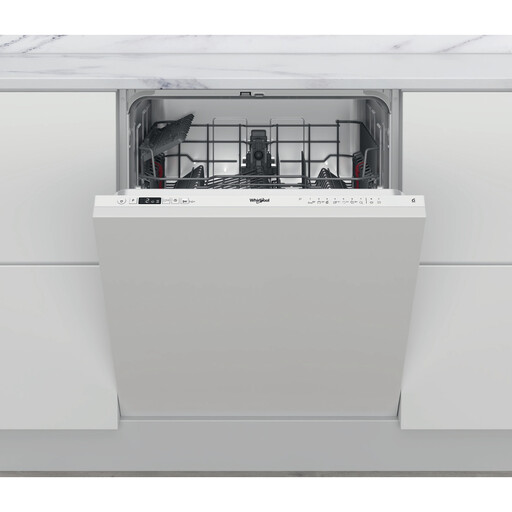 Image unavailable
This 60 cm model with capacity for 14 place settings could suit a fitted kitchen if your cabinet space can accommodate it. The Joybuy listing describes an installation behind a door panel. Check the cabinet-space dimensions, door fixings and plinth against the W2I HD526 A installation instructions. The product name indicates an energy rating of E; check the energy label to compare electricity and water use too.
A fully integrated dishwasher hides its controls behind the door, on the edge of the door itself. A semi-integrated model keeps its control panel visible, but still needs a cabinet space and a door panel beneath the controls.
Yes, if its dimensions and fixing system suit the new appliance, but don’t assume it will fit. Check the plinth and how the door moves in the installation instructions for the exact model too. IKEA specifically advises checking that its sliding fixings are compatible with the appliance.
UFC-Que Choisir says a dishwasher needs a water supply, an electricity supply and a waste-water outlet. Check that all three are accessible from the chosen cabinet space, and ask what the installation service includes.
For an integrated dishwasher, compare the kWh per 100 cycles, litres of water per cycle, capacity, Eco programme duration and noise level in dB. The European Commission lists these indicators for household dishwashers. Make sure you’re comparing like with like when looking at two models.