
当日/次日达

品质保障

开启新人专享福利: 全场免邮 | 低至 2 折 | 免费试用 30 天 JoyPlus 会员
下载 Joybuy
An insulated travel mug can make your commute, office days and train journeys much more enjoyable. But marketing promises alone are not enough to identify a travel cup that genuinely suits your routine. Some models are difficult to clean, too bulky or not secure enough to put in a bag.
Before you buy, three common pitfalls are worth bearing in mind:
For drinking coffee or tea during a journey, 250 to 350 ml is generally an individual serving. A 350 ml stainless steel mug is easy to carry and fits most cup holders, provided you check the shape of its base.
A capacity of 500 to 700 ml is better suited to long days, walks and outdoor activities. Above this, the container quickly becomes heavy once full. The 1.2-litre tumbler is intended more for prolonged hydration than for carrying a traditional coffee.
You should also check:
A double wall creates a barrier between the drink and the outside. Stainless steel with vacuum insulation generally limits heat transfer more effectively than a single wall, while BPA-free plastic helps reduce weight.
Borosilicate glass allows you to see the contents and can be practical at the office, but it requires more care when travelling. For a thermal cup with silicone components, inspect the parts regularly: a crack or deformation can affect how securely the lid fits.
The term BPA-free means that the material concerned does not contain bisphenol A. It does not mean that the product can automatically be used in an oven or microwave, or filled with a fizzy drink.
A mug described as leak-proof deserves a closer look. Look for a lid with a clearly identifiable seal, a closure system that is easy to understand and, if possible, a lockable opening. Even with a seal, carry hot drinks upright and avoid filling the mug to the brim.
For everyday use, look for:
A very hot drink can cause burns, even if the outside of the mug remains relatively warm rather than hot. Never use an insulated mug in a microwave or oven, or directly on a heat source. Fizzy drinks can also cause pressure to build up in some models.
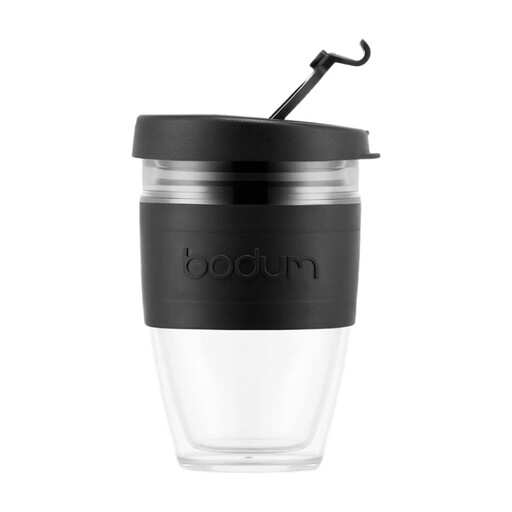
Why it suits this profile: With its 250 ml capacity, this mug is ideal for small coffees, teas and short journeys. Its transparent body lets you keep an eye on the level, while the silicone band provides a better grip.
Its sensible capacity means you avoid carrying a container that is unnecessarily heavy. It is advertised as dishwasher-safe, making everyday cleaning easier.
Double-wall construction, BPA-free body, silicone band and compact 250 ml format.
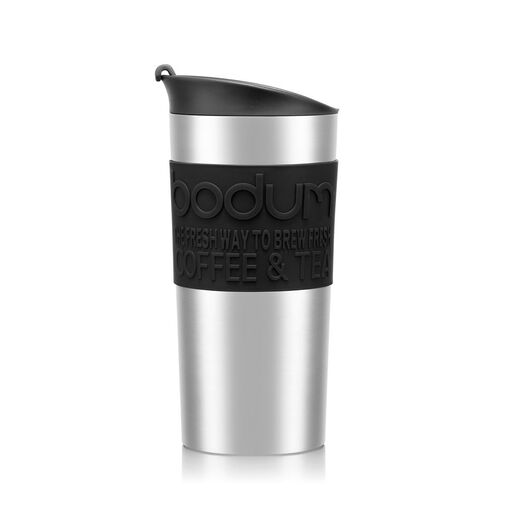
Why it suits this profile: This 350 ml travel mug combines a stainless steel structure with vacuum insulation. It is designed for commuters and users looking for a robust, durable individual-sized mug.
The product information states that the model is not completely watertight in every situation: carrying it upright means you do not take the anti-spill promise too literally.
Double-wall stainless steel, vacuum insulation, flip-top lid and removable non-slip sleeve.
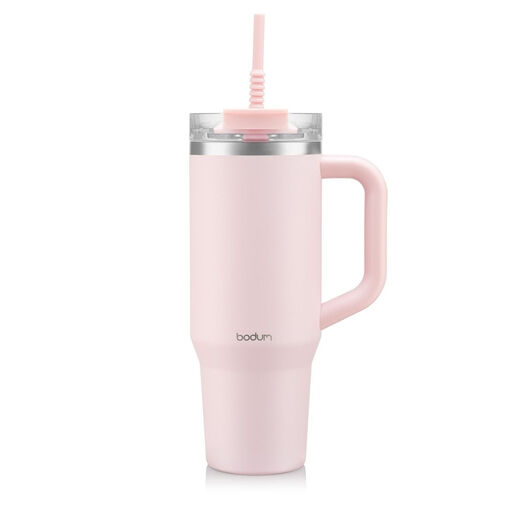
Why it suits this profile: With its 1.2-litre capacity, this model is aimed at people who spend long periods away from a water source: at the office, outdoors or on extended journeys.
Its large format meets the need for extended autonomy, but it does not replace a small car mug: its weight when full and its bulk should be taken into account.
Insulated stainless steel, handle, straw, lid and advertised dishwasher compatibility.
The lifespan of a reusable mug depends primarily on how it is used and cared for. Rinse it after every drink, wash the lid and seal separately, then allow each part to dry completely before reassembling everything. Avoid abrasive sponges and knocks, which can deform the base or damage the insulation.
Replace the lid or seal as soon as you notice a crack, persistent odour, deformation or a less secure closure. On a double-wall steel mug, a significant dent can also affect the insulating structure. Always check the model’s instructions before putting it in the dishwasher.
A 250 to 350 ml format is generally suitable for a serving of coffee, tea or hot chocolate. For several hours of hydration, an insulated bottle or a 500 ml tumbler or larger will be more suitable.
Not necessarily. A lid described as splash-resistant may help limit leaks when the mug remains upright, but it may not withstand being turned over in a bag or shaken. Check the manufacturer’s instructions and carry hot drinks upright.
Take the lid apart and remove the seal if the model allows it, then wash each component after use. Dry them thoroughly and store the mug open. Coffee, milk and tea residue often builds up around the seal and opening.