
Same-day & Next-day Delivery

Quality Guaranteed

Unlock Your Welcome Offers: FREE Delivery | Up to 80% OFF | Free 30-day JoyPlus trial
Download the APP
A coffee that goes cold before you reach the office, a bottle that leaks in your bag or a lid that is impossible to clean: insulated mugs and bottles suit a wide range of uses, but not every model is designed for everyday journeys. Busy adults, students, homeworkers, sports enthusiasts and coffee or tea lovers should pay close attention to the design, materials and usage instructions rather than relying solely on marketing claims.
An insulated cup or double-walled mug can slow down heat exchange, but not all designs offer the same performance. A double wall separated by an air gap does not provide the same results as vacuum insulation in stainless steel. This difference affects temperature retention, weight and impact resistance.
The term ‘leak-proof’ does not remove the need to check for a silicone seal, the closing mechanism and the product’s position during transport. A mug lying on its side in a bag is subjected to far more strain than a tumbler kept upright in a cup holder.
Straws, seals and flip-top lids are more likely to retain traces of coffee, milk or sugary drinks. As for the claim ‘dishwasher-safe’, this does not necessarily apply to every component. Check the instructions and see whether hand washing is recommended to preserve the design and seals.
A travel mug should also fit into your car’s cup holder and remain stable in a bag. A conical shape or non-slip base may prove more useful than a few extra centilitres.
A stainless steel insulated bottle will generally withstand impacts better than a glass model. Meanwhile, borosilicate glass coffee cups let you admire the colour and different layers of a latte or cappuccino. This glass handles temperature changes better than ordinary glass, although it is not unbreakable.
For plastic components, look for a clear indication that they are suitable for food contact, in line with the European framework applicable to materials intended to come into contact with food, particularly Regulation (EC) No 1935/2004. These components must also be used in accordance with the manufacturer’s instructions.
A cup with a straw is convenient for drinking cold beverages, but it is not automatically suitable for very hot liquids. For a hot drink:
An insulated bottle should never be placed in a microwave or oven, or set on a heat source. After dropping it, carefully inspect the seals, lid and wall.
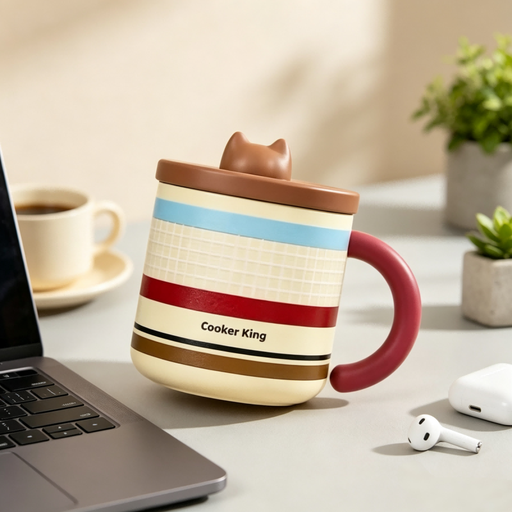
Why it suits this profile: its 450 ml capacity is ideal for the office, studying and coffee or tea breaks, without becoming too bulky.
The clearly stated capacity helps you avoid both a container that is too small for a full drink and a model that is too bulky for the office.
A 450 ml capacity and vintage brown checked design suited to everyday use.
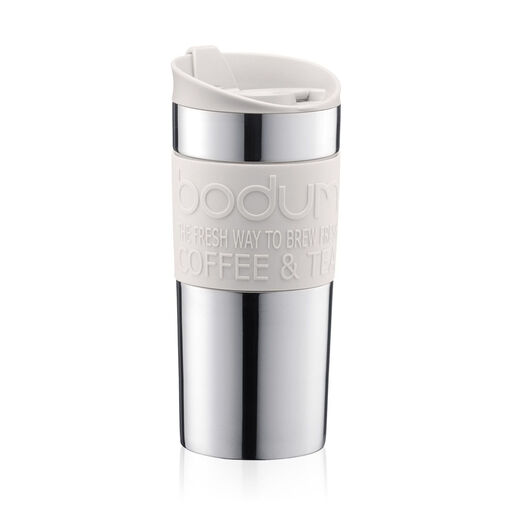
Why it suits this profile: this travel mug combines double-walled stainless steel construction with vacuum insulation in a 350 ml format.
The product details specify the type of insulation, flip-top lid and silicone seal – three points to check before placing your order.
Double-walled stainless steel, a 350 ml capacity and a lid that opens with one hand.
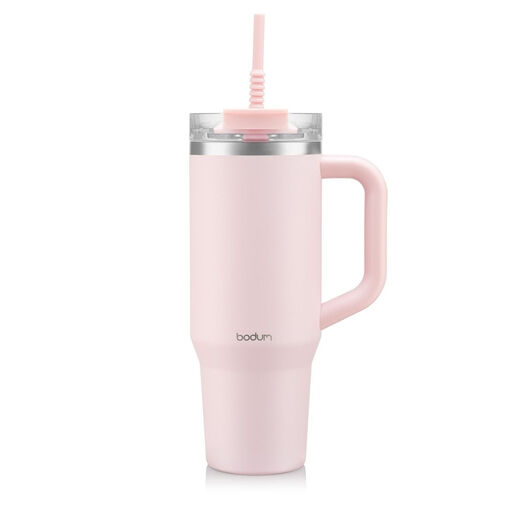
Why it suits this profile: its generous capacity is designed for long working days, outdoor activities and anyone looking to reduce the number of refills.
The 1.2 l capacity is clearly stated, so you can assess its weight and bulk before putting it in a bag or car.
Insulated stainless steel, a straw, handle and lid, with dishwasher compatibility stated by the manufacturer.
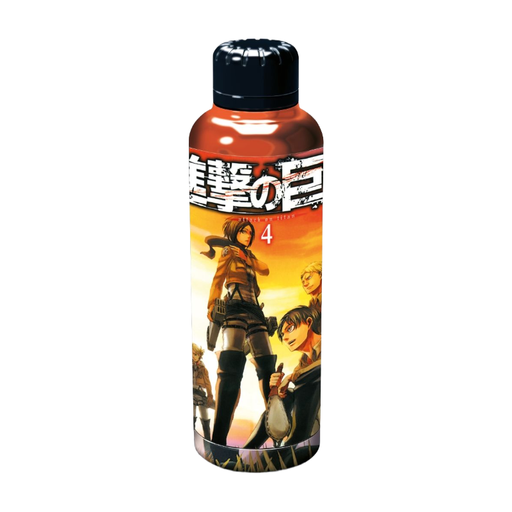
Why it suits this profile: its official Attack on Titan licensed design adds real visual appeal to a bottle made for school, the office, the gym or days out.
The 515 ml capacity and stainless steel construction are clearly specified, so the design does not distract from the essentials.
Stainless steel, a 515 ml capacity and an officially licensed Attack on Titan design.
We have put together a complete, real-time updated selection of products that meet these demanding criteria and European safety regulations.
For commuting, a capacity of 250 to 350 ml generally corresponds to a serving of coffee or tea. To last through an entire morning or accompany a workout, a bottle of around 500 ml avoids the need for frequent refills. Large tumblers of 1 l or more are better suited to extended use, provided you are happy to accommodate their weight and bulk.
Wash the container after every use with lukewarm water, mild detergent and a non-abrasive sponge. Where the design allows, remove the lid and seal, then leave each component to dry separately. Avoid bleach and metal bottle brushes or straws. Do not store the container closed while the inside is still damp.
Lifespan depends on how often it is used, impacts and maintenance. Replace the product if the lid leaks, the seal is cracked, the wall is badly dented or the insulation appears to have stopped working. With double-walled glass mugs, caution is still advised, even when they are made from borosilicate glass.