
Livraison le jour même ou le lendemain

Qualité garantie

Débloquez vos offres de bienvenue: Livraison GRATUITE | Jusqu'à -80 % | 30 jours d'essai gratuits à JoyPlus
Téléchargez l'application
Taking your lunch to work, school, on a trip or a hike sounds simple enough. Yet a poorly chosen insulated container can quickly disappoint if you focus only on its large capacity or a promise of "long-lasting" temperature retention.
A bag that is too bulky becomes awkward on public transport, a badly designed closure can lead to leaks, and a laptop compartment that is the wrong size reduces the product's everyday usefulness. Here are the criteria to check before you buy, along with a selection tailored to different needs.
An aluminium lining or insulating foam does not mean your meal will stay at a constant temperature all day. How long the temperature holds depends on the initial temperature of the food, how full the container is, how often you open it, and the outside temperature.
For an insulated lunch bag, a claimed lifespan of 2 to 4 hours may match the manufacturer's intended use. A stainless steel food flask with vacuum insulation can achieve 4 to 6 hours, but this is only a guide – it is not a guarantee that works in every situation.
A 40-litre insulated backpack might be fine for carrying a laptop, clothes and a meal for a full day. However, it can become cumbersome on the Tube or when cycling. On the other hand, a small lunch cooler may lack space for a water bottle, a food box and cutlery.
Make sure you distinguish between the capacity of the food compartment and that of the bag as a whole. Also check the internal dimensions. A mention like "15.6 inches" or "17 inches" usually refers to the laptop pocket, not the space available for food.
A leak-resistant closure reduces the risk of spills, but it does not make the bag completely invulnerable. Very liquid preparations should be placed in a leak-proof food box or a separately sealed container.
Another detail often forgotten: some insulated backpacks are not machine-washable. An aluminium lining, reinforced seams or supportive foam are generally cleaned with a damp cloth and a mild detergent.
For a single meal, a medium-sized compartment may be enough. For a family, a long journey or an outdoor activity, a 1.5-litre insulated jar or a large soup flask can be more practical than a small box.
A bag designed for work should clearly separate food from electronic devices. Dedicated pockets for your phone, keys, water bottle or charger reduce the risk of crushing and make packing simpler.
Bags made from polyester or water-repellent Oxford fabric are fine for daily commutes, provided they are not left out in heavy rain for long. The aluminium lining is easy to clean, while padded back and shoulder straps improve comfort when the bag is well loaded.
For containers, 304 stainless steel is commonly used for food contact. Some models also offer 316 stainless steel. In both cases, pay most attention to the quality of the lid, seal and threading: leak resistance depends on the whole system, not just the material of the container.
Before buying a backpack with a food compartment and a laptop pocket, measure your device, including the charger if you store it in the same place. A spec saying "up to 15.6 inches" or "up to 17 inches" is no substitute for checking the actual dimensions.
A built-in USB port can be handy during a journey, but it requires a power bank, which is usually not included. It is a cable pass-through, not an integrated battery. Make sure you position the cable correctly to avoid trapping it in the zip.
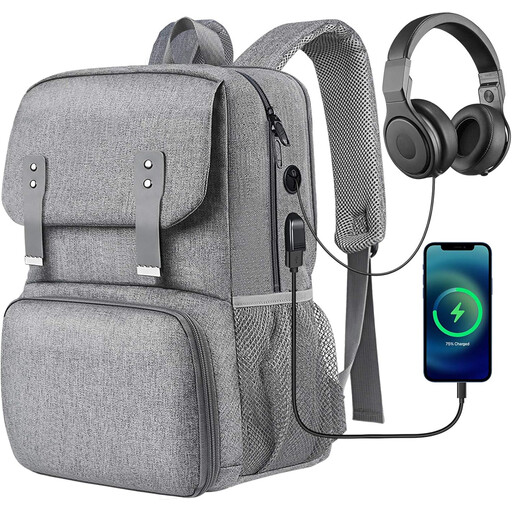
Why this choice suits this profile: This format works well for daily commutes, studies and short outings. It includes an insulated food compartment, a laptop pocket for up to 15.6 inches and several storage spaces.
The stated dimensions let you check compatibility with a standard laptop before buying. The insulating lining can be cleaned with a damp cloth, with no need for machine washing.
Insulated food compartment, USB port (requires external power bank) and anti-theft back pocket.
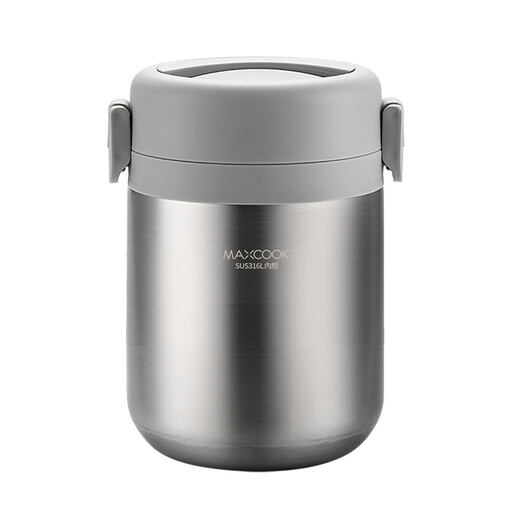
Why this choice suits this profile: This 1.5-litre stainless steel food flask is ideal for soups, saucy dishes and cold preparations to share or take along for a long day.
Its wide opening makes filling and cleaning easy. The manufacturer states a heat retention of 4 to 6 hours; pre-heating or pre-cooling the container before use helps optimise its performance.
316 stainless steel, 1.5-litre capacity, wide opening and airtight lid.
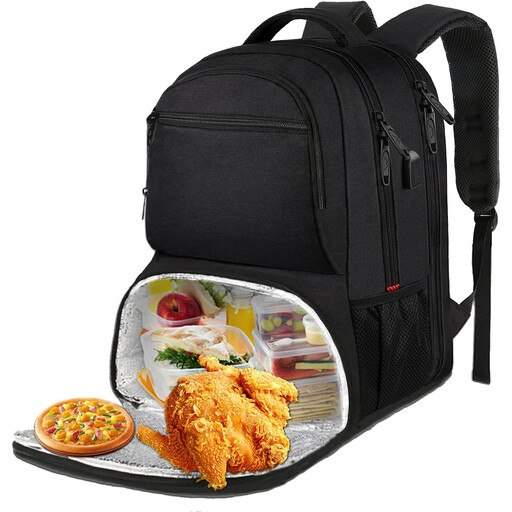
Why this choice suits this profile: With its claimed 40 litres, this insulated backpack is aimed at professionals, travellers and anyone who needs to carry a meal, accessories and a laptop of up to 17 inches.
The laptop compartment and food pocket are separate. The spec sheet does note that you should not overload the bag or machine-wash it – two things to keep in mind for daily use.
40-litre capacity, 17-inch laptop pocket, insulated compartment and design compatible with flat security checks.
We have put together a full selection, updated in real time, of products that meet these demanding criteria and European safety standards.
The duration varies by model and conditions of use. The bags shown generally claim 2 to 4 hours, while the Maxcook jars state 4 to 6 hours. These figures are provided as a guide by the manufacturer and depend on how full the container is, the starting temperature and how often it is opened.
A large soup flask with a wide opening is practical to fill, serve and clean, without having to transfer the contents. A capacity of 1.4 to 1.5 litres can be enough for several portions. Make sure the lid is properly closed and always carry the container upright.
No. The USB port and cable are typically used to connect an external power bank, sold separately. Store the power bank correctly and check that the cable does not interfere with the bag's closure.