
Livraison le jour même ou le lendemain

Qualité garantie

Débloquez vos offres de bienvenue: Livraison GRATUITE | Jusqu'à -80 % | 30 jours d'essai gratuits à JoyPlus
Téléchargez l'application
For a day at the beach, a family picnic, a hike or a work commute, the insulated backpack for 26 cans meets a very specific need: carrying drinks and meals while keeping temperature changes to a minimum. But the stated capacity alone isn't enough to tell the models apart. An unreliable zip, poor organisation or uncomfortable straps can quickly make the bag a chore to use day in, day out.
Here are the criteria to consider before buying, along with a selection suited to different uses.
A claim like "26 cans" often refers to the total across several compartments, not a single space dedicated entirely to drinks. So check the internal dimensions, whether there's a divider, and how the space is split between the insulated zone and dry storage.
A model might boast a generous capacity but prove impractical if the lining thickness, pockets or partitions eat into the usable space. For a family, a picnic backpack needs to let you separate food, bottles and accessories easily.
A waterproof insulated bag or leakproof backpack limits spills thanks to a suitable lining and seams. That doesn't mean it can be turned upside down or submerged without risk. The zip must stay properly closed, and food and ice packs need to be secured to stop them tipping over.
The product page should specify the lining material, the compartment design and the care instructions. Simply saying "waterproof" on the outer fabric doesn't necessarily tell you anything about the interior's leak resistance.
Twenty-six cans, ice packs and a meal quickly add up to a significant weight. A cooler backpack therefore needs adjustable straps, a padded or ventilated back panel and, for longer trips, a hip belt.
A bag that's light when empty isn't necessarily comfortable on a hike. Also think about checking the strap width, how stable the contents are, and how easy it is to access the different pockets.
The insulating foam forms a barrier between the contents and the outside temperature. Its thickness, however, needs to be paired with a durable lining that's easy to clean. PEVA, for example, is commonly used in insulated compartments and can be wiped clean with a sponge.
For an insulated lunch bag, go for a full zip closure and a lining that won't tear at the first snag. After each outing, empty the compartment, wipe away any moisture and leave it open to dry thoroughly.
A double insulated compartment comes in handy when drinks need to be kept separate from food or items that don't need chilling. The 26-can model featured here has a lower insulated compartment stated to hold 16 cans and an upper dry space for 10 cans. Its external dimensions are roughly 44 × 30.5 × 17.8 cm, with a stated weight of 700 g.
This setup suits anyone who wants to carry drinks, a lunch, cutlery and a few accessories all at once. It also means you don't have to open the whole bag just to grab a small item.
For hiking or camping, compare the empty weight, the handles, the straps and whether there's a hip belt. An insulated camping bag also needs to withstand the knocks of transport and be cleanable without a complicated process.
An Oxford fabric or water-repellent polyester can make outer cleaning easier. Still, it's best to use perfectly sealed containers and avoid placing sharp objects against the lining.
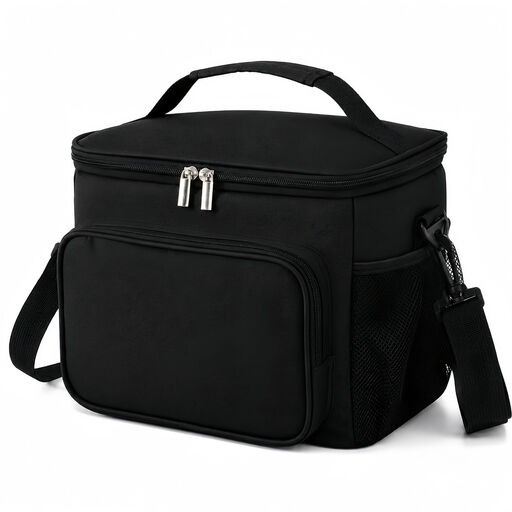
Why this choice suits this profile: its 15-litre size is ideal for daily meals, work and short outings, without the bulk of a large cooler backpack.
A more modest capacity makes it easier to gauge the actual usable space and avoids carrying a needlessly bulky bag.
Reusable 15-litre format and adjustable shoulder strap, as indicated by the product name.
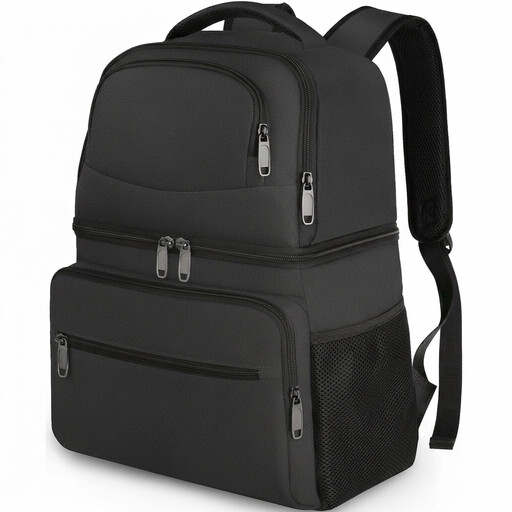
Why this choice suits this profile: its two-zone design is ideal for anyone who wants to carefully organise meals, drinks and accessories on longer outings.
The product page clearly distinguishes the lower insulated compartment from the upper dry space, rather than just stating a total capacity.
Stated 26-can capacity, leakproof PEVA inner lining, adjustable straps, hip belt and storage pockets.
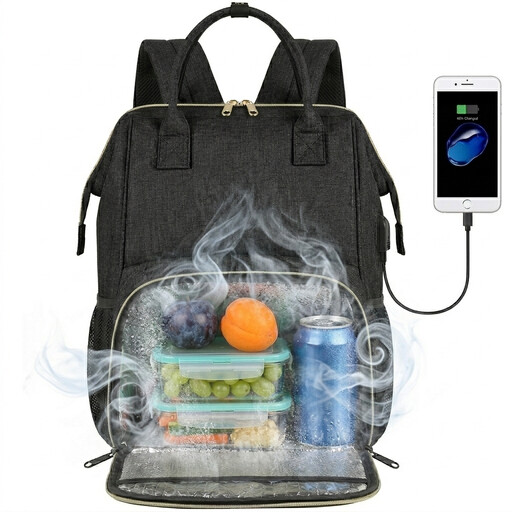
Why this choice suits this profile: this model combines an insulated meal compartment with a laptop space, a practical combination for journeys between home, study and office.
It's not just a simple portable cool bag: its dimensions include a laptop pocket for up to 15.6 inches and several storage spaces.
Water-resistant fabric, insulated compartment stated as leakproof, USB port (requires power bank) and security pocket.
We've put together a comprehensive, real-time updated selection of products that meet these demanding criteria and European safety standards.
It depends on the outside temperature, the amount of contents, how often it's opened and whether you use ice packs. The durations stated by manufacturers should be taken as guidelines linked to their own test conditions, not as a guarantee valid in all situations. To extend the cooling time, pre-chill your drinks and fill any empty spaces.
Place liquid foods in airtight containers, close the bag fully and avoid laying it on its side. After use, quickly wipe the lining with a damp cloth, then leave it to air dry. Regularly check the seams and zip for early signs of wear.
Yes, for a day hike, provided the total weight is within your carrying capacity. Check the empty weight, the quality of the straps, whether there's a hip belt and how the load is distributed. For a short outing, a more compact model will often be easier to handle. For a family or group, however, the extra volume can prove very useful.