For anyone keeping an eye on cup count
You regularly make decaffeinated coffee and want to compare the jar’s weight and stated number of cups with the amount you usually use.


For more eco-conscious shopping, compare the weight with the stated number of cups, using the same recommended serving size. Then check that the ingredients list contains decaffeinated instant coffee, rather than a milky or sweetened mix. A resealable container can make cupboard storage easier, but the words ‘jar’ and ‘bottle’ alone don’t tell you what it’s made of or how to recycle it.
You regularly make decaffeinated coffee and want to compare the jar’s weight and stated number of cups with the amount you usually use.
You’re looking for a coffee without a milky or sweetened mix, and use the serving and strength information to help choose a product to try.
You want to reseal the container and keep it in the cupboard, and check what it’s made of before following the recycling instructions for the jar and lid.
When comparing decaffeinated instant coffees for your cupboard, start with the pack size and serving instructions, then check the ingredients and information on the packaging.
| What to consider | What to check | Who is it for? |
|---|---|---|
| Quantity and cups | Net weight, stated number of cups and recommended amount of coffee per cup. | If I make it often, I want to know how many cups I’ll get from a jar using my usual serving size; around 42% of consumers prioritise this quantity comparison. |
| Ingredients and taste | Ingredients list and recommended serving size; any stated strength is a guide for that particular product. | For my evening black coffee, I want to avoid accidentally choosing a milky or sweetened mix. The ingredients and taste in the cup come first for around 33% of consumers. |
| Storage and recycling | Container material, whether it can be resealed after opening, storage instructions and recycling guidance. | I want to reseal the jar and sort each part according to its material; this is the main concern for around 25% of consumers. |
These words describe the packaging, not necessarily its material. Recycling instructions depend on the container and lid actually used.
Check the material and recycling instructions for the product you buy. For a glass container, ADEME advises putting the glass in the designated recycling bank and sorting a metal lid separately with packaging.
When checked, the Carrefour Extra listing showed the product as unavailable for Drive collection. A product listed online may not necessarily be available for collection from your chosen store.
Check availability at your local store before adding it to your shopping, and look for another product with ingredients that suit you if needed.
The word ‘decaffeinated’ alone doesn’t tell you the exact amount of residual caffeine in the product you’ve chosen.
If this figure matters to you, look for a product-specific caffeine content on the packaging or ask the manufacturer.
The Special Filter Decaf range includes 100 g of instant coffee in a bottle. Carrefour states that this product contains 100% decaffeinated instant coffee and makes 50 cups.
Auchan lists 100 g of freeze-dried decaffeinated instant coffee, said to make around 50 cups, with a stated strength of 6/10.
Carrefour describes 100 g of freeze-dried decaffeinated instant coffee, made from 100% decaffeinated instant coffee.
This selection features decaffeinated instant coffee in a jar for your cupboard. To compare it with other formats, take the serving size and product-specific information into account.
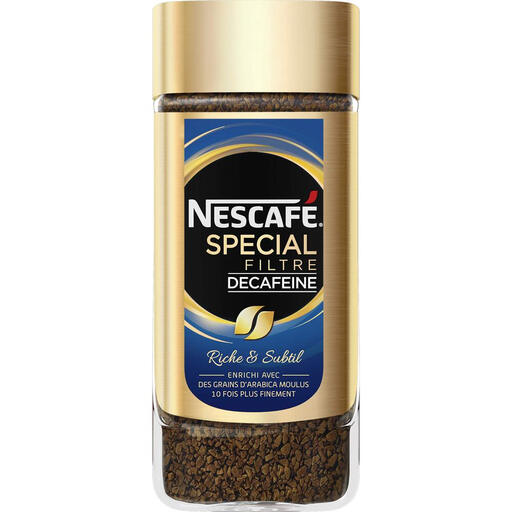 Image unavailable
An option to consider if you’re looking for decaffeinated instant coffee to keep in the cupboard.
The Joybuy listing describes a 100 g glass jar containing 100% decaffeinated instant coffee. Check which serving size suits you when comparing the number of cups with other products.
Read the ingredients list: the NESCAFÉ Special Filter Decaf and Auchan products mentioned here list decaffeinated instant coffee, while a cappuccino- or latte-style mix may contain other ingredients. Check the ingredients for the specific product you choose.
Follow the instructions for the product you buy. NESCAFÉ recommends one teaspoon per 100 ml of hot water, while the Auchan listing suggests one to two teaspoons in hot, but not boiling, water. The recommended amount therefore varies by product.
If the container is made of glass, empty it and put it in a glass recycling bank. According to ADEME, a metal lid should be sorted separately with packaging. Check the product’s recycling instructions too, to identify the different parts of your jar.