If you’re having a late-night snack and want to limit your caffeine intake, start by looking for instant coffee labelled “decaffeinated”: a mild flavour or low intensity isn’t enough to identify it. If you prefer regular coffee, choose your flavour profile separately from your sleep concerns. Anses says caffeine can delay falling asleep and reduce both the length and quality of your sleep. Then choose a format to suit how you’ll use it: sticks for the occasional cup, or a jar if you make it regularly.
Who is this choice for?
People who drink coffee late in the evening
If you sometimes enjoy a hot drink with a snack before bed, first distinguish between regular and decaffeinated coffee. Anses warns that caffeine can disrupt sleep, so a coffee described as mild doesn’t answer this question.
People who like making coffee without a machine
For the occasional cup, compare pre-portioned sticks with a jar, which lets you adjust how much you use. Choose according to where you’ll make it and how often you drink it.
People who choose by flavour and format first
You can compare the mild, balanced or intense flavour profiles listed on products, then check whether the pack size suits your needs. These flavour terms don’t tell you how much caffeine the coffee contains.
What should you check before choosing?
For a late-night snack, first decide whether you want caffeinated or decaffeinated coffee. Then compare the stated flavour and packaging, without treating intensity as an indicator of caffeine content.
| What matters |
What to check |
Who is it for? |
| Caffeine and sleep |
Look for the word “decaffeinated” and check that it’s instant coffee, rather than relying on its stated intensity. |
If I have a snack close to bedtime, I want to limit caffeine without giving up the taste of coffee. Around 33% of consumers prioritise this concern. |
| Preparation and portion size |
Compare sticks with a jar, and check the stated number of portions. |
For the occasional late-night break, I prefer a portion that’s easy to take with me and prepare. Around 27% of consumers put this convenience ahead of other criteria. |
| Flavour profile |
Check the ingredients when listed and read the brand’s flavour descriptions, without confusing them with a measure of caffeine content. |
To go with my snack, I’m looking for a mild, balanced or more intense flavour, depending on my preferences. Flavour is the top priority for around 20% of consumers. |
| How much to keep at home |
Check the net weight, number of portions and storage instructions before choosing a large jar. |
If I make coffee at home often, I want a format I can use up while keeping it in good condition. Around 20% of consumers prioritise finding a quantity that suits how they’ll use it. |
Common mistakes to avoid
-
Assuming “mild” means “decaffeinated”
Coffee described as mild, balanced or low in bitterness may still contain caffeine. This distinction matters if you’re drinking it close to bedtime: Anses says caffeine can affect sleep.
Look for the explicit “decaffeinated” label on the product; treat intensity and bitterness as flavour descriptions.
-
Choosing a large jar without considering how often you’ll use it
A jar and sticks suit different needs: a jar lets you adjust each serving, while sticks provide individual portions.
Check the weight, number of portions and storage instructions to choose packaging that suits your habits.
-
Assuming a listed product is available at your local store
Product ranges can vary between stores, click and collect and delivery options. For example, a listing for Carrefour Extra decaffeinated instant coffee stated that the product was no longer stocked.
Before buying coffee for a late-night break, check that the product and format you want are available from your chosen retailer.
-
Assuming an imported coffee is sold directly by the brand in France
France isn’t listed in Jacobs’ country selector, although third-party sellers offer some of the brand’s products there. The seller and product presentation may therefore differ from what you expected.
For an imported product, check the seller’s identity, the exact product and the information on its packaging.
Instant coffee brands to consider
These brands offer useful comparisons for blends, decaffeinated options and formats. Check each product individually rather than assuming that features of a range apply to every product in it.
Nescafé
The range includes instant coffees described as mild or balanced, as well as Spécial Filtre Décaféiné.
- Nescafé says Spécial Filtre Original combines Arabica and Robusta. The brand also describes Spécial Filtre Décaféiné as a blend decaffeinated using water.
- NES’s “no bitterness” description doesn’t mean “decaffeinated”. Check the exact product if caffeine content is important to your choice.
Carte Noire
A brand to look at if you’re after instant coffee in individual portions.
- Carte Noire describes its instant coffee as suitable for preparation without a coffee maker; retailer listings also mention sticks.
- Check the instant coffee product and format with your chosen retailer: the range highlighted by the brand also includes other types of coffee.
Carrefour Extra
A supermarket own brand offering jars and sticks of instant coffee, depending on local availability.
- Carrefour’s range has included Café Soluble Gold in 100 g and 200 g jars, as well as sticks.
- A listing for Carrefour Extra decaffeinated instant coffee says the product is no longer stocked; check with your local store for the product you want.
Plantation / Marque Repère E.Leclerc
An option to compare if you’re looking for instant coffee in a jar, in sticks or decaffeinated in the E.Leclerc range.
- The E.Leclerc category includes 100 g and 200 g formats, sticks and freeze-dried decaffeinated instant coffee.
- Check the exact product before comparing: packaging and whether it’s decaffeinated vary from one product to another.
Auchan
The supermarket’s own brand includes freeze-dried decaffeinated instant coffee in jars and sticks.
- Auchan lists a 100 g jar of decaffeinated coffee, stated to make around 50 cups, and a box of 25 decaffeinated sticks weighing 50 g.
- The intensity shown on these products describes the retailer’s stated flavour profile; it doesn’t measure their caffeine content.
Jacobs
A brand to compare when you come across an instant coffee product offered by a retailer.
- Third-party sellers offer Jacobs instant coffee products to consumers in France.
- France isn’t listed in Jacobs’ country selector. Check the seller, product and packaging information before buying.
Instant coffee available on Joybuy
This selection features decaffeinated instant coffee in a jar, for making a coffee-flavoured drink to enjoy with a late-night snack. If the variety of beans matters to you, choose your blend separately.
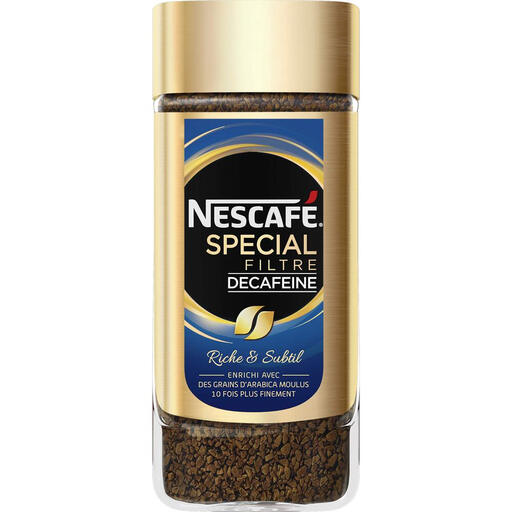 Image unavailable
NESCAFÉ Decaf Filter Coffee, 100 g
Worth considering if you want to limit your caffeine intake in a cup made at home to enjoy with a late-night snack.
Decaffeinated instant coffee in a 100 g format. If you’re looking for an Arabica-Robusta blend or need to know the exact amount of residual caffeine, check the information on the product.
View on Joybuy
Frequently asked questions
Is mild instant coffee always decaffeinated?
No. “Mild”, “no bitterness” and “balanced” describe the stated flavour, not the absence of caffeine. For a late-night cup, look for the word “decaffeinated” on the product you choose.
Why distinguish between regular and decaffeinated coffee before bed?
Caffeine can disrupt sleep: Anses says it can delay falling asleep and reduce both the length and quality of your sleep. If you want to limit caffeine with a late-night snack, first check whether the instant coffee is explicitly labelled decaffeinated.
Sticks or a jar: which should you choose for occasional use?
Sticks are handy if you want a pre-portioned serving to take with you; a jar lets you adjust the amount each time you make a cup. Check the number of portions and storage instructions, taking into account how often you make coffee.
How should you store a jar of instant coffee after opening?
Close the jar after use and follow the storage instructions on the packaging. If you only use a product occasionally, bear these instructions in mind before choosing a larger format.


