For managers focused on yield
To organise regular service, compare the jar’s weight, the advertised number of cups and the dosage for each product. You may not achieve the stated yield if cups are prepared differently.


For regular service, choose a jar of instant coffee with an advertised yield, dosage and storage guidance that suit your canteen. The 200 g size, advertised as making around 100 cups for some products, offers a useful guide for restocking. It’s worth tasting the coffee to check its flavour, while a decaffeinated option can meet a separate need.
To organise regular service, compare the jar’s weight, the advertised number of cups and the dosage for each product. You may not achieve the stated yield if cups are prepared differently.
If the coffee needs to suit a range of people, the stated strength and ingredients can help you shortlist products. A taste test with your team is more useful than a brand’s flavour description when deciding which one to keep in the cupboard.
A separate product can cater for people who want to limit their caffeine intake, without necessarily replacing the coffee you usually serve. Check that the size suits how often this option is likely to be used.
For a jar intended for the canteen, first check the ingredients and advertised yield, then consider whether the taste and serving instructions suit your users.
| Criteria | What to check | Who it matters to |
|---|---|---|
| Yield and restocking | Net weight, advertised number of cups and the corresponding dosage on the packaging. | If I need to restock the canteen regularly, I want to know how many servings to expect from a jar. Around 33% of consumers would make this a priority. |
| Whether people like the taste | Ingredients and stated strength, followed by a small-scale taste test in serving conditions. | If I’m serving the same coffee to several people, I’d rather check that they like it before settling on one product. This would be the priority for around 27% of consumers. |
| Decaffeinated option | The ‘decaffeinated’ label and the size of the separate product. | If some people want to limit their caffeine intake, I want to be able to offer them another clearly labelled jar. Around 20% of consumers would prioritise this option. |
| Dosage and storage | Preparation instructions, and guidance on sealing and storing the product. | When several people prepare the coffee, I need simple instructions and a jar that can be resealed between servings. Around 20% of consumers would put this arrangement first. |
Instant coffee made solely from coffee is different from a cappuccino-style mix, which may contain other ingredients. Your choice also determines whether everyone adds milk or sugar separately.
If you want to serve black coffee that people can customise, read the product name and ingredients list for each item.
The instructions for AUCHAN Intensité 6 and NESCAFÉ Spécial Filtre L’Original are different. The number of cups you actually make will therefore also depend on how much coffee is used for each serving.
Display the instructions for the jar currently in use next to the hot-water station.
Using a more generous measure will empty the jar sooner than its advertised yield suggests.
AUCHAN Intensité 6 should be stored in a cool, dry place in a tightly sealed container. If your cupboard setup makes it difficult to follow this instruction, using the product can become more awkward.
Follow the instructions on your chosen jar and close it between servings. Use a clean, dry spoon.
The range includes NES in a 200 g tin, advertised by Carrefour as making 100 cups, and Spécial Filtre L’Original in a 200 g size.
The range includes a 200 g jar of Café Soluble Gold, as well as other sizes of instant coffee.
The E.Leclerc range includes a 200 g jar of freeze-dried instant coffee, as well as decaffeinated options.
AUCHAN offers Intensité 6 freeze-dried instant coffee in a 200 g size, advertised as making around 100 cups.
The ranges we reviewed include Carte Noire instant coffee, including individual sachets.
A 200 g glass jar of Jacobs Gold is listed on Amazon France by a third-party seller.
These two Maxwell House jars are designed for preparing instant coffee for regular service. The twin pack is suitable if you need to stock up on more than one jar; the single jar lets you start with just one.
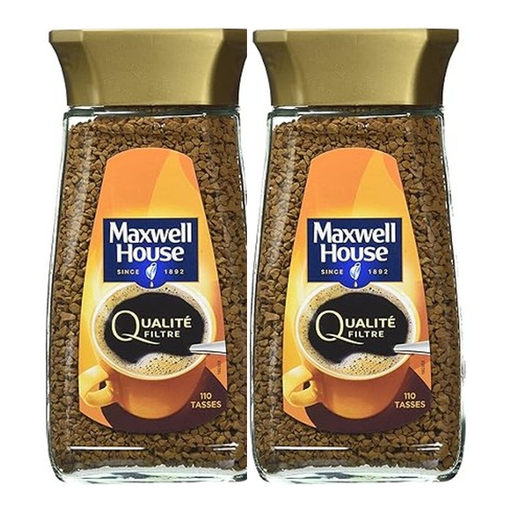 Image unavailable
This twin pack may suit a canteen that serves instant coffee regularly. Check the dosage on the packaging before planning your restock, and let people try the coffee before choosing it for regular service.
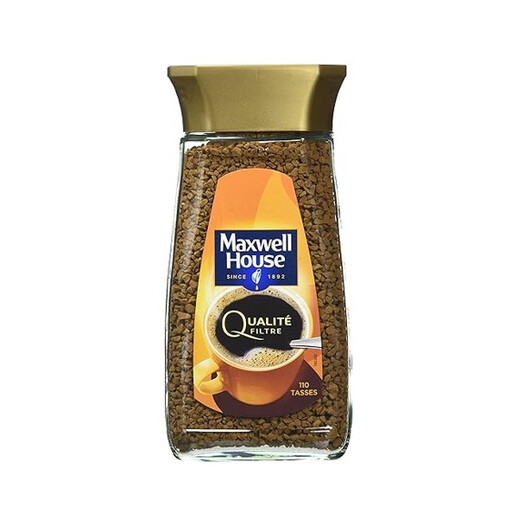 Image unavailable
This single jar lets you try a product before ordering several for the canteen. Joybuy lists it as 200 g of freeze-dried instant coffee in a glass jar, advertised as making around 110 cups; the actual number will depend on the dosage. Follow the storage instructions on the packaging.
Check the product name, ingredients list, net quantity and relevant date, among other details. France’s Directorate-General for Competition Policy, Consumer Affairs and Fraud Control notes that prepacked food labels must include certain information. Also check the nutrition information where it is required for the product in question.
No. The ingredients vary from product to product. Carrefour lists NESCAFÉ NES 200 g as ‘100% coffee’, while AUCHAN Intensité 6 is described as freeze-dried instant coffee. For each purchase, read the ingredients list rather than assuming what’s in the product from its shelf label.
Start with the instructions for the jar you’re using and keep them visible at the serving point. AUCHAN recommends one to two teaspoons per cup for its Intensité 6 product; NESCAFÉ recommends one teaspoon per 100 ml of hot, not boiling, water for Spécial Filtre L’Original. These instructions aren’t interchangeable between products.
Follow the storage instructions for the product you’ve bought. For its Intensité 6 instant coffee, AUCHAN says to keep the packaging tightly sealed in a cool, dry place. A clean, dry spoon also helps ensure consistent servings.