
Livraison le jour même ou le lendemain

Qualité garantie

Débloquez vos offres de bienvenue: Livraison GRATUITE | Jusqu'à -80 % | 30 jours d'essai gratuits à JoyPlus
Téléchargez l'application
A good night's sleep in the great outdoors is sacred: it's the key to recharging your batteries for a new day of adventure. Yet, choosing a simple inflatable camping pillow can quickly become a headache. Between promises of extreme lightness and fancy inflation gadgets, we too often end up with an uncomfortable accessory that ruins the entire experience.
As a gear expert for Joybuy, I'm here to help you see things more clearly. Let's break down the pitfalls to avoid and the criteria that truly matter to make an informed choice, perfectly suited to your needs.
Outdoor marketing is notoriously good at highlighting features that, in the field, turn out to be disappointing. Here are the three most common traps.
To avoid these traps, you need to focus on a few objective technical features. These are the true arbiters for assessing the quality and suitability of a travel pillow.
This is the first and most fundamental choice you'll make.
When hiking, shaving off grams is an obsession. A good hiking pillow should ideally weigh under 300 grams. But weight isn't everything: also check its packed size. Does it fit in a side pocket of your backpack, or does it take up precious space? The ideal product strikes the right balance between lightness and compactness.
The outer fabric will be in direct contact with your face. Opt for soft-touch polyesters (often called "peach-skin") or fabrics with a TPU (Thermoplastic Polyurethane) coating: they are durable, quiet, and much more pleasant than basic PVC. The shape is just as crucial: ergonomic models, with a cradle for the head and support for the neck, are the best insurance against morning stiffness. Some versatile models can even serve as lumbar support while travelling, whether on transport or on a simple camping chair.
To each adventurer, their ideal pillow. Here is a selection of products designed for different profiles, all evaluated according to the quality criteria we've just detailed.
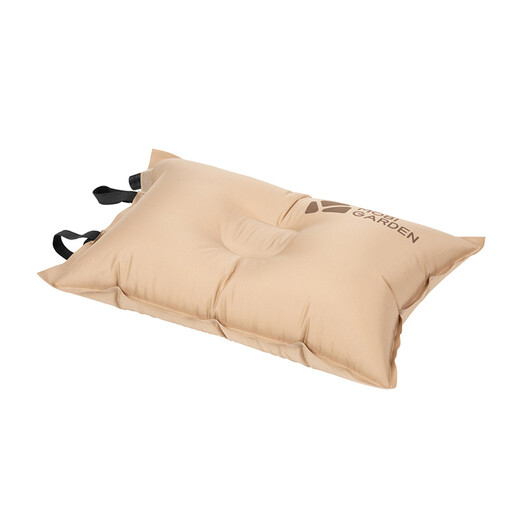
Why we chose it: For those who enjoy weekend camping, occasional bivouacking, or travel, and are looking for the best balance of comfort, portability, and ease of use.
Its self-inflating mechanism, paired with a reliable one-way valve, eliminates the risk of leaks and the chore of inflation. The 210T polyester fabric is soft and durable, a far cry from the "plastic" feel of entry-level models.
Its high-resilience PU foam core provides plush support, very close to the comfort of a home pillow, while remaining ultra-portable (260g).
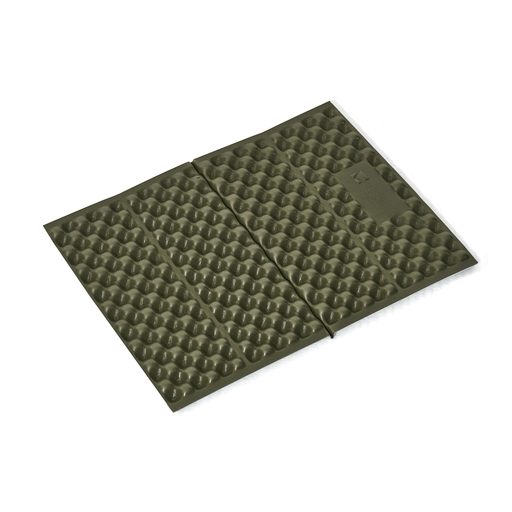
Why we chose it: For the minimalist hiker who counts every gram. It's not a pillow in the traditional sense, but a clever multi-use accessory: it serves as an insulating seat pad and can be folded to form a rudimentary head support.
It doesn't promise the comfort of a real pillow, and that's its strength: it avoids the "false promise" trap. Its primary function is to insulate from cold, damp ground, a mission it accomplishes perfectly thanks to its XPE foam.
Its feather-light weight of 45 grams and its versatility make it a cult item among ultralight backpacking (UL) enthusiasts who optimize their gear to the max.
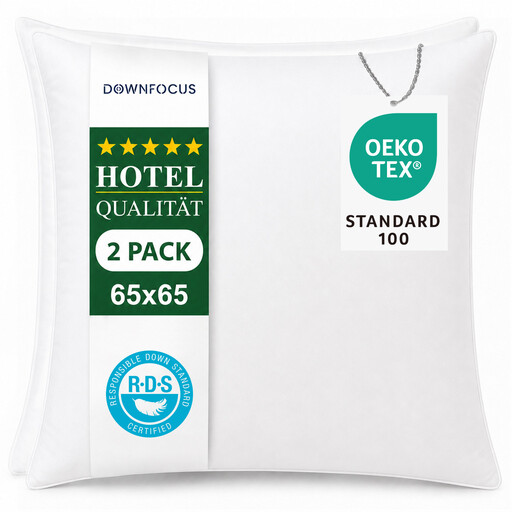
Why we chose it: For those who camp near their vehicle (van, RV, base camp) and for whom comfort is the top priority. The goal: to replicate the plushness of your bed, even in the wild.
This product doesn't pretend to be technical; it fully embraces its role as an "absolute comfort" pillow. While completely unsuitable for hiking, it's perfect when weight and volume are not constraints.
The unparalleled comfort of a 100% feather filling and a pure cotton cover, with Oeko-Tex and RDS certifications (ensuring animal welfare). The luxury of home, for your nights under the stars.
We have curated a complete selection of products that meet our demanding selection criteria and current safety standards.
A self-inflating pillow contains open-cell synthetic foam. Once compressed in its stuff sack, this foam is just waiting to expand back to its original shape. When you open the valve, the foam's expansion creates a vacuum that draws in air, inflating the pillow to about 70-80% of its volume. All that's left is to blow in once or twice to adjust the firmness to your liking before closing the valve.
It all depends on the quality of the materials and the care you give it. A good pillow, with a durable fabric and a quality valve, can last for many years. The usual weak points are punctures and delamination (the separation of the outer fabric from the waterproof membrane). To preserve it, keep it away from sharp objects, avoid sitting on it abruptly, and store it in a dry place, uncompressed, and with the valve open.
Definitely not in a washing machine! This could damage the internal foam and the seams. Cleaning should be done exclusively by hand. Lightly inflate the pillow, close the valve, then clean the surface with a damp sponge and mild soap. Rinse in the same way, without ever submerging the pillow. Let it air dry completely, with the valve open, before storing it.