
Livraison le jour même ou le lendemain

Qualité garantie

Débloquez vos offres de bienvenue: Livraison GRATUITE | Jusqu'à -80 % | 30 jours d'essai gratuits à JoyPlus
Téléchargez l'application
An inflatable camping mat can transform a night under canvas – provided you choose a model that suits your camping style. Product listings often focus on thickness or inflation speed, without always detailing the actual weight, valve type or fabric durability.
Whether you’re a motorhome owner, a long-distance hiker or heading off for a weekend as a couple, your priorities will differ. Here are the key factors to consider before you buy, along with a selection of models for different needs.
A very thick mat generally insulates better from the ground, but it’s also heavier and bulkier when packed away. Conversely, an ultra-thin camping sleeping mat will appeal to hikers counting every gram, but may offer less support on uneven terrain.
The shape of the air cells, the width and the stability of the mat all affect your sleeping position. The stated thickness alone is not enough to judge a model’s comfort.
Some mats have a built-in foot pump, while others require a separate pump or inflation by mouth. The difference is far from trivial when hiking: every extra accessory takes up space and adds weight to your pack.
Also check for a double valve, the deflation system and the stated inflation time. The figures provided by the manufacturer are based on specific conditions and can vary depending on the pressure applied or the temperature.
An outer fabric combined with a TPU waterproof layer can reduce moisture-related risks and make cleaning easier. That doesn’t make the mat indestructible, though: branches, stones and repeated friction remain its main enemies.
Even an ultralight hiking mat should be placed on a surface cleared of sharp objects. After each use, dry it thoroughly before storing to prevent odours and residual dampness.
For one person, a length of around 190 cm and a width between 55 and 60 cm will suit most adults. Taller people or those who sleep on their side may prefer a wider model.
For two people, a double camping mat or two mats linked by side buttons offer more space. Compare the dimensions of the mat when unfolded with those of your tent: a 2-person tent mat should leave enough room for bags and clothing.
The packed volume matters just as much. A model that fits into a bag the size of a bottle will slip much more easily into a rucksack than a bulky mat, even if its weight is reasonable.
When hiking, the total weight includes the storage bag and any pump. A model weighing 690 g, for example, will be much easier to carry than a double mat weighing over 1.5 kg. Obviously, it won’t serve the same purpose.
A built-in foot pump saves you from inflating the mat by mouth and can be handy with children or on family trips. However, check where the pumping area is located and how long it takes to reach a comfortable pressure.
Choose product pages that clearly describe the fabric, waterproof layer and valves. Compliance information should be accessible, especially for products sold in the European Union. This doesn’t replace common-sense precautions: keep the mat away from flames, respect the stated maximum load and avoid any sharp objects.
A built-in pillow reduces the number of accessories you need to bring. However, it won’t suit every body shape: check its height and, if necessary, pack a folded item of clothing to adjust the support.
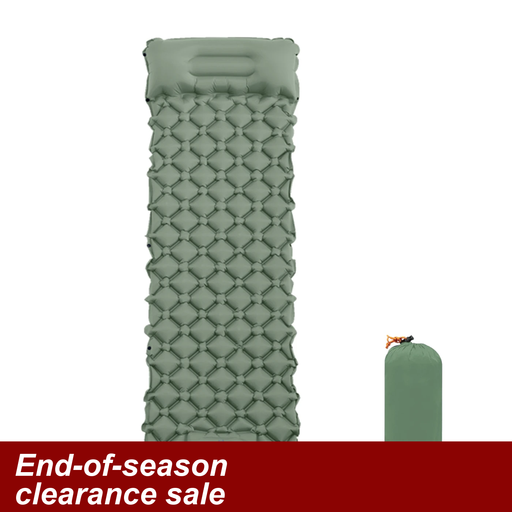
Why this choice suits this profile: This single mat is ideal for your first nights under canvas, weekend trips and outings where you need to keep your pack volume down. Its built-in foot pump means you don’t have to carry a separate pump.
The product page states it inflates using foot or hand pressure, without needing to blow into the mat. The double-layer valves are designed to make deflation easier.
Dimensions of 192 × 58 × 15 cm, stated weight of 690 g, built-in pillow and packed size of 26 × 10 cm.
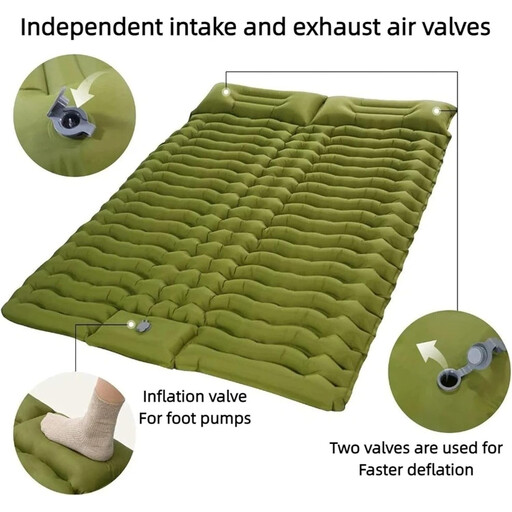
Why this choice suits this profile: Its double surface is ideal for couples, families and anyone who wants the freedom to move around in a spacious tent.
The foot pump is built-in and the double-valve design is said to speed up deflation. The 50D fabric with TPU layer is presented as water-resistant.
Surface of 200 × 140 cm, built-in pillow, foot pump and carry bag measuring 29 × 16 × 16 cm. The product page states a weight of 1.7 kg in the product name and 1.6 kg in the description: check the displayed value before purchasing.
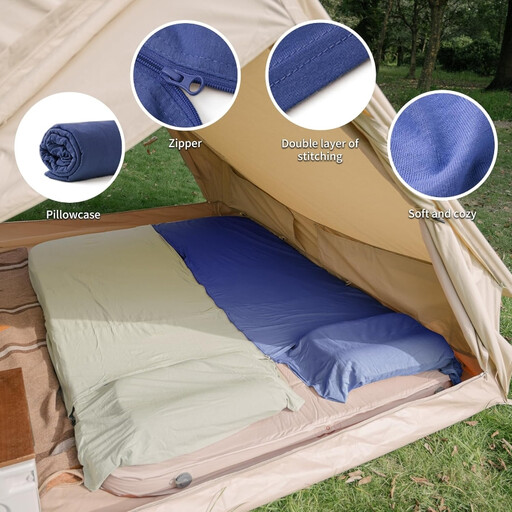
Why this choice suits this profile: This sleeping bag liner complements an inflatable camping mat on frequent trips, in mountain huts or shared accommodation. It’s aimed at users who want to add a washable fabric layer.
It does not replace a mat: its role is clearly complementary. This clarification prevents you from buying a fabric accessory expecting extra support or insulation.
Size of 210 × 75 cm and a designated pillow area. The product page also provides contact details for the responsible party established in the European Union.
A cushion designed for a specific lying position, such as the Inflatable Lying Cushion with abdominal opening and headrest, should not be confused with a camping sleeping mat: its shape and purpose are completely different.
We’ve put together a comprehensive, real-time selection of products that meet these criteria as well as European safety requirements.
A model with a built-in foot pump is inflated by pressing the designated area several times. Then close the valves and adjust the pressure according to your sleeping position. For models without a built-in system, an external pump may be essential.
It all depends on how often you use it, the storage conditions and the surface you place the mat on. A reinforced fabric and a TPU layer can improve its durability, but it’s best to avoid stones, branches and extreme temperatures. Inspecting the valves before each trip also helps prevent nasty surprises.
A double camping mat offers more space, but it is generally heavier and bulkier when packed than a single model. It is best suited to car camping, large tents and trips where gear is transported in a vehicle. For a backpacking route, two lightweight individual mats will often be easier to split between the group.