
Livraison le jour même ou le lendemain

Qualité garantie

Débloquez vos offres de bienvenue: Livraison GRATUITE | Jusqu'à -80 % | 30 jours d'essai gratuits à JoyPlus
Téléchargez l'application
A cluttered garage, a difficult-to-organise cellar or a workshop overrun with boxes: in many cases, a household storage unit simply is not enough. An industrial metal garage storage shelving unit helps free up floor space and keep tools, seasonal equipment, cleaning products and supplies together in one place.
There is one important caveat, however: a stated capacity of several hundred kilograms does not, on its own, guarantee that a particular model will suit your needs. Here are the main pitfalls to avoid, the criteria to check and our selection of models for different requirements.
A product listing may show an impressive capacity without explaining how it is distributed. For example, a heavy-duty 875 kg shelving unit may support five levels holding 175 kg each, provided the load is static and spread across the entire surface.
Always check:
A very heavy box placed over a small area creates more strain than a series of boxes spread across the entire shelf.
A tall, shallow structure can tip over if the weight is poorly distributed, if the floor is uneven or if an item is pulled out suddenly. The inclusion of an anti-tip kit is a real advantage, provided it is fitted correctly.
In a garage, workshop or warehouse, secure the shelving unit to the wall whenever the manufacturer recommends it. First identify the type of supporting surface — concrete, brick or partition wall — then choose suitable fixings. In a professional setting, also check the safety recommendations applicable to racking, particularly those based on the NF EN 15635 standard, depending on the installation and its surroundings.
An adjustable storage shelving unit is not just about its width. Remember to measure:
A structure measuring 180 or 200 cm in height may offer useful capacity, but it must remain accessible without having to use an unstable stepladder.
For a large-capacity garage shelving unit, the dimensions must match the items you intend to store. A depth of 40 cm is generally suitable for storage bins, tools and standard-sized boxes. With a depth of 60 cm, you can store bulkier equipment, although this will take up more floor space.
The number of levels is not everything. A 5-tier steel shelving unit with adjustable shelves allows you to reserve more height for containers or bulky appliances, then move the levels closer together for smaller boxes.
A powder-coated steel frame will generally withstand knocks and superficial scratches better than a lightweight structure designed primarily for decorative use. MDF shelves provide a flat, practical surface for boxes and small appliances, but they must be protected from damp and leaks.
For a damp cellar or garden shed, check the manufacturer's recommendations. Wipe up any splashes promptly and avoid placing containers that may leak directly on the shelves. Robust metal racking is not necessarily designed to withstand a damp environment.
Push-fit systems can speed up assembly, but check that the uprights are aligned and that the crossbars are inserted correctly. Wear gloves during assembly and follow the supplied instructions carefully.
A modular shelving unit that can be separated into two units is useful in garages divided into several areas. It can also act as a divider between a DIY area and a storage zone, provided that each section is stabilised correctly.
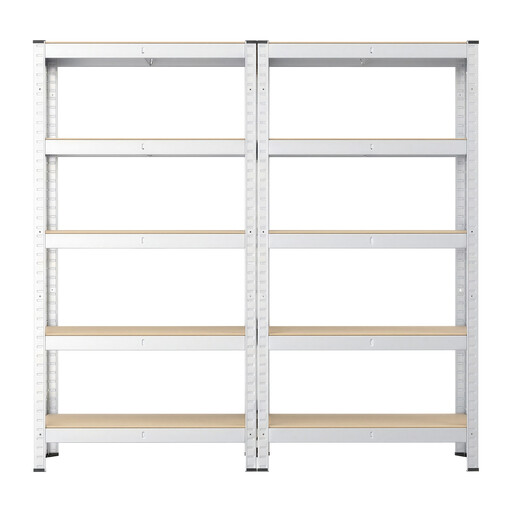
Why this choice suits this profile : This set of two shelving units allows you to organise two areas at the same time, such as a garage and a cellar. Each unit measures 30 × 75 × 150 cm.
The stated load capacity is 130 kg per level and 650 kg in total. Having both figures makes it easier to distribute items properly, rather than relying solely on the overall capacity.
Five adjustable levels, a powder-coated steel frame, two separable units and two anti-tip kits included.
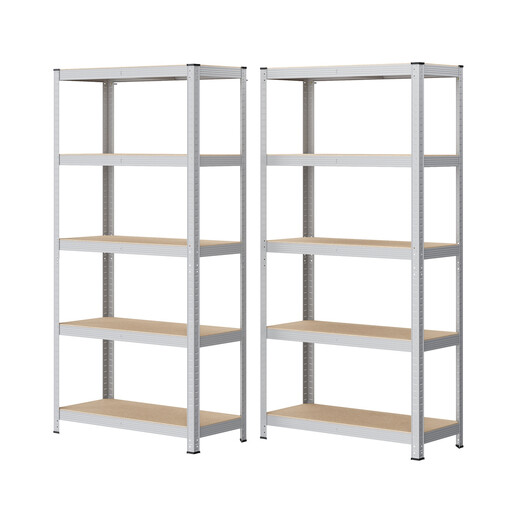
Why this choice suits this profile : This configuration is aimed at those who want more structured storage, with a stated total capacity of 875 kg and a silver finish that blends well into an organised workspace.
The dimensions of 40 × 90 × 180 cm and the load capacity of 175 kg per level are clearly specified. You should still check the available space and distribute loads evenly.
Two separate units, five adjustable levels, push-fit assembly and anti-tip kits supplied.
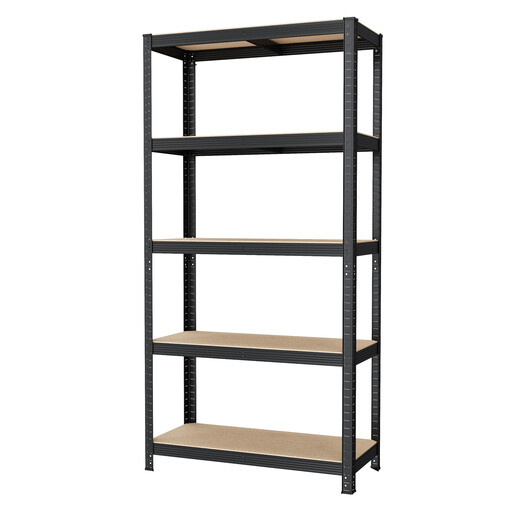
Why this choice suits this profile : This model is suitable for regularly storing tools, boxes or equipment in a garage, cellar, workshop or small storage area.
The listing clearly distinguishes between the 175 kg load per shelf and the total capacity of 875 kg, while also recommending wall fixing and even weight distribution.
Steel frame, five adjustable levels, the option to separate the structure into two units and an anti-tip device included.
We have put together a complete, real-time updated list of products that fully meet these strict selection criteria and European safety regulations.
Before loading the shelving unit, check that every crossbar is correctly inserted and that the shelves are sitting flat. Place the heaviest items on the lower levels, followed by lighter items higher up. Never exceed the stated capacity and do not climb onto the shelves.
In a garage or cellar, leave a gap between the structure and areas that may become wet. Regularly inspect the fixings, uprights and shelves so that you can quickly spot any deformation or loosening. Clean the surfaces with a slightly damp cloth, then dry them thoroughly.
Use the supplied anti-tip kit whenever the model includes one. Identify the wall material, choose suitable wall plugs and check that the fixing will not damage a pipe or cable. It should prevent tipping, but it is not a substitute for a properly levelled installation.
Capacity depends on the model, the number of levels and how the weight is distributed. A specification such as 175 kg per level generally refers to a static load distributed across the entire shelf. It does not necessarily mean that a single 175 kg object can be placed on a small surface.
Yes, provided its dimensions are suitable for the room and the manufacturer approves use in that environment. Check the humidity level, protect MDF shelves from leaks and ensure good ventilation. For a very damp cellar, choose materials and models specifically designed for these conditions.