
Livraison le jour même ou le lendemain

Qualité garantie

Débloquez vos offres de bienvenue: Livraison GRATUITE | Jusqu'à -80 % | 30 jours d'essai gratuits à JoyPlus
Téléchargez l'application
An induction-compatible non-stick frying pan can make everyday meals easier, provided you check a few key points before buying. An induction hob will not heat every frying pan: its base must contain a ferromagnetic material and remain sufficiently flat to transfer heat effectively.
Product descriptions often promote an “ultra-smooth” surface, outstanding durability or cooking with very little fat. These claims do not replace the technical information. Here are the criteria to check to avoid choosing a frying pan that does not suit your cooking habits.
A 28 cm non-stick frying pan usually has a diameter measured at the top rim. The base in contact with the hob may be considerably smaller. On an induction hob, this difference affects pan detection and heat distribution.
For one person, a 20 to 24 cm model is often enough for cooking an egg, making an omelette or frying a small portion. For a family, 26 to 28 cm sizes provide more room, but they are also heavier and may require more energy to reach temperature.
An all-hob frying pan is generally advertised as compatible with gas, electric, ceramic and induction hobs. However, some manufacturers recommend checking compatibility with halogen or infrared hobs. You should also check the oven-use limits, whether a lid is included and whether the handle is compatible.
The induction symbol does not always indicate the size of the magnetic base. So, when choosing an induction-compatible frying pan, read the entire technical specification.
The label PFOA-free frying pan describes a composition characteristic declared by the manufacturer. It does not mean that the coating will remain intact forever. Prolonged heating while empty, metal utensils, abrasive sponges and thermal shock can all accelerate wear.
To protect the non-stick surface, use low to medium heat, choose wooden or silicone utensils and wash the pan with a soft sponge.
Aluminium heats quickly and makes it possible to produce relatively lightweight frying pans. Stainless steel, often combined with an aluminium core in a multi-layer construction, provides a more rigid structure and even heat distribution.
An uncoated stainless-steel frying pan requires more control: gradual preheating, adding fat and using the right temperature. In return, it generally withstands metal utensils better. Cast iron and iron, such as a 3 mm iron frying pan, retain heat extremely well, but their weight and maintenance requirements — immediate drying and seasoning — are not suitable for every cook.
A ceramic frying pan may appeal thanks to its smooth surface and information about its composition. The product specification should state the type of coating and the usage instructions. Ceramic reinforced with mineral, diamond or titanium particles still requires you to avoid overheating and harsh utensils.
Classic non-stick coatings, such as those used on some Tefal products, are particularly practical for eggs, fish and pancakes. In particular, check the washing instructions, the maximum oven temperature and whether the handle can be removed.
An easy-to-clean frying pan is not necessarily designed to withstand repeated dishwasher cycles. The dishwasher can accelerate the ageing of certain coatings and handles. Hand washing in warm water with mild detergent and a non-abrasive sponge is generally preferable.
If the pan is oven-safe, check the maximum temperature specified by the manufacturer. A steel handle and a Bakelite handle do not have the same limits. Always remove a lid that is not oven-safe and use protection when handling the hot pan.
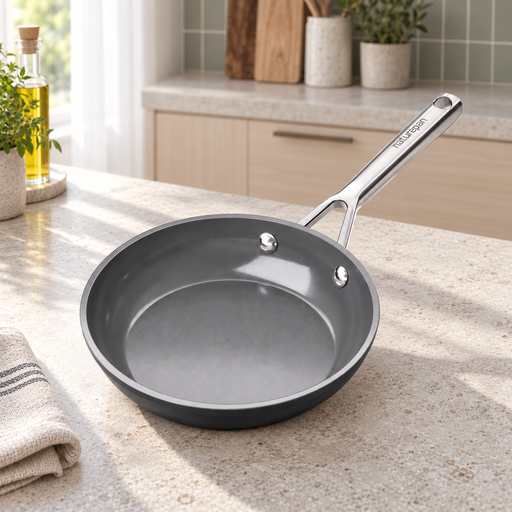
Why this choice suits this profile : Its 20 cm size is ideal for small portions, eggs and breakfast dishes, while taking up minimal space in a smaller home.
The specification confirms compatibility with induction, gas, electric and ceramic hobs, as well as use at low or medium temperatures.
Reinforced ceramic coating, base designed for improved heat distribution, stainless-steel handle and advertised dishwasher compatibility.
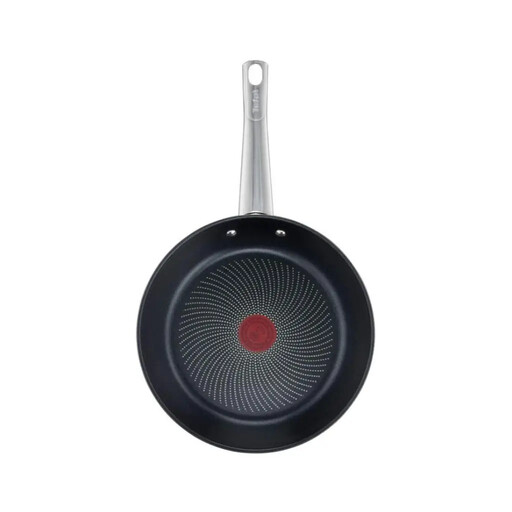
Why this choice suits this profile : Its 28 cm diameter and stainless-steel body are suitable for regular family cooking, with the flexibility to use it on several types of hob.
The specification mentions a base that ensures even heat distribution, a temperature indicator and compatibility with induction, gas, electric and ceramic hobs.
Titanium-reinforced non-stick coating, Thermo-Signal indicator, oven-safe up to 250 °C and advertised dishwasher compatibility.
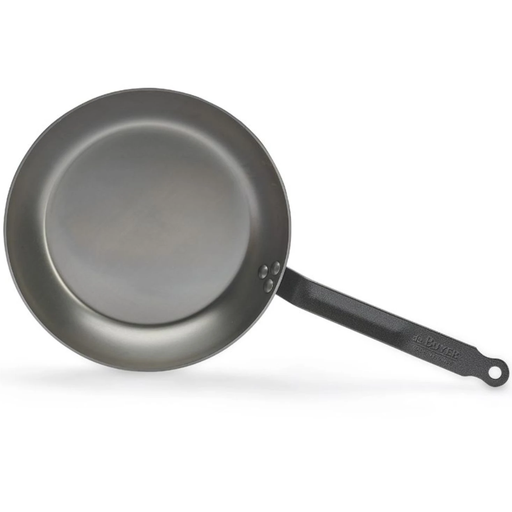
Why this choice suits this profile : This 28 cm iron frying pan is designed for cooks who want high-temperature cooking and are happy to carry out regular maintenance.
Its performance does not rely on a delicate non-stick coating, but on the gradual seasoning of the iron. However, the pan must be dried and oiled after every use.
3 mm thickness, induction compatibility, excellent heat retention and French manufacture according to the product specification.
We have put together a complete, real-time updated list of products that meet these demanding selection criteria and European safety regulations.
A non-stick surface helps food slide off without sticking, but the amount of fat required also depends on the temperature, the recipe and the condition of the coating. For everyday cooking of eggs, vegetables or fish fillets, a 20 to 28 cm non-stick model is a practical choice. For searing meat or frying food over a high heat, a stainless-steel or iron frying pan may be more suitable.
The expression frying pan for healthy cooking should be understood as the ability to reduce the amount of oil added to certain dishes, rather than as a medical claim. Always follow the manufacturer’s recommendations and replace a frying pan if its coating is badly scratched or peeling.
Place a magnet underneath the base of the frying pan. If it sticks firmly, the pan is likely to be compatible. Nevertheless, check the manufacturer’s specification: the shape and diameter of the base also play a role. An induction-compatible frying pan should display the corresponding symbol or an explicit statement of compatibility.
A 28 cm pan is generally suitable for several portions, while 24 or 26 cm models offer a good balance between capacity and ease of handling. Also measure the cooking zone on your hob to avoid choosing a base that is too small or too large for the ring you use.
Its lifespan depends on the coating, how often it is used and how well it is maintained. Avoid heating the pan while empty, excessive temperatures, metal utensils and abrasive products. Hand washing and storing the pans without allowing them to rub against one another can help preserve the surface for longer.