What should you check before choosing?
When replacing a hob, first check which pans you want to keep and how many dishes you cook at the same time. If you’re still deciding between fully induction, ceramic and a mixed hob, consider whether you want to keep gas as well. Then check the cut-out and connection requirements for your chosen model.
| Criteria |
What to check |
Who it matters to |
| Cookware compatibility |
Check that each pan you want to keep has a ferromagnetic base, and identify any cookware you would need to replace to use induction. |
If I want to keep my existing cookware, I need to know what will work on the new hob before choosing a technology. Around 40% of consumers rank compatibility as their top concern. |
| Cooking zones and flexible zones |
Count the pans you use at the same time, then compare the number of independent zones and the layout of any flexible zone. |
When I’m cooking several dishes or using a fish kettle, I need enough room for the pans I plan to use. This is the most important factor for around 30% of consumers. |
| Responsiveness and use |
Compare the features that will help with the way you cook. For specific models, look at independent tests of heat-up times and energy consumption. |
If I pay close attention to heat levels and my cooking habits, I want to base my choice on results that are relevant to the way I cook, rather than just the list of features. Around 20% of consumers prioritise this. |
| Keeping gas |
For a mixed hob, count the gas burners and induction zones separately, and check the connections required for both technologies. |
I want to try induction without giving up the dishes I cook on gas, even if that means sharing the hob between the two. Keeping gas is the main requirement for around 10% of consumers. |
Ceramic hobs don’t have the same requirement for a ferromagnetic pan base as induction hobs. A mixed hob keeps gas burners, but its total number of cooking zones isn’t the same as its number of induction zones. Check the exact configuration rather than relying on the hob’s width alone.
Brands to consider
These ranges illustrate different configurations. To choose the right hob, check the details for the specific model rather than relying on features associated with the brand as a whole.
Bosch
Bosch’s range includes induction hobs in different sizes, including models with flexible zones.
- Bosch describes FlexInduction as a zone designed for larger cookware.
- Check the flexible zone, number of cooking zones and cut-out dimensions for your chosen model; they aren’t the same across the entire range.
Whirlpool
Whirlpool offers FlexiCook induction hobs, including options for people looking for a combined zone for larger cookware.
- According to Whirlpool, FlexiCook lets you combine two cooking zones on equipped models.
- The cooking-zone layout and other features vary by model, so check how much space will remain for cooking several dishes at once.
Smeg
Smeg offers both induction hobs and mixed hobs that combine induction zones with gas burners.
- A mixed configuration lets you cook using both technologies, provided the model has the zones you need.
- The balance between gas and induction, the overall dimensions and the connections required vary by model.
Induction hobs on Joybuy
These two built-in hobs are for anyone switching to fully induction: one has four zones and the other has three. To decide which configuration is right for you, start with the number of dishes you cook at once, then check your cookware, the cut-out and the connection requirements for each model.
 Image unavailable
TOPWISH, 60 cm built-in induction hob, 4 zones
Worth considering if you use up to four pans for a meal.
The product title mentions touch controls, a Boost function, a timer, a child lock and a residual heat indicator. If you cook with a large or long pan, check the layout of the zones for the exact model.
Check the cut-out dimensions and connection instructions in the manual before ordering.
View on Joybuy
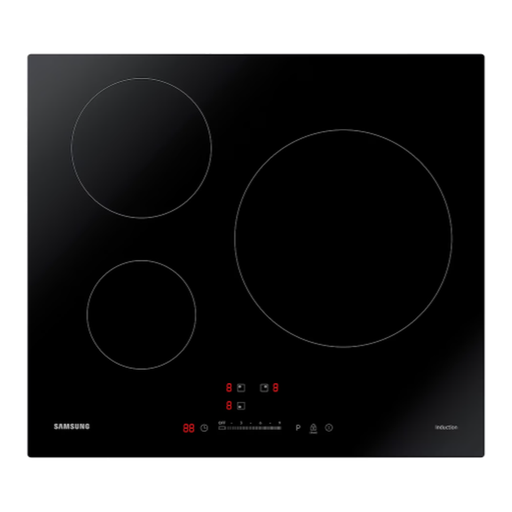 Image unavailable
Samsung NZ63M3707AK, 3-zone induction hob, 7200 W
Worth considering if three zones suit the number of pans you use at once.
The product title states a power rating of 7200 W. If you use a large or long pan, check the zone layout for the exact model.
Also check the cut-out, the connection requirements in the manual and whether the cookware you want to keep is compatible.
View on Joybuy
Frequently asked questions
How can I check whether my pans will work on induction?
Every pan used on an induction zone needs a compatible ferromagnetic base. Check the pans you plan to keep before buying a hob: UFC-Que Choisir points out that induction requires suitable cookware.
Should I choose three or four cooking zones?
Choose based on how many pans you use at once, rather than the number of people at the table. Also check their size and how they could be positioned on the hob you’re considering.
Can a flexible zone replace an independent cooking zone?
Not necessarily. Combining zones can make room for a large pan, but it may leave fewer independent spaces for other pans. Check the layout of the cooking zones and the options for combining them on your chosen model.
What should I check before fitting a built-in induction hob?
Compare the cut-out dimensions and electrical requirements in the model’s manual with your worktop and existing installation. If you’re unsure whether they’re compatible, ask a qualified professional to assess the connection before you buy.
Will a mixed hob let me keep all my cookware?
The gas burners on a mixed hob can be an option for cookware that isn’t suitable for induction, but they won’t make it work on the induction zones. Check that there are enough zones of each type for the way you cook, and look into the connections required.


