
Livraison le jour même ou le lendemain

Qualité garantie

Débloquez vos offres de bienvenue: Livraison GRATUITE | Jusqu'à -80 % | 30 jours d'essai gratuits à JoyPlus
Téléchargez l'application
Equipping your kitchen with an induction wok is a promise to transform your cooking and open up the joys of quick stir-fries and Asian flavours. The problem: the market is saturated with models making tempting promises that often hide deal-breaking flaws. As a product expert at Joybuy, my mission is to guide you through this jungle to make an informed choice, far from the marketing hype.
Before you dive in, let's review the three most common disappointments that await unwary buyers:
Identifying these pitfalls is the first step toward a smart and lasting investment.
To ensure you don't regret your purchase, a few technical specifications need to be examined closely. These are what will guarantee the quality and versatility of your future wok pan.
The choice of material has a direct impact on cooking and maintenance.
On an induction hob, the base of the wok is a crucial point. It must be:
A good all-hob wok guarantees maximum versatility if you ever change your type of cooker.
A lid is not a mere gadget. It transforms your wok into a multi-functional tool, essential for stewing, braising, steaming, or simply keeping a dish warm. A transparent glass model is a real bonus for monitoring cooking without losing heat. Also, consider suitable wok utensils, like a long spatula or a ladle, which are indispensable for tossing the ingredients in the deep pan.
Because every cook is unique, here are our recommendations. These are hand-picked models that meet specific needs while avoiding the pitfalls we've discussed.
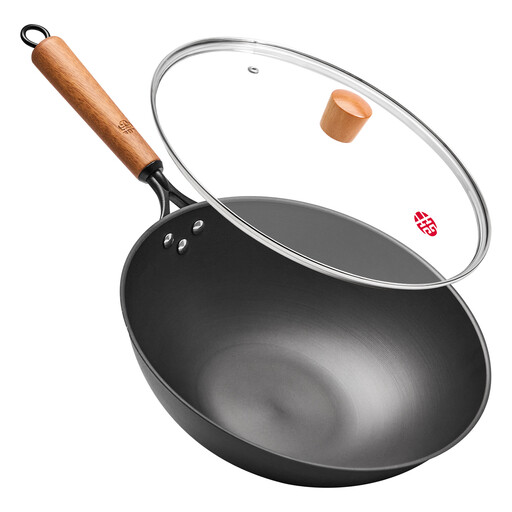
Why we recommend it: Ideal for those seeking the authenticity and performance of a traditional wok without sacrificing compatibility with modern hobs. It's designed for cooks willing to invest in maintenance to achieve an exceptional natural patina.
This wok is uncoated, so it makes no false promises. It embraces its need for seasoning, a sign of transparency. Its 14 cm flat bottom ensures stable and effective contact on induction hobs.
The high-temperature nitriding treatment improves its rust resistance compared to a classic iron wok. It comes with a glass lid and a matching spatula.

Why we recommend it: Perfect for those who want the benefits of a wok without the demanding maintenance. It combines the durability of stainless steel with the convenience of a next-generation non-stick coating for healthy cooking and express cleaning.
The internal honeycomb texture protects the ceramic coating from scratches, thus bypassing the fragile non-stick pitfall. Its 3-ply structure ensures fast and even heating.
Food-grade ceramic coating, with no toxic compound emissions at high temperatures. Compatible with all hobs, including induction, for total versatility.
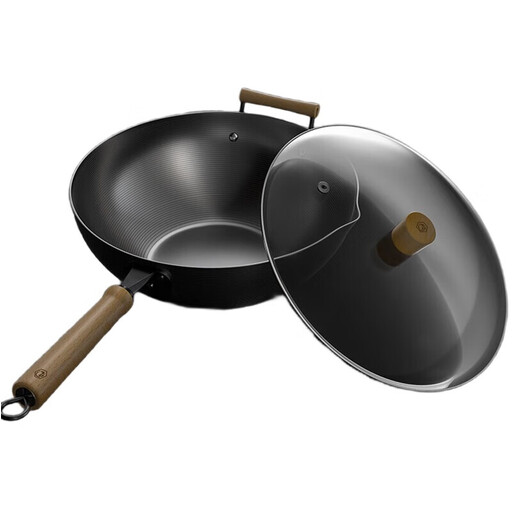
Why we recommend it: With its large 32 cm diameter and robust design, this wok is perfect for family meals. It offers a smart compromise between the performance of iron and increased ease of maintenance, making it ideal for multiple cooking techniques.
Its treated surface (iron nitride + iron oxide) resists corrosion and the use of metal utensils, making it more durable than a conventional non-stick coating. Its "thick bottom, thin walls" design ensures excellent heat distribution on induction.
Lightweight body made of 99.65% pure iron for easy handling. Versatile for stir-frying, simmering, deep-frying, and blanching. Comes with a tempered glass lid.
We have compiled a comprehensive list of products that meet our strict selection criteria and safety standards.
The process is quite simple. Start by washing the wok with hot, soapy water to remove its factory protective layer. Dry it completely, then place it on your hob over medium heat. Apply a thin layer of high-smoke-point vegetable oil (like grapeseed oil) to the entire inner surface using a paper towel. Heat the wok over medium-high heat until the oil begins to smoke. At this point, turn off the hob and let the wok cool completely. Wipe away any excess oil. Repeat this process two to three times to build up a good seasoning base.
It all depends on the material. For a well-seasoned carbon steel wok or iron wok, not only can you use metal utensils, but it's actually recommended! However, for a non-stick wok, even one with a honeycomb protection layer, it's safer to stick to wooden, silicone, or nylon utensils to preserve the lifespan of the coating.
Although both can be used for stir-frying, their shape sets them apart. A wok (or wok pan) has high, curved, and deep sides, ideal for tossing and stirring ingredients at very high temperatures without making a mess. A conventional sauté pan has straighter sides and is better suited for searing large pieces of meat or for dishes with sauce. The wok is the specialist for fast, dynamic cooking.