
Livraison le jour même ou le lendemain

Qualité garantie

Débloquez vos offres de bienvenue: Livraison GRATUITE | Jusqu'à -80 % | 30 jours d'essai gratuits à JoyPlus
Téléchargez l'application
Choosing an induction wok seems simple, but the market is a jungle of promises that evaporate the first time you turn up the heat. You dream of a versatile tool for quick stir-fries and slow-simmered dishes, but you're afraid of making the wrong purchase? We understand.
As a product expert at Joybuy, I'm here to help you navigate the terrain. Let's review the pitfalls to avoid and the criteria that truly matter to find THE wok that won't let you down on your induction hob.
Before you even start comparing models, let's learn how to sidestep the classic traps and spot the flaws that can turn a promising purchase into a kitchen nightmare.
To avoid these disappointments, three key points demand your full attention. They are what will make the difference between a good wok and a useless gadget.
The choice of material is crucial. It determines everything: cooking quality, ease of maintenance, and the long-term durability of your wok.
On an induction hob, there's no debate: the wok must be a flat-bottomed wok. This is the only way to ensure perfect contact with the hob for stable and even heat transfer. Make sure this base is sufficiently thick and made from a high-quality ferromagnetic material. This guarantees a rapid heat-up and a base that won't warp over time.
A 32 cm wok diameter is often the sweet spot for a family of 3 to 5 people. It provides enough space to stir-fry ingredients without them steaming. Also, consider a wok with a lid—it's a real bonus! It transforms your utensil into an all-hob sauté pan, ideal for simmering, steaming, or simply keeping a dish warm.
Because every cook is unique, here is our selection of woks tailored to different needs and preferences.
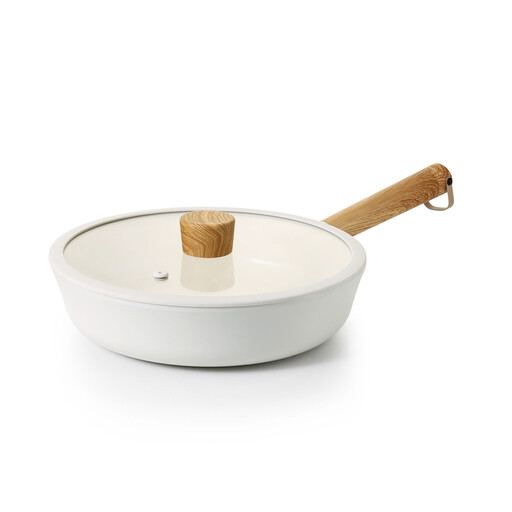
Why it's the right choice: Ideal for those who want simplicity above all else. This wok is the perfect everyday companion, for moving from stir-fried vegetables to saucy dishes without the hassle of maintenance. Its coating makes both cooking and cleaning a breeze.
Its ceramic coating is advertised as PTFE/PFOA-free. Its magnetic stainless steel base is designed for optimal compatibility with induction, which prevents the trap of uneven heating.
Ready to use out of the box, quick to clean, and highly versatile thanks to its lid. Compatible with all hobs.
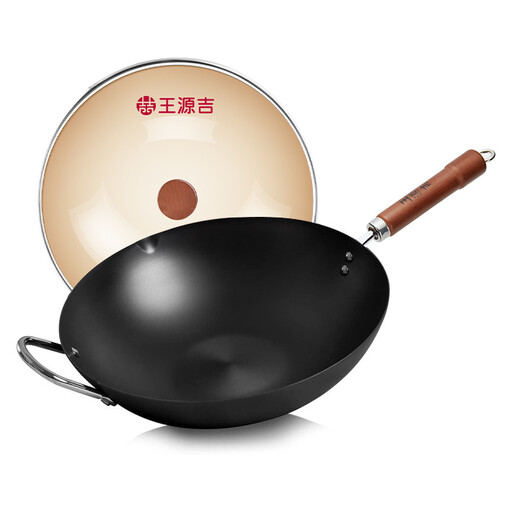
Why it's the right choice: For those who want to rediscover the authentic taste of wok cooking. This carbon steel model is built for very high-temperature cooking and developing a natural patina. An investment for purists and passionate cooks.
Here, there's no chemical coating that could degrade. The non-stick property is natural, achieved through seasoning. A long-lasting solution that knocks out the pitfall of fragile coatings.
Exceptional heat retention and conduction for a perfect sear. Virtually unlimited durability with proper maintenance.
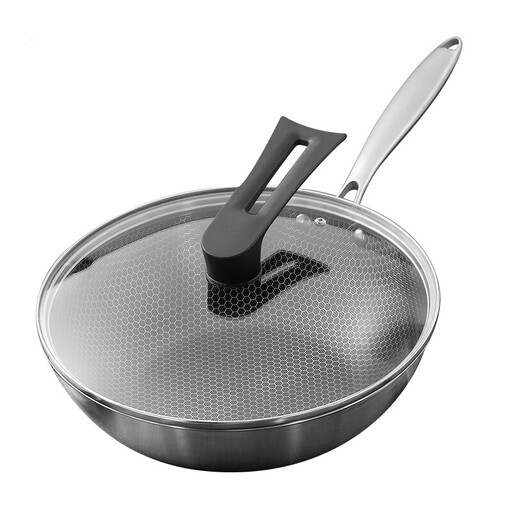
Why it's the right choice: Simply the best of both worlds. It combines the robustness of stainless steel with cleverly protected non-stick technology. Ideal for those who demand a durable, versatile wok that isn't afraid of metal utensils.
The honeycomb structure protects the non-stick coating from scratches, which solves the fragility problem of classic woks. Its multi-ply design ensures fast and even heating on induction.
Extremely durable, scratch-resistant (metal utensils are welcome), and perfect heat distribution.
We have put together a complete selection of woks that all meet our criteria for quality and durability.
Seasoning creates a protective and naturally non-stick layer. Here's how to do it: first, wash the wok to remove the factory's protective oil. Dry it thoroughly, then heat it on high heat until the metal changes colour. Off the heat, let it cool slightly, then coat the entire inner surface with a thin layer of vegetable oil using a paper towel. Put it back on the heat until the oil starts to smoke, then let it cool completely. Repeat this process two or three times. Your wok is now seasoned and ready to use!
Yes, absolutely. The vast majority of induction woks also work on gas, electric, and ceramic hobs. Their flat bottoms and materials make them very versatile utensils, true all-hob sauté pans. However, you should still check the manufacturer's recommendations to be certain.
A PFOA-free wok does have a non-stick coating (usually PTFE or ceramic), but it is guaranteed to be free of perfluorooctanoic acid, a controversial chemical compound. In contrast, an uncoated wok (like a carbon steel or raw stainless steel model) is bare: it has no chemical layer. Its non-stick properties are achieved differently: through seasoning for carbon steel, or through proper management of heat and fat for stainless steel.