
Same-day & Next-day Delivery

Quality Guaranteed

Unlock Your Welcome Offers: FREE Delivery | Up to 80% OFF | Free 30-day JoyPlus trial
Download the APP
Finding the perfect induction wok—one that won't end up collecting dust in a cupboard after two months—can quickly become a headache. Between marketing jargon and hidden design flaws, it's easy to make a purchasing mistake. As a product specialist at Joybuy, I'm here to separate fact from fiction for you. Let's break down the common traps to avoid and the criteria that truly matter, so you can buy with confidence.
On paper (or rather, in the product photo), many woks seem to tick all the boxes. But in practice, disappointment often follows. Here are the three classic mistakes that can cost you dearly.
To avoid these setbacks, here are the three technical points to examine closely. They are the guarantee of a high-performance induction wok built to last.
The choice of material is crucial: it determines how quickly the wok heats up, how it distributes heat, and how easy it is to maintain.
On an induction hob, a flat-bottomed wok is a must. But be careful, the devil is in the details: check that the diameter of this flat base is wide enough (at least 14 to 16 cm) to ensure perfect stability and maximum contact with the induction element. A good indicator of versatility is the mention "all-hob wok sauté pan", which confirms its compatibility.
For a family of 3 to 5 people, a diameter of 30 to 32 cm is the ideal format. It offers enough volume to mix and toss ingredients without sending everything onto the hob, while remaining manageable. For a couple or a single person, a 28 cm model will do the job perfectly.
Rather than an endless catalogue, we've selected three models that meet specific needs, all validated against our performance and durability criteria.
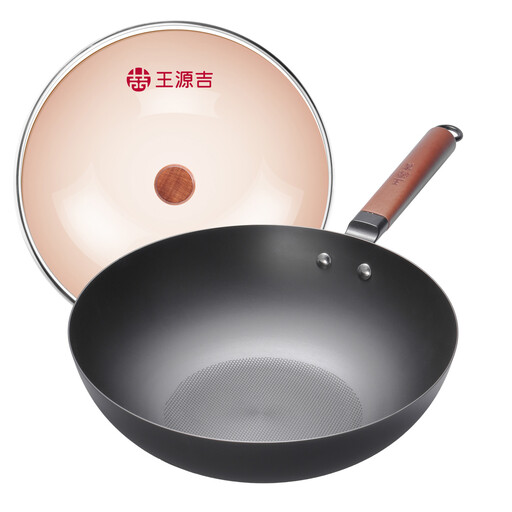
Why it stands out: Ideal for those seeking the authenticity and performance of a carbon steel wok. Its light weight (1.1 kg) makes it very easy to handle for toss-frying, and it's designed to develop a natural non-stick patina over time.
It has no chemical coating, which eliminates the risk of premature wear. The user creates the non-stick surface themselves, which improves with every use.
Ultra-fast heat conduction for a perfect sear. Its nitriding treatment provides superior rust resistance compared to classic carbon woks.
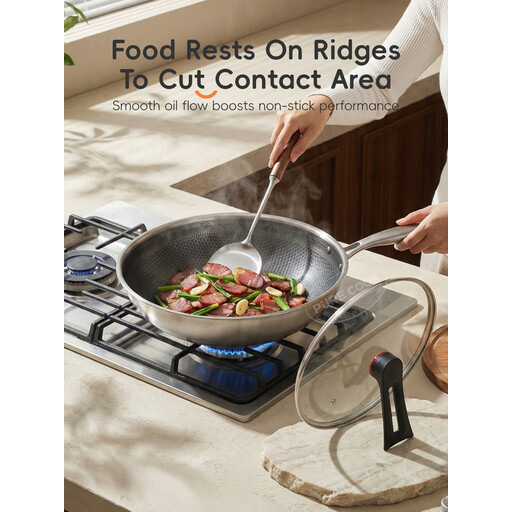
Why it stands out: Perfect for those who want the simplicity of non-stick without the drawbacks of a chemical coating. Its 304 stainless steel structure is durable and its 32 cm wok size is ideal for family use.
It relies on a honeycomb texture etched into the stainless steel to create a physical non-stick effect. This structure resists scratches from metal utensils, unlike conventional coatings.
Its triple-layer construction ensures fast, even heating. All-hob compatible, it's easy to clean and requires no seasoning.
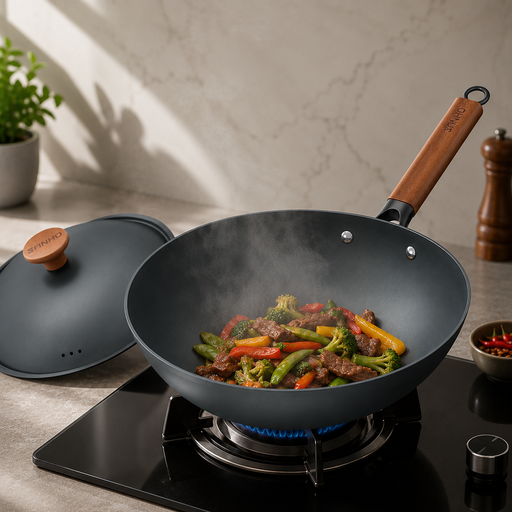
Why it stands out: The turnkey solution for those who want a healthy, hassle-free option. Guaranteed free of PFAS, PFOA, and PTFE, it requires no seasoning. A simple wash and it's ready to use.
It bypasses both the trap of fragile coatings and the hassle of seasoning. Its "physical non-stick" technology is integrated into the steel and is safe for metal utensils.
Ready to use right out of the box. Its wide flat bottom ensures perfect stability on induction hobs, and its beechwood handle stays cool to the touch.
Explore our complete selection of woks that meet our strict criteria: performance, durability, and safety.
Seasoning is a process that creates a protective and naturally non-stick layer. Here are the key steps:
On an induction or ceramic hob, it's not even a question: the flat-bottomed wok is the only viable and most effective option. It guarantees direct, stable contact with the heat source, which is essential for lightning-fast heating. While a round bottom theoretically has an advantage over a gas flame that can "lick" up the sides, a quality flat-bottomed wok will deliver nearly identical results for everyday cooking.
Absolutely! This is one of the great advantages of a carbon steel wok or a raw stainless steel one. Forget the fear of scratching the bottom: these materials are built to withstand metal spatulas, spoons, and other utensils. Even better, their regular use helps to polish and strengthen the natural non-stick patina over time.