
Livraison le jour même ou le lendemain

Qualité garantie

Débloquez vos offres de bienvenue: Livraison GRATUITE | Jusqu'à -80 % | 30 jours d'essai gratuits à JoyPlus
Téléchargez l'application
Choosing a new induction-ready stainless steel cookware set can quickly become a daunting task. Between marketing promises and complex technical sheets, it's easy to get lost. The result of a poor choice? Utensils that warp, food that systematically sticks, or uneven cooking, especially on an induction hob. To help you invest wisely, we break down the pitfalls to avoid and the technical criteria that truly matter.
The problem isn't the material itself, but the quality of its manufacturing. Here are the essential points to watch out for before making your choice:
To avoid these disappointments, simply focus on a few objective technical characteristics. They are the true guarantors of the quality and longevity of your future stainless steel kitchen utensils.
The term 18/10 stainless steel (or AISI 304) is not just a marketing gimmick. It refers to an alloy containing 18% chrome and 10% nickel.
This alloy is renowned for its stability and safety, making it a standard for professional stainless steel kitchen equipment and a trusted choice for preparing family meals, including for the youngest members.
This is the most important technical point for an induction-compatible stainless steel pan. Stainless steel alone is not an excellent heat conductor. To overcome this flaw, quality manufacturers integrate a multi-layered "sandwich" base.
The most common structure is a triple-layer (tri-ply) base: a layer of aluminium (an excellent conductor) is sandwiched between two layers of stainless steel. This type of 3-ply stainless steel stockpot ensures a rapid temperature rise and, above all, perfectly uniform heat distribution across the entire surface. No more hot spots that burn food in the centre of the pan!
Beyond cooking performance, everyday practicality is paramount. A stainless steel cookware set with removable handles offers several advantages:
Rather than long lists, we have matched specific products to user profiles to help you find the solution that fits your habits.
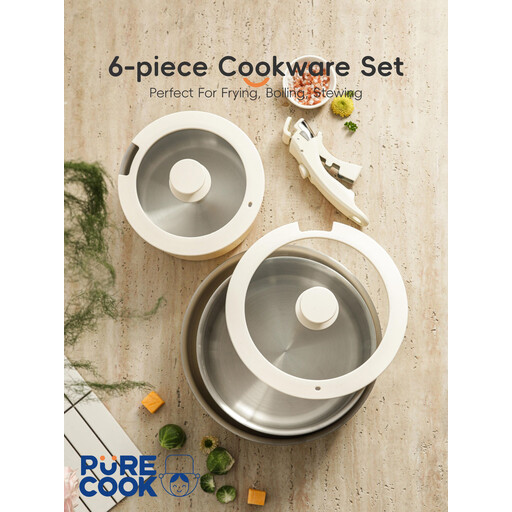
Why we chose it: This set checks all the boxes for versatility and space-saving. The removable handle allows you to move from hob to oven and store the three pieces very compactly, a major asset for modern kitchens.
The triple-ply construction ensures excellent responsiveness on induction, avoiding the trap of "compatible" but underperforming bases. The 304 steel and stackable design tick all the boxes for durability and practicality.
Maximum modularity thanks to the detachable handle and stackable design. The ceramic exterior makes cleaning easier.
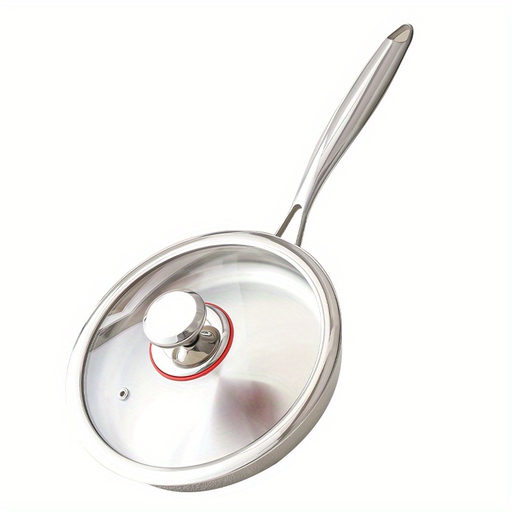
Why we chose it: For those who love searing meat or executing precise cooking techniques, temperature control is essential. This 28 cm pan with its triple-ply base offers the responsiveness and heat distribution needed for pro-level results.
Its full triple-ply construction (steel-aluminium-steel) is the very definition of a high-performance induction utensil. It far surpasses models with just a bonded disc on the bottom, ensuring even cooking across the entire surface.
Fast and uniform heat conduction for precise cooking control. Its robustness allows for the use of metal utensils.
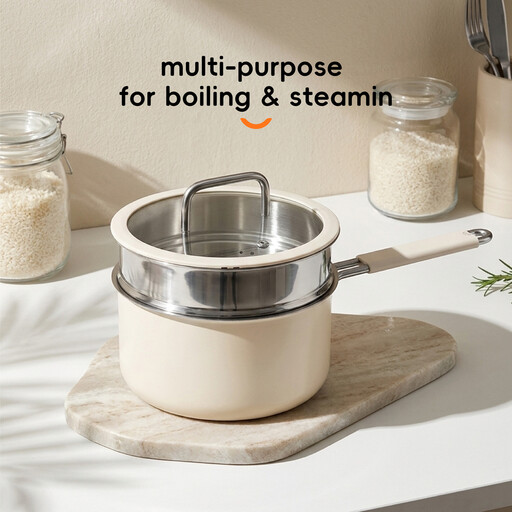
Why we chose it: When preparing baby food or delicate sauces, the neutrality of the material is the top priority. This saucepan uses 316 stainless steel, a superior grade that is even more resistant to corrosion, offering complete peace of mind.
It goes beyond the 18/10 standard by offering 316 stainless steel (surgical grade), eliminating any doubt about food safety. The included steamer basket makes it a very practical 2-in-1 tool for healthy cooking.
316 stainless steel for maximum inertness and food safety. Ideal for baby food and gentle cooking.
Discover our complete and up-to-date selection of products that meet these strict selection criteria and current safety standards.
Stainless steel is not a non-stick coating, but it can become non-stick with the right technique. The secret is preheating. Heat the dry pan over medium heat. To test the temperature, drop a bead of water on it: if it sizzles and evaporates, it's not hot enough. If it forms a ball that rolls across the surface (the Leidenfrost effect), the temperature is perfect. Then add your fat, followed by your food.
A good quality stainless steel cookware set is a long-term investment. Unlike coated pans that need to be replaced every 2 to 5 years, a set made of 18/10 stainless steel with a thick base can last for several decades with proper care. It doesn't scratch easily, doesn't warp, and doesn't lose its cooking properties.
Yes, 18/10 (or 304) stainless steel is considered one of the safest and most stable materials for food contact. It is inert, meaning it does not react with food (even acidic ones) and does not release any chemicals or metal particles into your food, unlike alternatives with coatings that can degrade over time.