
Livraison le jour même ou le lendemain

Qualité garantie

Débloquez vos offres de bienvenue: Livraison GRATUITE | Jusqu'à -80 % | 30 jours d'essai gratuits à JoyPlus
Téléchargez l'application
Finding the right induction saucepan can quickly become a headache. Between marketing promises and confusing spec sheets, it's easy to end up with a pan that heats poorly, gets damaged in record time, or has a questionable composition. As the Head of Product Recommendations at Joybuy, my mission is to help you see things more clearly. Together, let's break down the pitfalls to avoid and the criteria that truly matter for making the right choice.
Before you even start comparing models, it's crucial to know how to spot a deal that's too good to be true. Here are the most common mistakes?:
To avoid these traps, focus on a few objective technical specifications.
On an induction hob, the quality of the base is paramount. It must be ferromagnetic (a magnet should stick to it firmly) and sufficiently thick. A thick base, known as a "sandwich" or "encapsulated" base, made of several layers (usually an aluminium core sandwiched between two sheets of stainless steel), ensures fast and even heat distribution. This prevents hot spots that burn food and guarantees controlled cooking, whether for a delicate saucepan or for boiling water.
The choice of material directly impacts your saucepan's durability, maintenance, and safety.
For one or two people, a 16 cm saucepan with a lid is often sufficient and versatile. It can serve as an all-hob milk pot, a saucepan for sauces, or for cooking small portions. Also, check the quality of the handle: is it securely attached? Does it stay cool during cooking (a "cool-touch" handle)? A transparent glass lid is a real plus for keeping an eye on your cooking without heat loss.
Here are a few options that meet specific needs, taking into account performance and safety criteria.
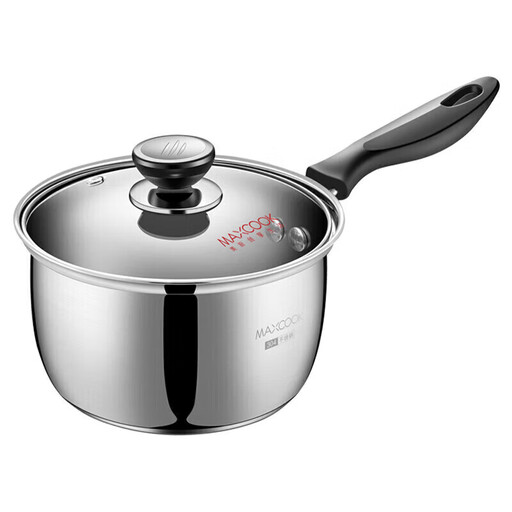
Why we chose it: Ideal for preparing baby food or single servings. Its 100% 304 stainless steel construction is a guarantee of absolute safety, with no chemical coatings. Its compact size is perfect for daily use and optimized storage.
It immediately eliminates the risk of fragile coatings and health concerns thanks to its 304 stainless steel, a stable and proven material. Its encapsulated base ensures excellent responsiveness on induction.
Durability and safety: An inert and robust material with no risk of degrading over time. The pouring spout is a thoughtful detail to prevent drips.
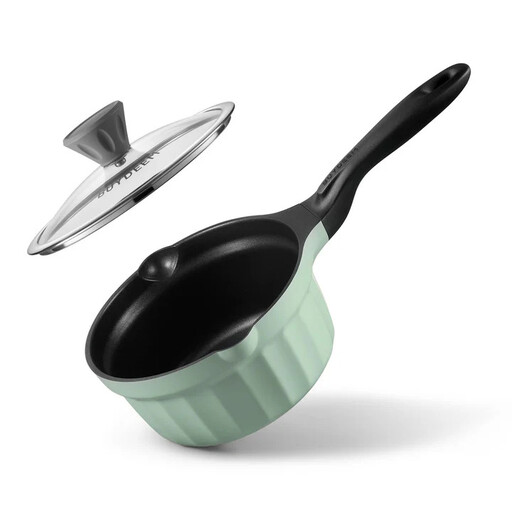
Why we chose it: Perfect for couples or individuals looking for everyday efficiency. Its light weight, rapid heat-up, and non-stick coating simplify preparing sauces, soups, or pasta. Cleanup becomes a breeze.
It removes any ambiguity about safety by clearly stating its coating (by ILAG, Switzerland) is guaranteed free of PFOA, PFOS, lead, and cadmium. Its thick base is optimized for fast, even heating on all hobs.
Practicality above all: Lightweight, truly non-stick for a quick cleanup, and equipped with a very handy pouring spout.
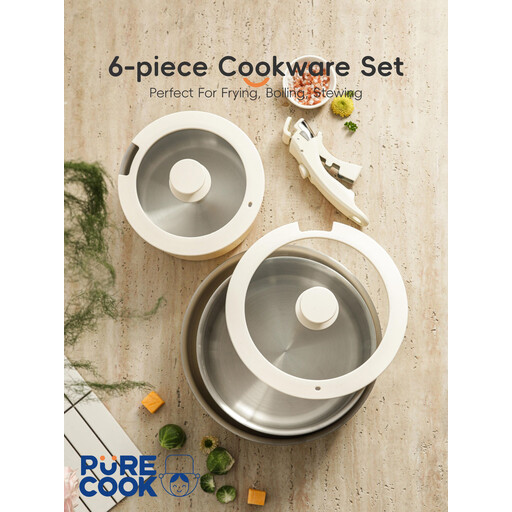
Why we chose it: The solution for those short on space but not on culinary ambition. The removable handle allows the saucepan, sauté pan, and stockpot to stack perfectly. The set goes from the hob to the oven, then straight to the table, before fitting into a single drawer.
This set combines the best of both worlds: a 304 stainless steel interior for durability and a ceramic-coated exterior for easy cleaning. Compatibility with all hobs, including induction, is ensured by a high-quality technical base.
Space-saving and versatile: The removable handle is the key to ultra-compact storage and versatile use: hob, oven, table, fridge...
We have put together a complete selection of products that meet our quality criteria and current safety standards.
The foolproof trick is the magnet test. Take a magnet (a simple fridge magnet will do) and place it on the bottom of your saucepan. If it sticks firmly to the base, your cookware is ferromagnetic and should work on an induction hob. If it doesn't stick, or only weakly, it is unfortunately not compatible.
The longevity of a ceramic coating greatly depends on its care. On average, with regular and careful use, it lasts between 1 and 3 years. To preserve it, avoid metal utensils (opt for wood or silicone), don't overheat it while empty, and let it cool down before washing it by hand with a non-abrasive sponge.
There's no one-size-fits-all answer; it all depends on your favourite dishes and cooking habits.