Anyone who wants to keep their cookware
You’re replacing a hob and would like to carry on using most of your pans. Start by checking their bases, then note the sizes you actually use.


You can switch to induction without replacing all your cookware, as long as the pans you want to keep have a ferromagnetic base and fit the hob’s cooking zones. Test their bases with a magnet, then choose your hob based on how many pans you use at once. If any essential cookware isn’t compatible, consider replacing just those items or choosing a mixed-fuel or ceramic hob. For a built-in hob, also check the worktop cut-out and the model’s installation instructions.
You’re replacing a hob and would like to carry on using most of your pans. Start by checking their bases, then note the sizes you actually use.
You use several pans at a time, a large stockpot or a griddle. The number of cooking zones matters, but their size and layout also need to suit the way you cook.
Your kitchen is already fitted. Before choosing a model, compare its installation instructions with the worktop cut-out, the space below the hob and your home’s electrical connection.
To keep your cookware, first work out which items will work on induction and which would need another solution. Then compare the hob’s cooking zones and installation requirements with the way you cook.
Consider this if: your essential pans have a ferromagnetic base, or you’re happy to replace any that aren’t compatible.
Bear in mind: a pan without a ferromagnetic base won’t activate the cooking zone, as UFC-Que Choisir points out.
Consider this if: you’d like to use induction while keeping pans designed for cooking on gas.
Check first: this option requires your home to be suitable for a gas installation and use.
Consider this if: keeping non-magnetic pans is a priority and you don’t want to switch to induction.
Bear in mind: you’ll be giving up induction cooking rather than finding a solution for each pan’s compatibility.
| Criteria | What to check | Who is this important to? |
|---|---|---|
| Cookware compatibility | Test the base of each pan you use regularly with a magnet. Also compare its shape and diameter with the cooking zones you’re considering. | If I want to keep my usual pans, I need to know which ones will work on induction; around 36 % of consumers prioritise this compatibility. |
| Cooking zones and larger pans | Count how many pans you use at once and check the cooking-zone layout against your largest pans. | To prepare several dishes at once, I need enough cooking zones without giving up my large stockpot; around 29 % of consumers prioritise capacity and cooking-zone sizes. |
| Built-in installation | Compare the worktop cut-out and ventilation requirements with the installation instructions. If in doubt, have the circuit and connection checked. | In a fitted kitchen, I need to know whether the new hob can be installed where the old one was; around 21 % of consumers prioritise installation compatibility. |
| Replacing cookware | Identify any incompatible pans you use often before deciding which ones to replace. | If only a few frying pans aren’t compatible, I’d rather replace the ones I use most; around 14 % of consumers prioritise keeping replacements to a minimum. |
A ferromagnetic base is what makes a pan work on induction. According to UFC-Que Choisir, a pan without one won’t activate the hob, so its appearance or the words ‘stainless steel’ alone aren’t enough to tell you if it’s compatible.
Hold a magnet against the base of each pan you use regularly and note which ones you might need to replace before choosing your hob.
Three or four cooking zones don’t automatically mean there’ll be a suitable one for a large frying pan, griddle or rectangular dish.
Measure the bases of your largest pans and compare them with the cooking-zone layout. If you regularly use pans designed for one, consider a flexible zone.
UFC-Que Choisir distinguishes between a hob’s external dimensions and the size of the worktop cut-out. So don’t assume that two models with a similar visible width will be interchangeable.
Measure the existing cut-out and compare it with the installation plan for the exact model.
Depending on the worktop material, altering the cut-out can be difficult or even impossible.
Legrand says a built-in induction hob isn’t connected like a small appliance plugged into a standard socket. Portable hobs are a separate case.
Check the model’s instructions and have your home’s electrical circuit checked if you’re unsure. Don’t alter the wiring yourself.
Some of the brand’s induction models offer cooking zones that can be combined to accommodate pans of different sizes.
The PIX631HC1H induction model showcases Bosch’s FlexInduction zones, designed for larger pans.
Siemens offers induction hobs in different widths, so you can find one to suit the space available in your kitchen.
This selection features a three-zone built-in induction hob. It’s worth considering if three zones suit the way you cook and your essential pans have compatible bases.
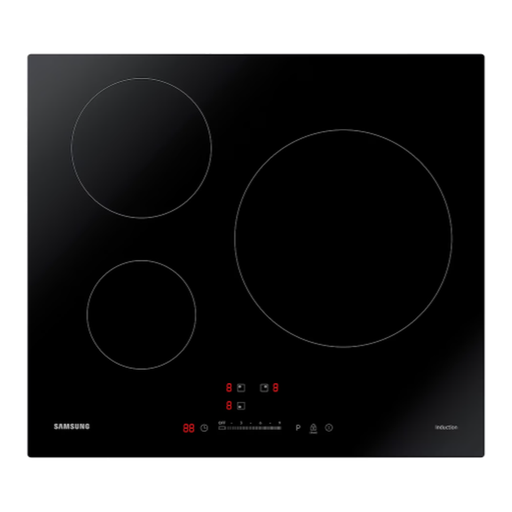 Image unavailable
Worth considering if you’d like to cook on three zones with pans suitable for induction. This model has a stated power rating of 7 200 W. Compare the cooking-zone layout with the bases of your pans, then check the cut-out and connection requirements against your home.
Hold a magnet against the base of each saucepan or frying pan you use regularly. If it sticks, the pan meets the magnetic criterion described by Electrolux. Also look for the induction symbol and check the condition of the base, then compare its dimensions with the cooking zones on the hob you’re considering.
No. Don’t assume that a standard socket is suitable for a built-in hob: Legrand says it needs a specific connection and a dedicated circuit, unlike some portable hobs. Follow the model’s instructions and have your home’s installation checked if you’re unsure.
Three zones may be enough if you don’t use more pans at once, but the number of zones doesn’t guarantee that a large pan will fit one. Compare the size and layout of each model’s zones with your pans. If you regularly use a suitably sized large pan, look for a zone that can be combined with another.
It’s worth considering if you often use a griddle or rectangular pan. Electrolux describes its Bridge function as allowing two zones to be joined on some models. However, check the hob’s size requirements and the dimensions of your cookware. For round pans, start by comparing the individual cooking zones.