
Livraison le jour même ou le lendemain

Qualité garantie

Débloquez vos offres de bienvenue: Livraison GRATUITE | Jusqu'à -80 % | 30 jours d'essai gratuits à JoyPlus
Téléchargez l'application
Is your new induction pan already losing its non-stick coating after just a few months of use? Is its base warping, preventing it from sitting perfectly flat on your hob? If this scenario sounds familiar, rest assured, you're not alone. The market is flooded with promises, but not all pans are created equal—especially for induction cooking, which has very specific technical requirements.
As the Head of Buying Guides at Joybuy, my mission is to help you cut through the noise. Let's forget the marketing jargon and focus on what really matters for making an informed and, above all, long-lasting choice. We'll review the most common pitfalls and the essential criteria to check before you buy.
To avoid these pitfalls, focus on three technical pillars.
The choice of coating has a direct impact on durability, maintenance, and the overall cooking experience.
This is the crucial element for performance on an induction hob.
A pan is an everyday tool: its design should simplify your life, not complicate it.
Here are a few models that meet specific needs, all selected based on our performance and durability criteria.
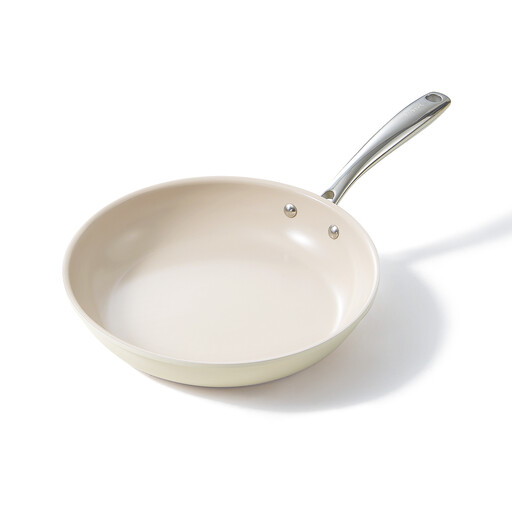
Why this model stands out: Perfect for everyday meals, this 24 cm pan combines a forged aluminium body (for quick heating) with a healthy ceramic coating that requires little oil. Its size is ideal for one to two people.
Its triple-layer ceramic coating is designed for durability superior to entry-level coatings. Its thick base ensures even heat distribution on induction hobs, preventing hot spots from forming.
Oven-safe up to 450 °C, with a riveted stainless steel handle for a secure grip. Formidable versatility for searing, frying, or finishing a dish in the oven.
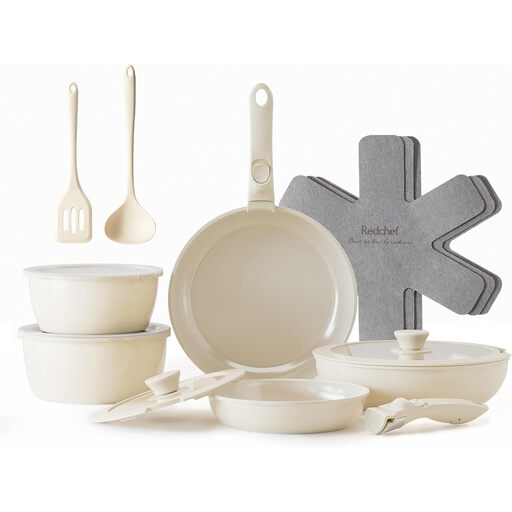
Why this model stands out: For those living in apartments, studios, or who are RV enthusiasts, this set is the all-in-one solution. The pans and pots stack perfectly, and the detachable handle frees up considerable cupboard space.
Far from being a gimmick, the detachable handle system is designed to be both sturdy and secure. This set offers a complete and cohesive cooking ecosystem, from the hob to the oven, and even to the fridge thanks to the included storage lids.
Space savings of up to 75%. The ceramic coating is guaranteed PFAS/PTFE/PFOA-free. The items are oven-safe (up to 450 °C without the handle) and dishwasher-safe.
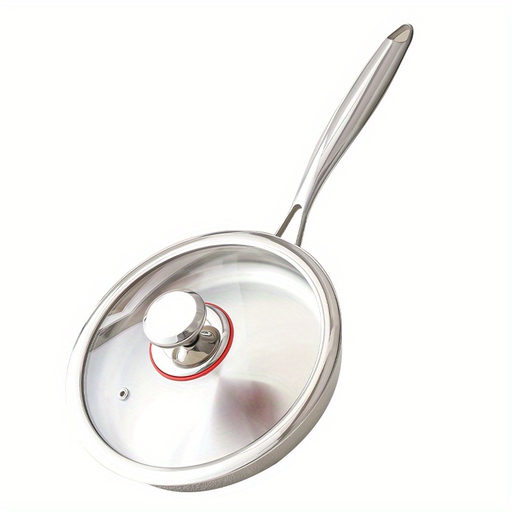
Why this model stands out: For anyone tired of replacing their non-stick pan every couple of years. The multi-ply 304 stainless steel is a true long-term investment: it resists scratches, corrosion, and extremely high temperatures.
This model doesn't rely on any fragile non-stick coating. Its durability is inherent to its solid construction. The triple-ply structure (stainless steel-aluminium-stainless steel) guarantees far superior heat conduction than a basic stainless steel pan and prevents any warping.
Unbeatable durability, compatible with metal utensils. Ideal for searing meat and fish at high temperatures to achieve a beautiful caramelisation. The glass lid is a bonus for monitoring cooking.
We have compiled a comprehensive and up-to-date selection of products that meet our strict selection criteria and current safety regulations.
A well-made ceramic pan, if used with wooden or silicone utensils and washed by hand, can maintain its non-stick properties for several years. Above all, avoid thermal shock (running a hot pan under cold water), which can crack the coating.
A stainless steel pan does not have a chemical non-stick coating. Its non-stick property is "physical" and is achieved by mastering a simple technique known as the Leidenfrost effect: heat the pan over medium heat, then perform the water drop test. If the drop beads up and glides across the surface like a marble, the temperature is perfect. Only then should you add your oil or fat, followed by your food. Once you've mastered this technique, a quality stainless steel pan becomes an ultra-high-performance and virtually indestructible cooking tool.