
Livraison le jour même ou le lendemain

Qualité garantie

Débloquez vos offres de bienvenue: Livraison GRATUITE | Jusqu'à -80 % | 30 jours d'essai gratuits à JoyPlus
Téléchargez l'application
A good non-stick pan is an indispensable ally for everyday cooking. Yet, choosing a new one, especially for an induction hob, can quickly become a headache. Between promises of "healthy" cooking, "stone-effect" coatings, and compatibility claims, it's hard to know what to believe. As the Head of Product Recommendations at Joybuy, my mission is to help you decode the marketing jargon to make an informed, durable choice that truly fits your needs.
Before we dive into our top picks, let's break down the three common pitfalls to avoid so you won't regret your purchase.
Most consumers are looking for a healthy, PFAS-free pan, but they often stop at the "PFOA-free" label. The problem? PFOA is just one of thousands of substances in the PFAS family (per- and polyfluoroalkyl substances). Its use has been highly regulated in Europe since 2020, making it an easy claim for brands to make. Relying on this label alone can mask the presence of other compounds from the same family, like PTFE. A truly healthy pan will highlight a complete absence of PFAS or use alternative materials like ceramic.
A pan can be technically compatible with induction but still deliver disappointing performance. The issue often lies in a ferromagnetic base that is too thin or doesn't cover the entire bottom. The result is undeniable: the pan heats up slowly, unevenly, and wastes energy. A high-performance induction non-stick pan must have a thick, fully magnetic base to ensure rapid heating and even heat distribution.
While the speckled appearance of a stone-effect pan may be appealing, it is by no means a guarantee of durability. In most cases, it's just a standard non-stick coating (often PTFE-based) with a visual finish applied on top. The true robustness of a pan depends on the quality and number of layers of its coating, as well as the construction of its body (e.g., cast aluminium).
To avoid these pitfalls, focus on two key points that make all the difference in performance and safety.
The choice of coating is crucial for healthy cooking and effortless cleaning.
All-hob compatibility, including induction, and durability depend directly on the pan's construction.
Here are a few models that tick all the boxes, designed for different uses.
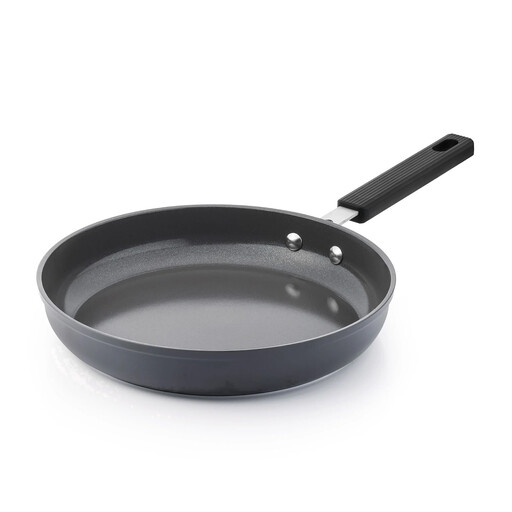
Why we chose it: Perfect for omelettes, fried eggs, or quick meals, its 24 cm size is ideal for one or two people. A simple, healthy, and effective essential for hassle-free daily use.
Maximum transparency: its ceramic coating is certified free of PFAS, lead, and cadmium, going far beyond the simple "PFOA-free" claim.
A breeze to clean (just a wipe with a sponge) and compatible with all hobs, including induction, making it a true kitchen workhorse.
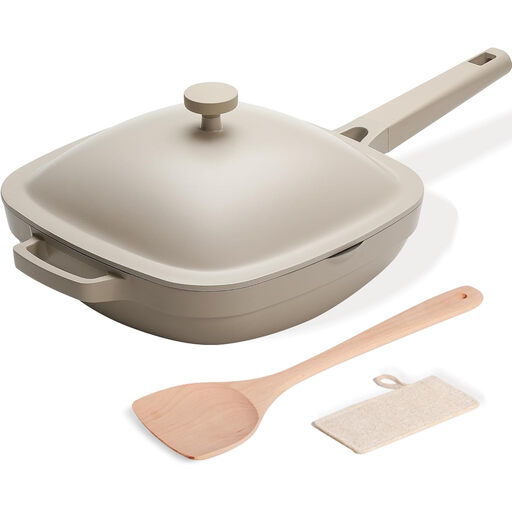
Why we chose it: With its generous 3.6 L capacity and high sides, it's the perfect partner for stews, stir-fries, and large family meals. Its cast aluminium body gives it the robustness needed for intensive use.
No smoke and mirrors here: it combines a warp-resistant cast aluminium body with a Ti-Ceramic (titanium-reinforced ceramic) coating for real durability, far from just a stylistic gimmick.
Extremely versatile thanks to its lid and pouring spouts, it does it all: searing, sautéing, simmering, and even frying. A true all-in-one for the kitchen.
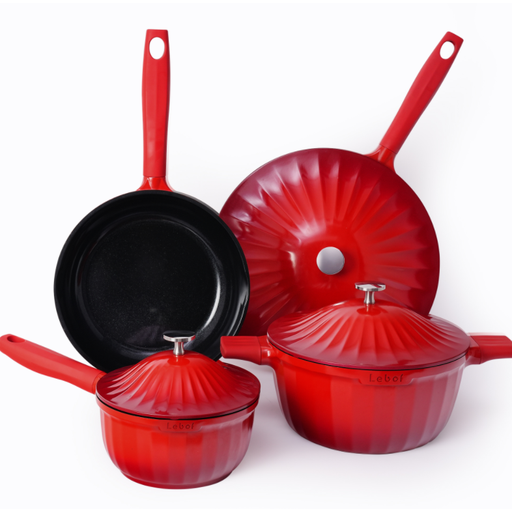
Why we chose it: Looking to replace all your old cookware? This complete set is the perfect turnkey solution. With frying pans, saucepans, and a stockpot, it covers all your needs with consistent performance and style.
This entire induction-compatible set is built on a solid foundation: cast aluminium and a Ti-Ceramic coating. The result: efficient, uniform heating and a guaranteed composition that is free of PFAS, PFOA, and PTFE.
The coherence of a complete set that is as high-performing as it is elegant. We appreciate the thoughtful details, like the domed lids and stay-cool handles.
Discover our full selection of cookware that meets our strict standards for performance and safety.
Its longevity primarily depends on its care. On average, a high-quality, well-maintained pan can retain its non-stick properties for 3 to 5 years. The golden rules to make it last: avoid metal utensils, cook over low to medium heat, and wash it by hand with a soft sponge after it has cooled down.
The foolproof method is the magnet test: place a magnet on the outer bottom of the pan. If it sticks firmly across the entire surface, you're good to go! Also, look for the official induction symbol (a horizontal coil icon) on the packaging or engraved on the bottom of the pan.
The difference is fundamental. A ceramic pan has a coating made from silica (derived from sand), which is naturally PFAS-free. The term "stone effect," on the other hand, is purely cosmetic. It describes the speckled appearance of a coating that could be ceramic... or classic PTFE. The bottom line: don't be fooled by appearances. What truly matters is the actual composition of the coating (look for the "PFAS-free" label) and the quality of the pan's construction (cast aluminium body, thick base).