
Livraison le jour même ou le lendemain

Qualité garantie

Débloquez vos offres de bienvenue: Livraison GRATUITE | Jusqu'à -80 % | 30 jours d'essai gratuits à JoyPlus
Téléchargez l'application
An induction-compatible nonstick frying pan needs to combine several qualities: even heating, stability on the hob and easy cleaning. Behind the marketing descriptions, however, there are significant differences between aluminium pans, ceramic models, stainless steel pans and versions with removable handles.
Before making your choice, here are the most common pitfalls to avoid and the criteria that genuinely matter when comparing the available models.
A nonstick frying pan is not necessarily compatible with induction. To work on this type of hob, it must have a ferromagnetic base or a base specifically designed for induction cooking. A standard aluminium pan may therefore be unusable on an induction hob.
Always check the list of compatible cooking surfaces: induction, gas, electric, ceramic and, where specified, halogen. The product listing should explicitly state “all hobs”; compatibility cannot be inferred from the material alone.
These two claims do not describe exactly the same thing. A PFOA-free pan may still use another type of nonstick coating. If you are looking for a PFAS-free frying pan, make sure the manufacturer states this explicitly.
Ceramic-coated models may be marketed as free from PTFE, PFOA or PFAS. Their lifespan also depends on the temperature used, the utensils chosen and how they are maintained. A marketing claim can never replace a precise technical specification.
A 20 cm frying pan is suitable for eggs, individual portions or a small kitchen. For two people, a diameter of 24 or 26 cm provides more cooking surface. The 28 cm format is better suited to family meals, but it requires a sufficiently large cooking zone and more cupboard space.
A removable handle can make storage easier, provided it is properly locked before every use. It should never be positioned directly over a flame or used in the oven unless the instructions specifically allow it.
An aluminium frying pan heats quickly and is generally lightweight. It is practical for omelettes, vegetables and everyday cooking. When used on induction, however, the quality of the base and coating becomes especially important.
An uncoated stainless steel frying pan withstands metal utensils and high temperatures well. It does, however, require a different cooking technique: gradual preheating, the addition of fat and careful temperature control to minimise sticking.
Multilayer constructions, such as 304 stainless steel combined with an aluminium core, aim to deliver both efficient heat distribution and excellent rigidity. The 28 cm PURECOOK model features a three-layer construction and is compatible with all hob types. As its surface is not nonstick, it is better suited to cooks prepared to take greater care during preparation.
A nonstick coating allows you to cook with less fat and makes cleaning easier. To protect it, use wooden, silicone or nylon utensils, avoid abrasive sponges and do not leave the empty pan heating for too long.
Some models are advertised as dishwasher-safe. This does not necessarily mean that dishwasher cleaning will preserve the coating for as long as gentle hand washing. Check the recommendations for each model before choosing a pan marketed as easy to clean.
A thick or encapsulated base can help distribute heat more evenly. On an induction hob, place the pan in the centre of the cooking zone and avoid sudden temperature changes.
Oven compatibility varies considerably from one model to another. The 20 cm Naturepan is advertised as heat-resistant up to 260 °C, while the 24 cm Naturepan Hybrid has a stated maximum temperature of 230 °C, with the lid removed. By contrast, the Tefal Ingenio pans featured here are not intended for oven use according to their product specifications. The handle and any other removable components must always be taken into account.
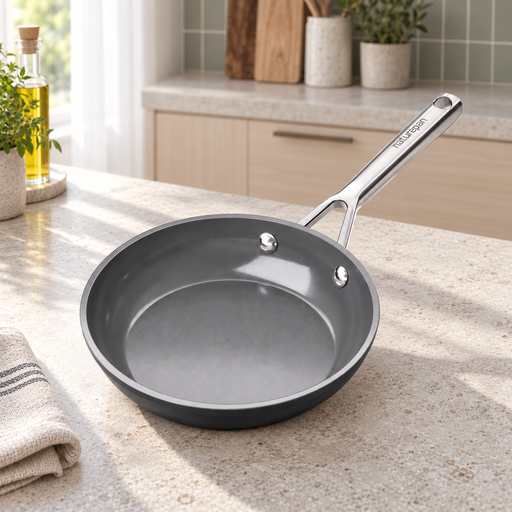
Why this model may suit you: Its compact format is ideal for individual portions, eggs and small kitchens equipped with an induction hob.
The product listing specifies compatibility with induction, gas, electric and ceramic hobs, along with a ceramic coating advertised as free from PTFE, PFAS and PFOA.
20 cm diameter, stainless steel handle, oven use advertised up to 260 °C and dishwasher compatibility according to the product listing.
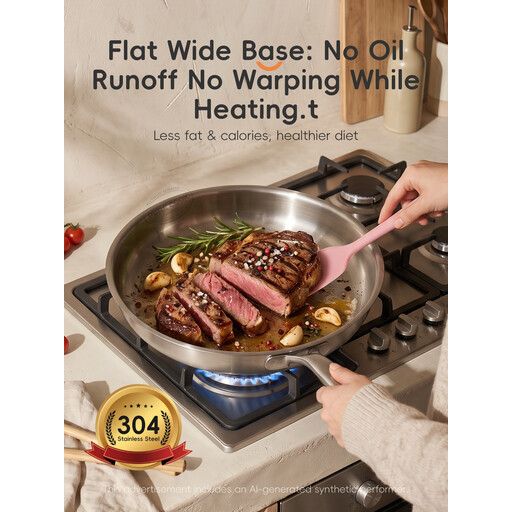
Why this model may suit you: Its generous diameter and aluminium-core construction are well suited to family meals and high-heat cooking.
The product listing clearly states that there is no nonstick coating, so buyers know they will need to master preheating and temperature control.
304 stainless steel, aluminium core, compatibility with all hob types and advertised dishwasher-safe cleaning.
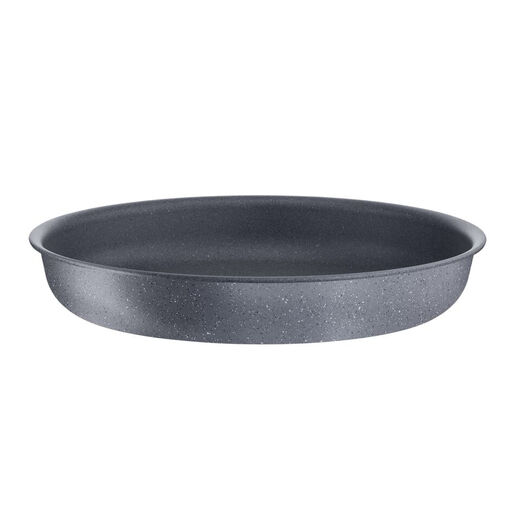
Why this model may suit you: Its removable handle and stackable design are ideal for kitchens where every centimetre of space matters.
The product listing specifies that the handle is sold separately, recommends hand washing and states that the pan is not intended for oven use.
26 cm diameter, induction-compatible base, Thermo-Signal indicator and mineral coating advertised as PFOA-free.
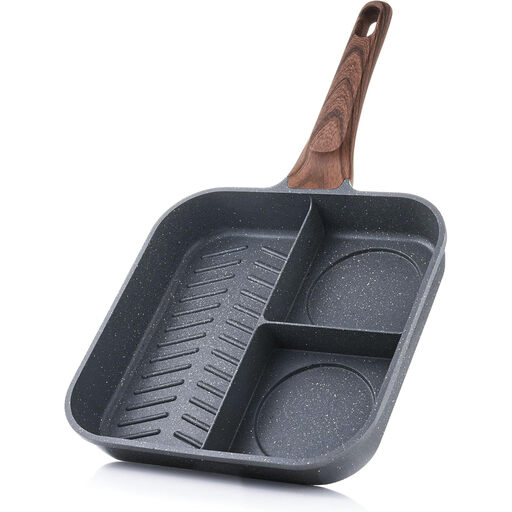
Why this model may suit you: Its three sections let you prepare eggs, bacon, vegetables or small portions at the same time on an induction hob.
The product listing mentions a 4.5 mm magnetic base, but also specifies mandatory hand washing and incompatibility with oven use.
Three compartments, coating advertised as free from PFOA and PFOS, and compatibility with induction, gas and electric hobs.
We have brought together an up-to-date selection of frying pans that meet these purchasing criteria and the compliance requirements applicable in France and the European Union.
Yes, provided the product listing also states that it is compatible with gas. Many “all-hob” models work on induction, gas, electric and ceramic hobs. Nevertheless, check the diameter of the base to make sure it matches your cooking equipment.
Choose 20 cm for an individual portion or a small hob, 24 cm for one or two people, 26 cm for everyday meals and 28 cm when cooking for several people. A larger pan will not necessarily heat more effectively if the induction zone is too small.
It depends on the heat used, the utensils and the cleaning method. Use low to medium heat, avoid heating the pan empty, let it cool before cleaning and use a soft sponge. If the surface is scratched, begins to flake or sticks noticeably more than before, it is best to replace the pan.