
Livraison le jour même ou le lendemain

Qualité garantie

Débloquez vos offres de bienvenue: Livraison GRATUITE | Jusqu'à -80 % | 30 jours d'essai gratuits à JoyPlus
Téléchargez l'application
A built-in gas hob gives you instant, precise control over the flame, making it easy to adjust the heat to suit every dish. But choosing one involves more than just counting the burners or picking a black glass finish. Cut-out dimensions, gas type, safety features and installation requirements can all make the difference between a great buy and an appliance that isn’t right for your kitchen.
Here are the key things to check before ordering a gas hob, along with a selection of models for different needs.
A hob listed as 60 cm wide won’t necessarily need a 60 cm opening in your worktop. Depending on the model, the cut-out may measure around 56 × 48 cm, 47,5 × 26,5 cm or 73 × 48 cm.
Before replacing your old hob, take the time to measure:
A two-burner domino gas hob is ideal for a small kitchen, but naturally won’t offer the same capacity as a four- or five-burner model.
A hob that’s compatible with natural gas and propane may not be ready to use straight away with both fuels. Many appliances are set up for natural gas at 20 mbar and supplied with injectors for conversion to propane or LPG at 30/50 mbar.
Always check:
An incorrectly converted hob can affect combustion and compromise the safety of the entire installation.
A higher power rating alone doesn’t guarantee a better cooking experience. The distribution of power across the burners matters just as much. A hob with a 3,3 kW burner, a medium-sized burner and a 1 kW zone will often be more versatile than a model with a higher total output that doesn’t suit your pans.
For everyday cooking, choose a layout that lets you boil, sear, simmer and keep food warm over a low flame.
The hob layout matters as much as the number of burners. A powerful burner in the centre can accommodate a wok or large stockpot, while a small burner at the side is more convenient for gentle cooking.
A gas hob with a thermocouple detects if the flame goes out accidentally and automatically cuts off the gas supply. This feature doesn’t replace proper installation, good ventilation or regular maintenance. However, it’s still an important safety feature to look for in the product specifications.
Ignition can be manual or electronic. A gas hob with electronic ignition usually needs an electrical connection, often at 220-240 V. Remember to check the cable length, socket position and manufacturer’s recommendations.
A tempered glass gas hob can usually be cleaned with a soft cloth and a suitable cleaning product once the surface has cooled. However, it can be vulnerable to knocks and abrasive products. Stainless steel stands up well to everyday use, but fingerprints and splashes are often more visible.
Cast-iron pan supports provide excellent stability for heavy pans. They’re more substantial than lightweight grates, but may need a little more attention when cleaning. In all cases, check that the supports are removable and that the burners are correctly reassembled after cleaning.
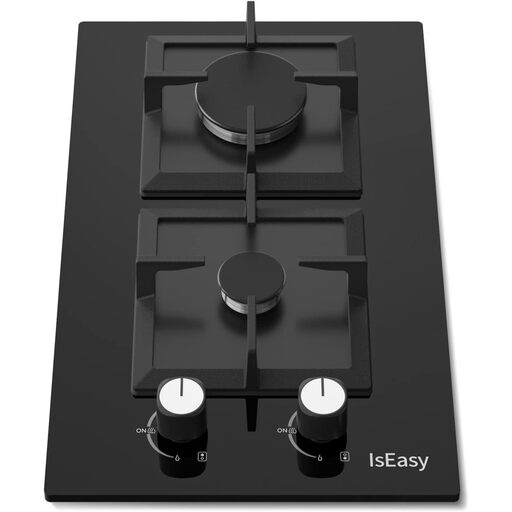
Why this model suits this type of user: At 31 cm wide, it fits easily into a small kitchen, while its two burners, rated at 2,7 kW and 1 kW, cover everyday cooking needs.
The product details list thermocouple safety, injectors for natural gas and propane, and electronic ignition. However, check the cut-out dimensions in the instructions before buying.
A black glass surface, cast-iron pan supports and a stated total output of 3,7 kW.
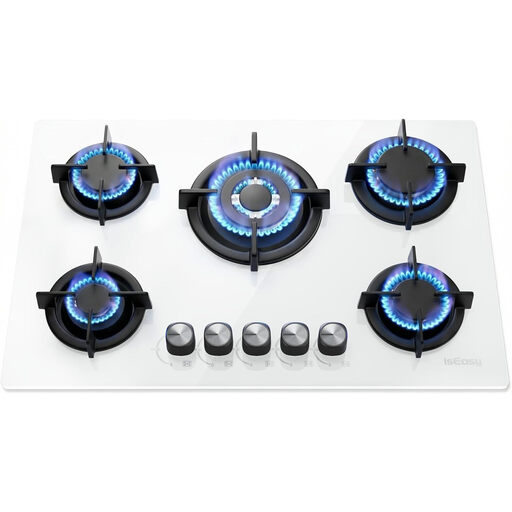
Why this model suits this type of user: At 77 cm wide, with a stated total output of 10,5 kW, it’s designed for spacious kitchens and anyone who likes to prepare several dishes at once.
Its five burners, ranging from 1 kW to 3,3 kW, offer more than just one very powerful burner. The manufacturer also provides for conversion to LPG.
8 mm tempered glass, cast-iron pan supports, electronic ignition and thermocouple safety on every burner, according to the description.
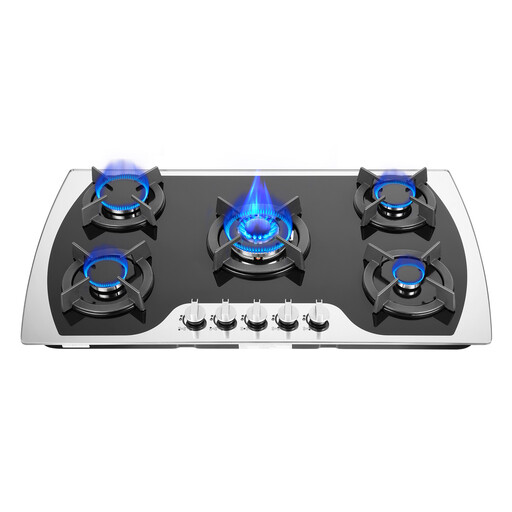
Why this model suits this type of user: With five burners and a stated size of 83 × 47 cm, it’s well suited to large families, busy kitchens and even small catering spaces.
The product details specify five power levels and mention flame failure protection. However, have the cut-out and gas connection checked before installation.
7 mm tempered glass panel, non-slip cast-iron pan supports, pulse ignition and conversion between natural gas and LPG, with injectors included.
We’ve put together a comprehensive selection, updated in real time, of products that meet these strict criteria as well as European safety requirements.
A built-in gas hob must be installed in accordance with its instructions and the local regulations in force. For a gas connection or fuel conversion, use a qualified professional. You’ll also need a leak test, a compatible hose, the correct regulator and adequate ventilation.
After each use:
A 30 to 31 cm two-burner gas hob takes up little space and is suitable for one person, a couple or occasional use. If you regularly cook several dishes at once, a 60 cm three-burner gas hob will give you more flexibility.
A thermocouple is a particularly useful safety feature: it cuts off the gas supply if the flame goes out accidentally. However, it doesn’t replace proper installation, adequate ventilation or the checks specified in the instructions.
It depends on the price of gas, the power setting, cooking time and the condition of the burners. To avoid wasting energy, match the flame to the diameter of your pan, use a lid where appropriate and choose a burner that suits the size of your cookware.