
Livraison le jour même ou le lendemain

Qualité garantie

Débloquez vos offres de bienvenue: Livraison GRATUITE | Jusqu'à -80 % | 30 jours d'essai gratuits à JoyPlus
Téléchargez l'application
An induction-compatible non-stick frying pan can make everyday meals much easier, provided you look beyond its colour or the promise of « non-stick cooking ». Eggs, pancakes, fish, vegetables and meat do not place the same demands on a frying pan. The diameter, base construction and care requirements all have a direct impact on ease of use.
A frying pan described as suitable for all hobs must have a base designed for induction. Simply mentioning « gas, electric and ceramic hobs » is not always enough. Check that induction is explicitly listed in the technical specifications. On an induction hob, the base must be ferromagnetic and sufficiently flat to transfer heat efficiently.
A frying pan that works on gas may therefore not work at all on an induction hob. If in doubt, it is better to check the manufacturer’s specifications than rely on the appearance of the underside.
« Stone », « granite », « titanium » and « ceramic » often refer to a finish or a commercial formulation. These terms alone are not enough to assess a frying pan’s durability. Instead, look at the construction of the body, the usage recommendations and the heat resistance.
A frying pan with a ceramic coating can make it easier to release food, while a reinforced non-stick frying pan may be better suited to everyday use. In both cases, metal utensils, heating the pan while empty and abrasive sponges will accelerate wear.
A very lightweight frying pan is easy to use for tossing vegetables, flipping pancakes or cooking one-handed. However, it may be less stable on some hobs. Conversely, a heavier model often distributes heat more effectively, but becomes less manoeuvrable once full.
The handle also deserves your attention. Wood, stainless steel and insulating materials each require different precautions. Even when a handle is described as heat-resistant, you should still use an oven glove if cooking continues for an extended period.
Also remember to measure the surface that can actually be used. The stated diameter generally refers to the top edge of the frying pan, rather than the area that is genuinely in contact with the food.
An aluminium frying pan heats up quickly and is generally lightweight. It is very well suited to everyday cooking, particularly when it has a base specifically designed for induction. A stainless steel frying pan offers a more rigid structure and good mechanical resistance, but it may be heavier and requires greater control to prevent certain foods from sticking.
Multi-layer models combining stainless steel and aluminium are designed to distribute heat more evenly. Even so, you should still increase the temperature gradually: on both induction and gas, start at a medium heat, then adjust it according to the recipe.
To preserve a non-stick surface:
The dishwasher is convenient, but some manufacturers recommend hand-washing to extend the life of the coating. If the frying pan is supplied with a lid, also check whether the lid is oven-safe and the maximum temperature it can withstand.
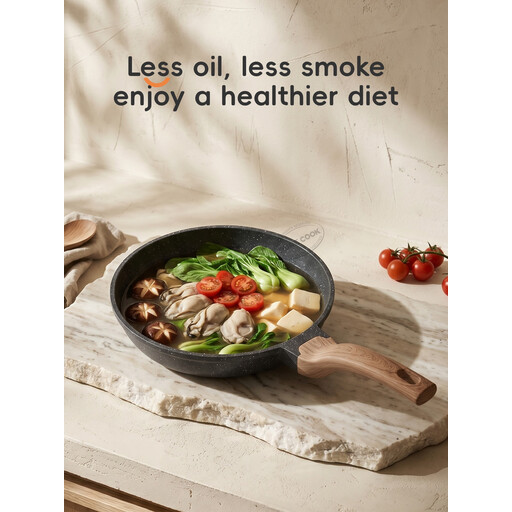
Why this choice suits this profile : Its 24 cm size and aluminium body are well suited to everyday meals. Its light weight makes it easy to handle, which is a real advantage when you are just starting out.
The specifications state that it is compatible with induction, gas and electric ceramic hobs. They also specify that it must be washed by hand.
Versatile 24 cm size, aluminium body and stone-effect non-stick coating.
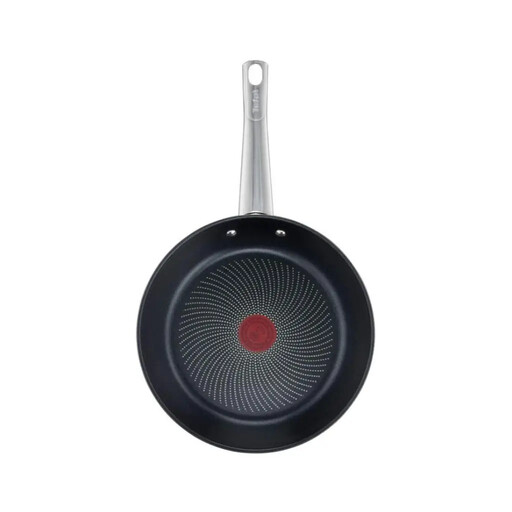
Why this choice suits this profile : Its large stainless steel design is aimed at households looking for a robust, well-constructed frying pan for preparing several portions.
The specifications mention four hob types, a Thermo-Signal indicator, oven use up to 250 °C and dishwasher compatibility.
28 cm diameter, titanium-reinforced non-stick coating and riveted stainless steel handle.
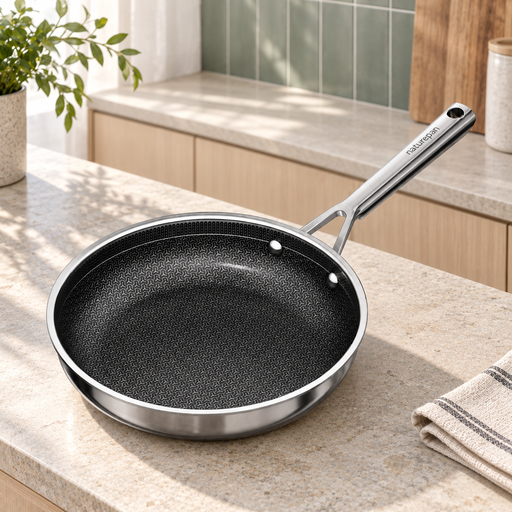
Why this choice suits this profile : Its hybrid surface is suited to those who alternate between gentle cooking and searing, while looking for a size that is easy to handle.
The specifications clearly distinguish between the hexagonal surface, the stainless steel areas and the ceramic coating. They recommend using low to medium heat and washing by hand.
Multi-layer stainless steel construction with an aluminium core, compatible with induction, gas, electric and ceramic hobs.
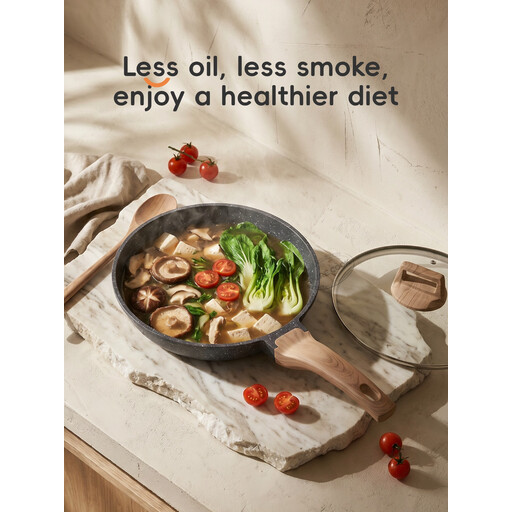
Why this choice suits this profile : Its 21 cm diameter and glass lid are well suited to individual portions, eggs and slow-cooked dishes.
The lid is clearly listed, as is compatibility with induction, gas and ceramic hobs. It must be washed by hand.
Lightweight aluminium body, non-stick coating and tempered glass lid for keeping an eye on your cooking.
We have put together a complete, real-time updated list of products that fully meet these strict selection criteria and European safety regulations.
Even a well-designed non-stick frying pan requires a few precautions. Heat it gradually, add the food before the temperature rises too high and avoid leaving the empty pan on an induction hob. To prevent food from sticking, a small amount of oil and a moderate temperature are generally all you need.
Stop using the frying pan if the coating starts to peel or shows visible damage. The manufacturer may also specify a maximum oven temperature. Follow it carefully, particularly when the handle or lid is involved.
A 28 cm frying pan provides a comfortable surface for preparing four portions, while a 24 cm model is easier to handle and better suited to meals for one or two people. For versatile cooking, the choice mainly depends on the size of your induction zone and the number of people you are cooking for.
It depends on the model. Some specifications allow it, such as those for the TEFAL Cook Eat, but hand-washing with a soft sponge is often recommended to preserve the coating. The PURECOOK models featured here are listed as not dishwasher-safe.
It is better to avoid them. Wooden, silicone or nylon spatulas reduce the risk of scratches. This precaution applies equally to a conventional frying pan and to a model with a ceramic coating.