
Livraison le jour même ou le lendemain

Qualité garantie

Débloquez vos offres de bienvenue: Livraison GRATUITE | Jusqu'à -80 % | 30 jours d'essai gratuits à JoyPlus
Téléchargez l'application
An induction-compatible non-stick frying pan can make everyday meals much easier. But it is important to look beyond an attractive product description. A magnetic base that is too thin, a mistreated coating or the wrong diameter can turn a promising purchase into a utensil that ends up forgotten at the back of the cupboard.
Before choosing between a ceramic frying pan, a non-stick wok or an all-hob frying pan, focus on three things: genuine compatibility with your hob, the type of coating and the care requirements.
A frying pan advertised as suitable for gas, electric and ceramic hobs will not necessarily work on an induction hob. This technology requires a base containing a magnetic material. The word “induction” should therefore appear clearly in the technical specifications.
The symbol is not everything: also check the composition of the base, its diameter and the recommended cooking-zone dimensions provided by the manufacturer.
Marketing claims such as “scratch-resistant”, “reinforced” or “long-lasting” do not replace good usage habits. Even an aluminium frying pan with a reinforced coating can quickly lose its performance if it is heated while empty, scrubbed with an abrasive sponge or used with metal utensils.
Its lifespan therefore depends on the material, but also on the way you cook with and wash the frying pan.
A 20 cm frying pan is suitable for eggs, individual omelettes and small portions. For two to four people, a diameter of 26 to 28 cm offers greater versatility. Above 30 cm, capacity increases, but so do weight and storage requirements.
On an induction hob, the base should also match the cooking zone. A large frying pan placed on a small zone may heat less evenly.
A ceramic frying pan generally has a mineral coating that helps food release easily while allowing you to cook with little fat. Some product descriptions state that the coating is free from PTFE, PFOA or PFAS. However, this information remains a manufacturer’s claim and is not necessarily independent certification.
A PFAS-free non-stick frying pan may appeal to anyone wishing to avoid certain groups of substances, provided you check exactly what the claim covers. PTFE, meanwhile, provides an effective non-stick surface, but overheating and metal utensils should be avoided.
Honeycomb or textured surfaces add a layer of mechanical protection. They can reduce direct contact between the utensil and the coating, but gentle cleaning is still essential.
For even cooking, choose a flat, stable and sufficiently wide base. A thick base also helps reduce temperature fluctuations, although it often makes the utensil heavier.
A dishwasher-safe frying pan is convenient for everyday use. However, repeated washing at high temperatures can speed up wear to a non-stick coating. When recommended by the manufacturer, hand-washing with a soft sponge remains the best approach.
Also check the maximum oven temperature, particularly if the handle is made from plastic or is removable. A frying pan with a removable handle can save space in a small kitchen, but the handle must be securely locked before lifting the utensil and kept away from naked flames.
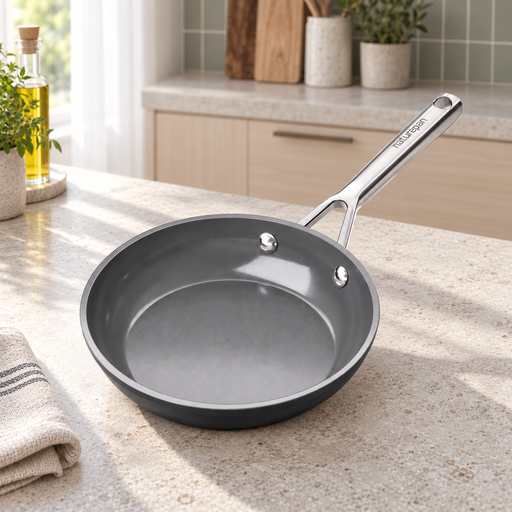
Why this choice suits this profile : Its small diameter is ideal for a first frying pan, a studio flat or individual portions. The product description states that it is compatible with induction, gas, electric and ceramic hobs.
The product description specifies that the base is suitable for several heat sources and that it can be washed in the dishwasher. To protect the coating, however, it is best to use low to medium heat and soft utensils.
20 cm format, aluminium body, ceramic coating advertised as free from PTFE, PFAS and PFOA, plus a stainless-steel handle advertised as oven-safe up to 260 °C.
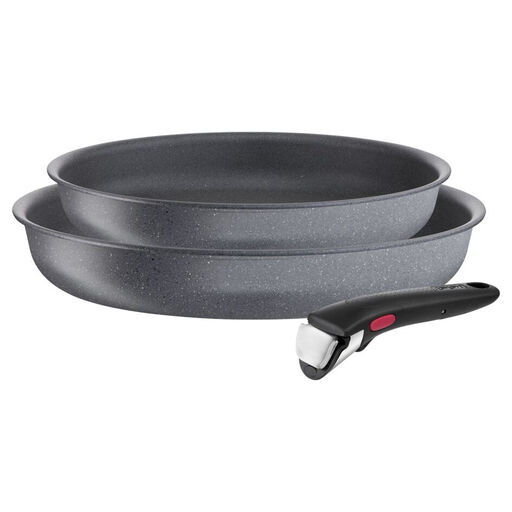
Why this choice suits this profile : This duo covers everything from individual portions to family meals. The removable handle also makes it easier to stack the pans in a shallow cupboard.
Induction compatibility is clearly stated. However, hand-washing is recommended and oven compatibility is not specified: two limitations to consider before ordering.
Two diameters, a removable handle and an induction-ready base. The product description also mentions a PFOA-free coating.
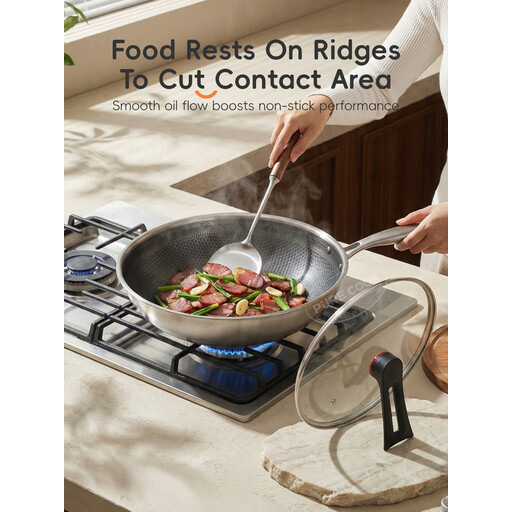
Why this choice suits this profile : With its 32 cm diameter and glass lid, this wok is made for family meals, stir-frying and slow-cooked dishes that need to retain their moisture.
The three-layer construction and compatibility with induction, gas and ceramic hobs are clearly specified. However, plan to wash it by hand and avoid thermal shock.
Multi-layer 304 stainless steel, glass lid, handle advertised as staying cool on the hob and a generous 32 cm diameter.
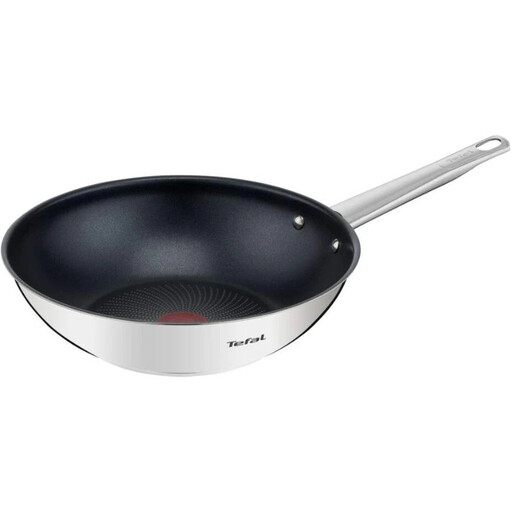
Why this choice suits this profile : Its mid-sized diameter is ideal for everyday meals without taking up as much space as a large wok. The product description states that it can be used on all types of hob.
The product description specifies induction compatibility, dishwasher safety and a maximum oven temperature of 250 °C. These details help you check how it can really be used, rather than relying solely on the word “versatile”.
28 cm, Thermo-Signal indicator, base designed for good heat distribution, riveted handle and coating advertised as free from PFOA.
We have brought together a complete, up-to-date selection of products that meet these demanding criteria, as well as European safety standards.
To protect your utensil and avoid having to replace it too soon:
A frying pan with a lid helps prevent splashes and is practical for slow cooking. In a small kitchen, a stackable model or one with a removable handle makes storage easier. However, check whether the handle is included or sold separately.
Yes, provided it is also designed for electric or ceramic hobs. Always check the product specifications: induction and ceramic hobs rely on two different technologies.
There is no standard lifespan. Frequency of use, cooking temperature, utensils and cleaning method all affect how quickly it wears. Gentle washing and moderate heat will help the surface remain effective for longer.
These two materials do not meet exactly the same needs. Ceramic generally makes it easier to release food, while stainless steel provides a surface without an added coating and offers good mechanical resistance. The best choice depends on your recipes, your cooking habits and the level of care you are prepared to provide.