A kitchen already well equipped for induction
You mainly own pans with ferromagnetic bases. You can then focus on the cooking zones, the hob’s power rating and whether it will fit your existing cut-out.


An induction hob is a good fit if the pans you use most often have a ferromagnetic base, provided you also check the electrical connection and the cut-out dimensions required by the model. If several of your essential pans won’t work on induction, compare a ceramic or mixed hob with the option of replacing only the incompatible items. A flexible zone is only worth considering if you genuinely need it for your larger pans.
You mainly own pans with ferromagnetic bases. You can then focus on the cooking zones, the hob’s power rating and whether it will fit your existing cut-out.
You regularly use non-magnetic pans or aren’t sure whether they’re compatible. Before switching technology, you want to find out which items you might need to replace.
You cook with a griddle, an oval casserole dish or a large stockpot. The size of the cooking zones and any flexible zones matters just as much as their number.
Consider it if: your essential pans have ferromagnetic bases and the model can be installed in your kitchen.
Bear in mind: according to Que Choisir, a pan without a ferromagnetic base won’t work on induction; a flexible zone doesn’t change this requirement.
Consider it if: you want to keep pans that don’t work on induction, as long as they’re suitable for this type of hob.
Bear in mind: the cooking zone heats the surface, so residual heat is something to consider after use.
Consider it if: you want to use the induction zones for compatible pans and keep gas burners for other cookware.
Check: the electrical and gas connections, as well as the cut-out; combining two technologies doesn’t necessarily make installation simpler.
If you’re replacing your hob but want to keep your current pans, start with the items you actually use. Then check the installation requirements and the space needed for your largest pans.
| Criteria | What to check | Who is it for? |
|---|---|---|
| Cookware compatibility | Check the base of each essential pan: induction requires a ferromagnetic base. | If my usual pans don’t work on induction, I want to be able to keep using them; around 36% of consumers could make keeping their cookware their main priority. |
| Installation and cut-out | Check the connection and the model’s power requirements against the available circuit, then measure the worktop cut-out. Promotelec states that a hob must be connected to a dedicated circuit. | Before replacing my hob, I want to know whether the new appliance will fit my kitchen; almost 29% of consumers could put this compatibility first. |
| Cooking zone sizes | Compare your largest pans with the cooking zone dimensions; consider a flexible zone if you regularly use long or oval cookware. | I’m looking for a cooking surface that suits my griddle or oval casserole dish; around 21% of consumers could prioritise larger cookware. |
| Additional purchases | Work out which pans you’d actually need to replace if you choose induction, and check whether installation might require any additional work. | If I’m only missing a few compatible items, I’d rather compare replacing those individually with changing my hob; around 14% of consumers could prioritise keeping additional purchases to a minimum. |
Two hobs can look alike but heat in different ways. According to Que Choisir, a pan without a ferromagnetic base won’t activate an induction hob.
Check your most-used pans before choosing a hob rather than relying on how its surface looks.
This mix-up could mean replacing cookware you planned to keep.
The advertised width alone won’t tell you the cut-out dimensions. The connection and power requirements also vary by model.
Measure the existing cut-out, then ask a professional to compare the available circuit and connection with the instructions for the model you’re considering.
An ill-fitting cut-out could mean altering the worktop; an unsuitable connection could require electrical work.
Bridge or FlexiBridge functions combine cooking zones on some models, but they won’t make a non-magnetic pan compatible with induction.
Measure the large pans you use regularly and compare them with the dimensions of the zones on the specific model.
Some induction hobs from the brand have zones that can be combined, which may be worth considering if you use large pans.
Worth considering if you’re looking for an induction hob with cooking zones that suit your pans.
A ceramic model to consider if you want to avoid the magnetic compatibility requirement of induction.
This ceramic hob could be a good option if you want to keep cookware that wouldn’t work on induction. However, check that each pan is suitable for use on this hob, and confirm the model’s cut-out and connection requirements.
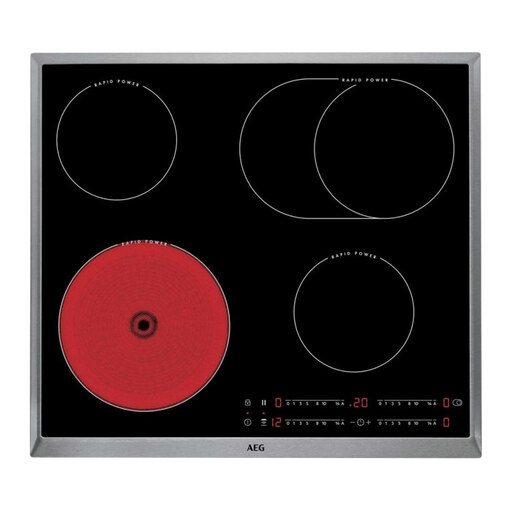 Image unavailable
Worth considering if you want to keep cookware that isn’t compatible with induction, provided it’s suitable for this ceramic hob and has a stable base.
This 60 cm model: before buying, compare your worktop cut-out and electrical connection with the information in the instructions.
Every pan used on an induction zone needs a ferromagnetic base. Start by checking the ones you use most often: according to Que Choisir, a pan without this type of base won’t activate the cooking zone.
No. According to Que Choisir, induction uses a magnetic field, while a ceramic hob with radiant or halogen zones heats the cooking surface. A pan that isn’t compatible with induction still needs to be suitable for the ceramic hob you’re considering.
Ask a qualified professional to check the circuit and available connection, and confirm they’re suitable for the power requirements of your chosen model. Promotelec states that a hob must be connected to a dedicated circuit; this information alone isn’t enough to assess your existing installation.
The stated width alone won’t tell you whether a hob will fit your worktop. For example, Electrolux lists a cut-out size of 560 × 490 mm for the EIV653. Always compare the measurements of your existing cut-out with the installation diagram for the exact model.
No. In France, the legal guarantee of conformity applies to eligible goods sold by a business to a consumer, as explained by the Ministry of the Economy; an additional commercial warranty is separate. Read its terms and conditions before deciding whether it offers useful extra cover.