Households switching to induction
If you plan to keep your saucepans and frying pans, test their bases with a magnet before choosing a hob. Then compare the diameter of your cookware, especially smaller pans, with the guidance in the instructions.


If your most-used pans are compatible and their sizes suit the hob zones, switching to induction means you can keep them without replacing your entire cookware set. A ceramic hob removes the need for magnetic pan bases, while a mixed hob can retain some gas cooking options alongside induction, provided its layout and connection suit your kitchen. In every case, compare the worktop cut-out and installation requirements with the instructions for the model you choose.
If you plan to keep your saucepans and frying pans, test their bases with a magnet before choosing a hob. Then compare the diameter of your cookware, especially smaller pans, with the guidance in the instructions.
In an existing kitchen, the key measurement is the cut-out in the worktop, which is different from the hob’s overall dimensions. The instructions for the new model will also specify its ventilation requirements.
If you cook with a large casserole, a fish kettle or several pans at once, check the layout of the zones and their dimensions. A bridging zone is only useful if it suits the cookware you actually use.
Worth considering: if your essential cookware has compatible bases and you want heat directed to the pan.
Bear in mind: incompatible pans will need to be replaced or used with another type of hob.
Worth considering: if keeping non-magnetic cookware matters more to you than switching to induction.
Bear in mind: this technology heats by radiant or halogen heat, rather than using a magnetic field beneath the pan.
Worth considering: if you want to keep cooking with gas while also using induction with compatible pans.
Bear in mind: induction zones still require suitable cookware, while gas needs an appropriate connection.
Once you’ve chosen a technology, check your cookware and kitchen against the specifications of the exact model. Two hobs of the same type may not fit in the same way.
| Criterion | What to check | My needs |
|---|---|---|
| Cookware compatibility | For induction, check whether a magnet sticks to the base of each pan you rely on. Also check that the base is flat and that its diameter is suitable for the zones, as stated in the instructions. | I want to keep the pans I use regularly, including the small one I often reach for. If some aren’t suitable for induction, I could replace just those. |
| Cooking zones and large pans | Compare the number, layout and size of the zones with the dishes you cook at the same time. For a long or wide pan, check the instructions for using an extendable or bridging zone. | I often cook several dishes at once, so my larger pans need to fit properly on the hob. |
| Electricity consumption | In its table based on 409 cycles a year, ADEME gives figures of 115 kWh/year for induction and 200 kWh/year for ceramic hobs. These are comparison figures, not a promise of how much your household will use. | I’ll take my cooking habits into account, as well as any pans I might need to replace to switch to induction. |
| Fitting and installation | Measure the cut-out in the worktop, not just the visible width of the old hob. Compare it with the new model’s fitting dimensions and ventilation requirements; have the connection checked if work is needed. | My kitchen is already fitted, so I want to check that my chosen hob will fit rather than assume its dimensions match the old one. |
The material name alone doesn’t tell you whether a pan will work on an induction zone. According to Electrolux France, a magnet should stick to the base of the pan.
Test the cookware you use regularly, then compare its diameter with the instructions for the hob you’re considering.
If you want to keep using an incompatible pan for the same dishes on induction, you may need to replace it.
A hob’s overall dimensions are not the same as its cut-out size, as UFC-Que Choisir points out. So, a visible width close to that of your old appliance doesn’t guarantee that the existing cut-out will fit.
Measure the existing opening and compare it with the model’s installation information before ordering. Check the ventilation requirements too.
Four zones don’t necessarily mean there’ll be a suitable place for your largest pan or for all the pans you use together. Extendable zones are designed for particular cookware sizes.
Start with the pans you actually use and check the size and layout of the zones. Look for a flexible zone if your cookware calls for one.
ADEME’s comparison of induction and ceramic hobs is based on 409 cycles a year. If you cook more or less often, your energy use may be different.
Use the figure to compare the technologies, then take your own habits into account, along with the cookware you want to keep or replace.
These examples show configurations you can compare. The features mentioned apply only to the ranges or models concerned.
Bosch offers induction and ceramic hobs, making it possible to compare both technologies from the same manufacturer.
Electrolux offers a hob that combines induction and gas, which may be worth considering if you want to keep both options.
The Siemens ED751HSB1E induction hob is an example of a four-zone model with a combiZone.
This option is for anyone switching to a four-zone built-in induction hob. To decide whether it suits your kitchen, check your cookware and the model’s installation requirements.
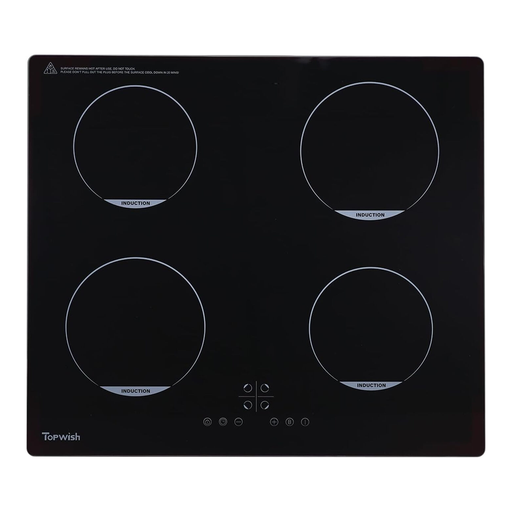 Image unavailable
Its four zones are suited to cooking with several pans at once, provided their layout works for your cookware. The model is listed with touch controls, a Boost function, timer, child lock and residual heat indicator. For induction, test the base of your pans with a magnet and check the diameters accepted by each zone. Compare the fitting dimensions and ventilation requirements with your kitchen. The specifications list a maximum power of 7200 W and a connection without a mains plug; if you’re unsure, ask a professional to check this.
Place a magnet against the base of each pan you want to keep: it should stick. Then check that the base is flat and that its diameter is suitable for the zones, as stated in the instructions for your chosen hob.
A radiant ceramic hob doesn’t need the ferromagnetic base required for induction. If you want to keep this cookware, check that its bases are still suitable for the instructions for your chosen model.
It may let you keep using some pans on the gas burners, while reserving the induction zones for compatible cookware. Check the layout of the zones on the specific model and the gas connection requirements in your kitchen.
Measure the cut-out in the worktop: it’s different from the hob’s overall dimensions. Compare this measurement and the ventilation options with the installation instructions for the new model.