You want to keep your cookware
You already own saucepans, frying pans or stockpots that you use regularly. Before choosing induction, you’ll need to find out which pieces are compatible and which you might have to replace.


You can consider switching to induction without replacing all your cookware if the pans you use most have a compatible base. Test them with a magnet, then check the hob’s requirements and your home’s electrical installation. If several essential pans aren’t suitable, compare the cost of replacing just those with a ceramic hob or a mixed hob, depending on your cooking habits and installation options.
You already own saucepans, frying pans or stockpots that you use regularly. Before choosing induction, you’ll need to find out which pieces are compatible and which you might have to replace.
Your cookware is only part of the decision: you also need to check that your home’s electrical circuit and protective devices are suitable for the new hob. Having an old hob in place doesn’t necessarily mean the installation is suitable.
You could replace a few pans, but would like to keep the ones you rely on in the kitchen. The choice then comes down to induction, a ceramic hob or, if installation is an option, a mixed hob.
Start with the pans you actually use, then check the installation before deciding which hob to choose.
Consider it: if your essential pans have a ferromagnetic base, or if you only need to replace a few.
Bear in mind: unsuitable pans won’t heat up on its cooking zones.
Consider it: if keeping pans that fail the magnet test matters more to you than switching to induction.
Check: the pans you can use and the instructions for your chosen model; confirm the details in its manual.
Consider it: if you’d like to split your cooking between induction and gas zones.
Bear in mind: each technology has its own cooking zones, and gas installation requirements need to be checked separately.
| Your priority | What to check | Who is this for? |
|---|---|---|
| Keeping your pans | Test the base of the pans you use with a magnet, and check the requirements for your chosen hob too. | If I often cook with the same pans, I want to know which ones I can keep using before changing my hob. Around 40% of consumers put keeping their cookware first. |
| Checking the installation | Compare the model’s connection requirements with your home’s circuit and protective devices. According to Enedis, an induction hob needs a dedicated circuit and a dedicated protective device. | Before replacing my hob, I want to avoid choosing an appliance without knowing whether its power supply is suitable. This is the top priority for around 30% of consumers. |
| Choosing a technology | Compare how well your essential pans work with each option; for a mixed hob, check how the cooking zones are divided. | If some pans are especially important in my kitchen, I want to decide whether it’s better to replace a few or choose a different hob. Around 30% of consumers put this trade-off first. |
Que Choisir points out that induction requires suitable saucepans and frying pans. A pan with a non-ferromagnetic base won’t heat up on an induction cooking zone.
Hold a magnet against the base of each important pan, then check the hob manual for any other requirements. This will help you identify which pieces of cookware, if any, need replacing.
Even if all your pans are compatible, that doesn’t confirm your home’s electrical circuit is suitable for the hob. Enedis says an induction hob needs a dedicated circuit and a dedicated protective device.
Compare the model’s connection requirements with your existing installation. If you can’t confirm that they’re compatible, ask a qualified professional to assess it.
You may need an inspection or modifications to your installation.
On a model that combines induction and gas, the cooking zones are split between the two technologies. Pans used on the induction zones still need to be compatible.
Check how the zones are divided on your chosen model, and have the home’s electrical and gas installation requirements assessed separately.
These products offer two ways to approach switching to induction: choose a portable or built-in hob after checking your cookware, or replace a stockpot as needed.
 Image unavailable
Worth considering if you’re looking for a portable induction hob rather than replacing a built-in model. The product title lists eight power levels, seven preset functions and a three-hour timer. Test your most-used pans with a magnet, and check that they have a flat base and a diameter of 12 to 26 cm, as specified for this hob. Make sure the connection type is suitable before choosing it.
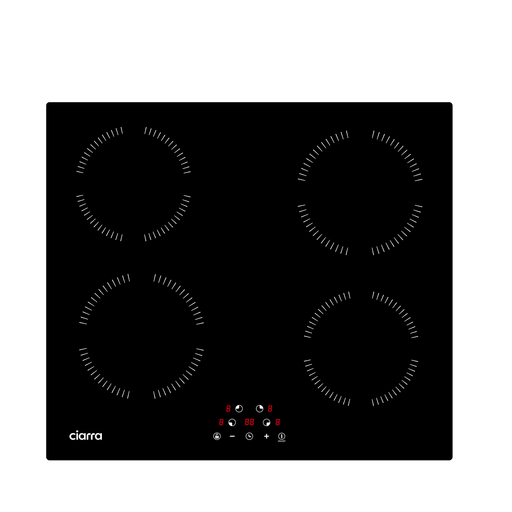 Image unavailable
Worth looking at if you’re replacing a built-in hob and want to check your cookware against each cooking zone. The product title lists nine power levels. Check the base and diameter requirements for each pan in the manual, then have a professional confirm that your circuit and protective devices meet the model’s requirements before installation.
 Image unavailable
Worth considering if a stockpot you use regularly is one of the pieces you need to replace for induction. The product details describe it as compatible with induction and say it comes with a glass lid; check that its base meets your hob’s requirements. The listing gives conflicting information about the grade of steel, so confirm this if it’s important to your choice.
Hold a magnet against its base. If it sticks, the pan passes the basic test described by Que Choisir for identifying a base containing iron. Also look for the word or symbol for induction, if one appears on the cookware.
No. It checks whether the base is ferromagnetic, which is necessary for induction, but it doesn’t confirm all the requirements for your particular hob. Check the manual, especially the requirements for cookware.
Check the model’s connection requirements against your existing installation. Enedis says an induction hob needs a dedicated circuit and a dedicated protective device. If you can’t confirm that your installation is suitable, ask a qualified professional to assess it.
Yes, if keeping those pans is your priority. Failing the test means they can’t be used on induction, but that alone doesn’t confirm they’ll work with a particular ceramic hob. Check the manufacturer’s guidance before choosing.
No. Que Choisir recommends disconnecting the appliance if the ceramic surface is chipped, cracked or broken. Don’t continue to use it in that condition.