Start by thinking about the pans you want to keep and how you like to cook. Induction requires cookware with a ferromagnetic base, while a ceramic hob uses a different heating method. A mixed hob lets you keep gas burners alongside an induction zone, but you’ll need to check the requirements for both. In every case, compare the manual for your chosen model with the worktop cut-out, and ask a professional to confirm that it’s suitable for your installation.
Who are these options for?
Households keen to keep their existing cookware
If replacing your frying pans and saucepans is a key consideration when choosing a new kitchen, check them before opting for induction. UFC-Que Choisir points out that this technology requires compatible cookware, while a ceramic hob works differently.
Cooks who use large pans
If you often use a large casserole or an elongated pan, check the size of the cooking zones and whether the hob actually has a Bridge function or flexible zone. Electrolux lists a Bridge function on its EIV734, but a hob’s width alone doesn’t tell you whether it has one.
Households looking to keep gas
A mixed hob can combine gas burners with induction: Electrolux’s KDI640713K, for example, has one induction zone and three gas burners. Cookware used on the induction zone must still be compatible, and the gas setup should be checked for the specific model.
What should you prioritise?
Choose your hob technology based on the cooking method you want to keep or switch to. Then check your cookware, cooking zones and the installation requirements for the model you’re considering.
Induction
Consider it: if your cookware is compatible, or you’re happy to replace any that isn’t, particularly if you want fast heat-up times.
Bear in mind: a pan without a ferromagnetic base won’t heat up on an induction zone, according to UFC-Que Choisir.
Ceramic
Consider it: if you want an electric hob without magnetic compatibility requirements, after checking that your cookware is suitable for the cooking zones you choose.
Bear in mind: its radiant or halogen cooking zones don’t heat in the same way as induction.
Mixed induction and gas
Consider it: if you want to keep gas burners while adding an induction zone, provided your gas installation is suitable.
Bear in mind: the induction zone still requires compatible cookware, and you’ll need to check the model’s manual for its gas specifications.
| Criteria |
What to check |
Who it matters to |
| Cookware compatibility |
Check every pan you use on induction and identify which ones you’d need to replace. |
I want to keep my frying pans and saucepans without finding out after buying that they don’t work on induction; around 33% of consumers put this compatibility first. |
| Heating and large pans |
Compare the size of the cooking zones with your pans; check whether the hob has a Bridge function or flexible zone. |
A large casserole or griddle matters more to me than keeping all my cookware; fast heating and available space are the top priorities for around 27% of consumers. |
| Keeping gas |
For a mixed hob, check the layout of the cooking zones, the gas specifications and the model’s manual. |
I still want to be able to cook with gas as well as having an induction zone; around 20% of consumers prioritise this combination. |
| Another electric option |
Confirm the heating type and compare the installation dimensions with the existing cut-out. |
I’d rather replace my hob with an electric option that doesn’t rely on a ferromagnetic base; around 20% of consumers put this preference first. |
Mistakes to avoid
-
Assuming every metal pan works on induction
UFC-Que Choisir explains that induction requires a ferromagnetic base: without compatible cookware, the zone won’t heat up. This could affect both your choice of hob and which pans you decide to keep.
Check the saucepans and frying pans you actually use, then make a separate list of any that need replacing.
-
Confusing the hob’s width with the required cut-out
The appliance’s external dimensions alone don’t tell you the size of the opening needed in your worktop. The Electrolux EIV734 and KDI640713K product specifications show that dimensions vary by model.
Measure the existing cut-out and compare it with the exact manual, including the required clearances.
An unsuitable cut-out may mean modifying the worktop.
-
Assuming a mixed hob means you don’t need to check the gas connection
A mixed hob has gas specifications specific to that model, and the cookware used on its induction zone must still be compatible.
Check the manual for the type of gas required, and get confirmation that the appliance is suitable for your installation before choosing it.
-
Assuming a wide induction hob has a flexible zone
A Bridge function depends on the model: Electrolux lists one for the EIV734, but you can’t tell from the hob’s width alone.
If you use large pans, check the features listed and the dimensions of the zones involved.
Brands to consider
Electrolux
Worth considering if you’re comparing an induction hob with a Bridge function and a mixed induction and gas hob.
- Electrolux lists a Bridge function and a maximum power of 7 350 W for the EIV734; the KDI640713K combines an induction zone with three gas burners.
- The gas specifications, dimensions and installation requirements for the KDI640713K don’t apply to every hob in the range.
Bosch
Ceramic and induction models to compare individually.
- Bosch identifies the PKE611CA8E as a ceramic hob measuring 592 × 522 mm.
- Bosch lists the induction model PIL615R14E as unavailable; check the status of each model you’re considering.
Siemens
An induction range to consider if hob width is one of your criteria.
- Siemens offers induction hobs and domino hobs in widths from 30 to 90 cm.
- This range doesn’t tell you the installation dimensions or whether a particular model has a flexible zone.
Ceramic hobs on Joybuy
These two ceramic hobs are electric options that don’t require cookware with a ferromagnetic base. Before choosing one, check that your cookware is suitable for its cooking zones and that its installation requirements suit your kitchen.
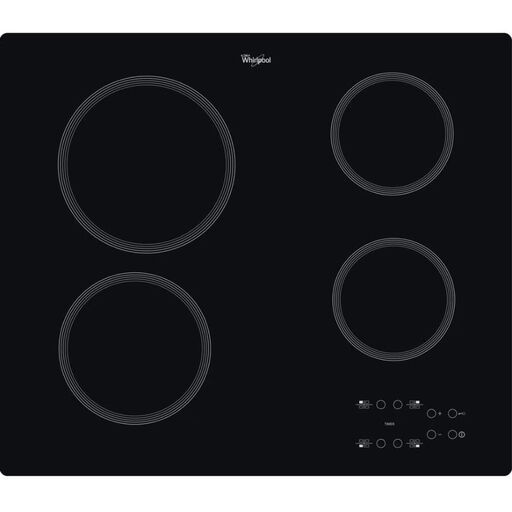 Image unavailable
Whirlpool AKT 801-NE, 4-zone ceramic hob
Worth considering if you want an electric hob without magnetic compatibility requirements. This model has four cooking zones; check that your cookware is suitable and compare the manual with your worktop and installation.
View on Joybuy
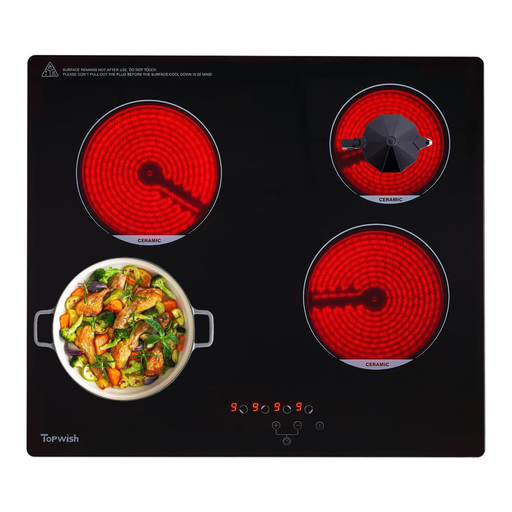 Image unavailable
TOPWISH, 4-zone built-in ceramic hob, 60 cm
Worth a look if you want four ceramic cooking zones with touch controls. The product name lists a child lock and residual heat indicator; check the power rating in the manual before asking a professional to confirm that it’s suitable for your installation.
View on Joybuy
Frequently asked questions
Will my old saucepans work on an induction hob?
Yes, if their bases are ferromagnetic and the hob recognises them; not all cookware is. UFC-Que Choisir highlights this requirement for induction, so check the pans you use regularly before deciding which ones to keep.
Does a ceramic hob work in the same way as an induction hob?
No. Ceramic hobs with radiant or halogen zones can look similar to induction hobs, but induction heats the pan using a magnetic field. Compare the heating method and cookware compatibility, not just the look of the surface.
Is the stated width enough to plan the installation?
No. Use the cut-out dimensions in the manual for the exact model. The specified cut-out for the Electrolux EIV734 is 680 × 490 mm; this measurement doesn’t apply to another hob, even one with a similar stated width.
Will my saucepans work on the induction zone of a mixed hob?
Only if their bases are compatible with induction. On a mixed hob such as the Electrolux KDI640713K, the gas burners and induction zone are two separate cooking methods; check the manufacturer’s instructions for each one too.


