
Livraison le jour même ou le lendemain

Qualité garantie

Débloquez vos offres de bienvenue: Livraison GRATUITE | Jusqu'à -80 % | 30 jours d'essai gratuits à JoyPlus
Téléchargez l'application
An induction frying pan needs to combine several qualities: rapid heat-up, stability on the hob, a diameter that matches the cooking zone and suitability for the way you cook. However, product listings are not always clear about the features that really matter.
Before placing your order, it is worth distinguishing between verifiable information and generic claims. Here are the criteria to consider when choosing a frying pan compatible with induction, gas, electric hobs and ceramic hobs.
The phrase “all hob types” does not necessarily guarantee that the frying pan will work with every installation. To work on an induction hob, its base must contain a suitable ferromagnetic layer. Check that the product listing explicitly mentions induction, rather than just gas or electricity.
If you use several types of hob, look for a clear indication that the pan is compatible with gas, electric, ceramic and induction hobs.
A non-stick frying pan allows you to cook with little fat, but its coating does not respond well to overheating when empty, metal utensils or abrasive sponges. The claim “PFOA-free” refers to one specific substance; it does not replace checking the full composition and care instructions.
Ceramic coatings, including those reinforced with mineral particles, can offer excellent non-stick performance when new. To preserve it, use a low to medium heat and wooden, silicone or plastic utensils.
A dishwasher-safe frying pan can save time in everyday use. However, repeated washing and detergents can accelerate wear to a non-stick coating. If the manufacturer recommends hand washing despite stating that the pan is dishwasher-safe, this advice should be taken seriously.
The right size depends on the number of people you are serving and the size of the cooking zone on your induction hob.
The stated diameter generally refers to the top edge of the frying pan. The base may be noticeably smaller, so if your hob has small cooking zones, remember to check the actual base diameter as well.
Aluminium heats up quickly and generally helps to keep the frying pan lightweight. It is often combined with a magnetic base to ensure induction compatibility. Stainless steel offers good resistance to scratches and high temperatures, but it requires controlled preheating to prevent food from sticking.
Multi-layer constructions — such as stainless steel with an aluminium core — aim to combine good heat conduction with stability. The PURECOOK 304 stainless steel three-layer frying pan and the Maxcook 304 stainless steel frying pan without a non-stick coating are examples of this design. These models are advertised as compatible with several types of hob and dishwasher-safe, while requiring the pan to cool before cleaning.
When choosing a frying pan for healthy cooking, in practical terms, focus on whether it allows you to cook with little oil, the stated durability of the coating and which utensils are permitted. A non-stick surface is not necessarily designed to withstand extreme heat or the use of metal utensils.
A ceramic frying pan may be well suited to delicate foods, while an uncoated stainless steel frying pan is more suitable for searing and browning. Oven compatibility should also be clearly specified: the maximum temperature, whether this includes the handle and whether the lid needs to be removed.
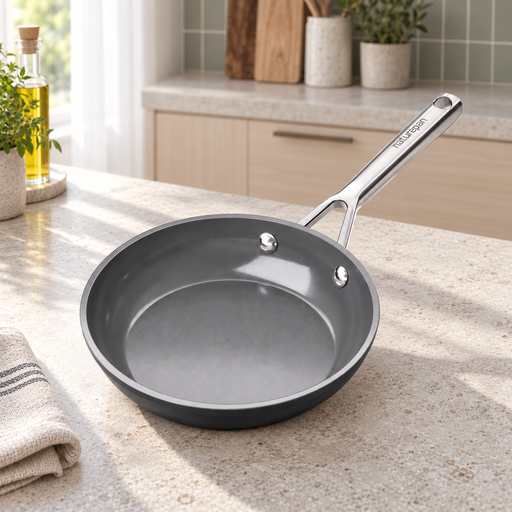
Why this choice suits this profile : Its compact size is ideal for small portions, students and kitchens where every centimetre of space matters.
The listing clearly states compatibility with induction, gas, electric hobs and ceramic hobs, as well as dishwasher use.
A reinforced ceramic coating, a stainless steel handle and stated oven use up to 260 °C.
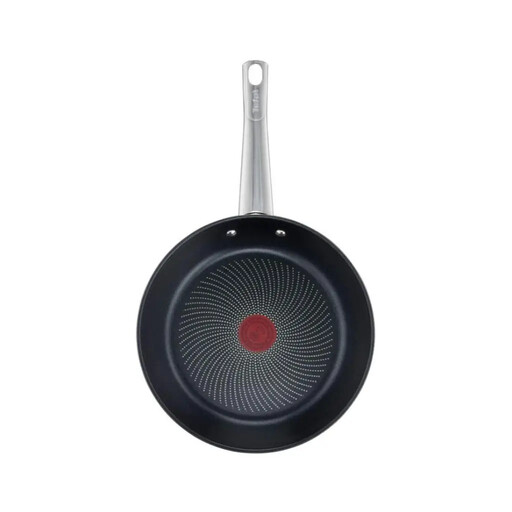
Why this choice suits this profile : Its large diameter and stainless steel construction are well suited to family meals and frequent cooking.
The listing details the four compatible hob types, the maximum oven temperature and the manufacturer’s stated PFOA-free composition.
A Thermo-Signal indicator, titanium-reinforced non-stick coating, oven compatibility up to 250 °C and dishwasher-safe design.
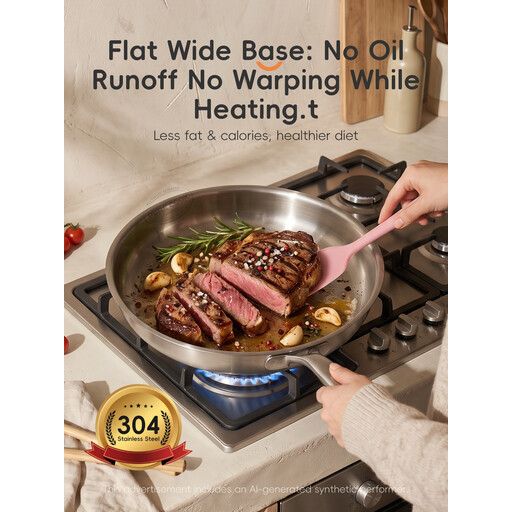
Why this choice suits this profile : Without a non-stick coating, it is designed for searing food, preparing sauces and regularly using different types of utensils.
The listing clearly distinguishes the 304 stainless steel and aluminium core from a non-stick coating, while stating compatibility with all hob types.
A three-layer construction, stated scratch resistance and dishwasher use specified in the product listing.
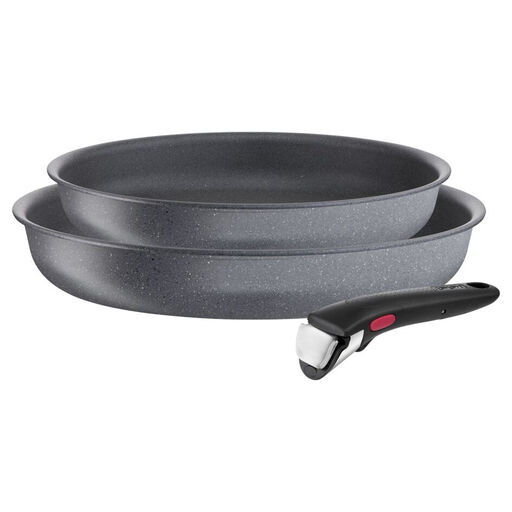
Why this choice suits this profile : The two diameters and removable handle make storage easier in a small home or shallow cupboard.
Compatibility with induction, gas, electric hobs and ceramic hobs is clearly specified. Hand washing and the fact that it is not oven-safe are also clearly stated.
Two sizes, a Thermo-Fusion base and a removable handle; the handle must be correctly locked before every use.
We have selected a complete, real-time-updated range of products that meet these demanding criteria and European safety requirements.
Look for the explicit term “induction” in the product listing or instructions. The simple “all hob types” symbol is not always enough. You can also hold a magnet against the base: if it sticks, this indicates the presence of a ferromagnetic material. However, this test does not replace the manufacturer’s information.
A 24 cm frying pan is generally suitable for everyday meals for one or two people. A 26 cm frying pan is more versatile, while a 28 cm frying pan is better suited to families and larger quantities. Simply check that the base diameter matches the cooking zone on your hob.
No. This must be explicitly stated by the manufacturer. Even when dishwasher use is permitted, hand washing with a soft sponge will help preserve the coating. For models with a removable handle, also check the specific care instructions: the handle is not necessarily dishwasher-safe.