
Livraison le jour même ou le lendemain

Qualité garantie

Débloquez vos offres de bienvenue: Livraison GRATUITE | Jusqu'à -80 % | 30 jours d'essai gratuits à JoyPlus
Téléchargez l'application
Choosing a new induction cookware set can quickly become a headache. Between the marketing jargon and confusing spec sheets, it's easy to end up with utensils that heat poorly, get damaged in a few months, or are the opposite of what you'd consider healthy cooking. As a product expert at Joybuy, I'm here to separate fact from fiction for you. Let's review the pitfalls to avoid for a smart, long-lasting purchase.
Here are the three common mistakes to avoid:
To avoid these disappointments, it's better to focus on a few concrete technical criteria. These, not the brand's marketing, are what guarantee the quality and durability of your future kitchen utensils.
The performance of an induction pot or pan on an induction stovetop depends entirely on its base. It must be perfectly flat to ensure maximum contact with the cooktop and thick enough to distribute heat evenly and prevent warping.
The crucial point? The presence of a ferromagnetic material. A simple trick to check this: hold a magnet to the bottom of the utensil. If it sticks firmly, compatibility is guaranteed. An encapsulated base, which integrates a stainless steel plate, is often a sign of rapid and uniform heating.
The coating of a non-stick pan is crucial for ease of use and cleaning. To see clearly, here are the main types of coatings:
Everyday practicality is just as important as cooking performance.
To illustrate these criteria in a concrete way, here are a few products that meet specific needs.
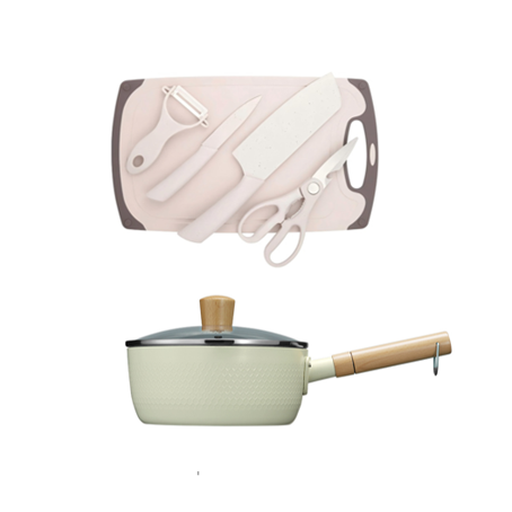
Why we chose it: Ideal for students or young professionals moving into their first place. This kit provides the essentials for preparing simple meals (pasta, sauces, porridge) without having to buy each item separately. It's a cost-effective and functional solution to get started in the kitchen.
It offers a complete, induction-verified solution, preventing the purchase of incompatible or poor-quality items for a first kitchen setup.
All-in-one starter kit (pot, lid, board, knife) with an excellent price-to-quality ratio.
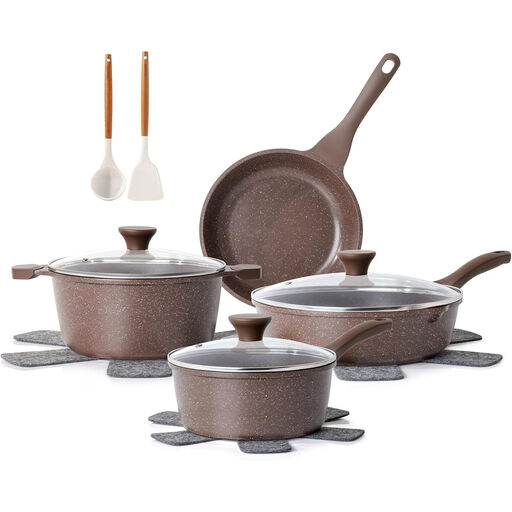
Why we chose it: Perfect for families who cook daily and need a **pot and pan set** in various sizes. The inclusion of utensils and pan protectors makes it a turnkey kit for upgrading your cookware.
The manufacturer clearly states that the coating is free of PFOA, PFOS, lead, and cadmium. This transparency unambiguously checks the "healthy cooking" box.
A very comprehensive 13-piece set offering great versatility for all preparations, from simmering sauces to grilling.
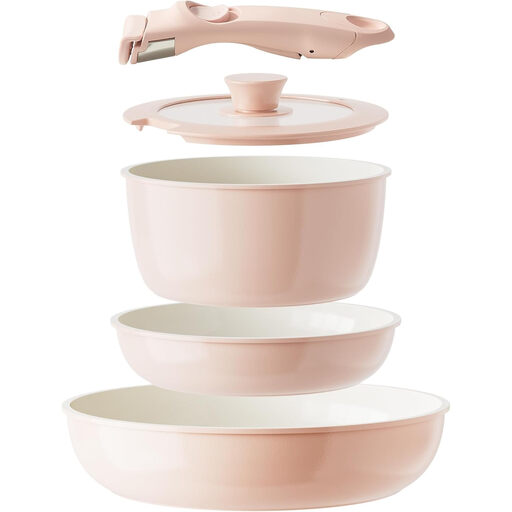
Why we chose it: Designed for those who are short on space or appreciate modularity. The **detachable handle** allows you to stack the pans and pots, move them to the oven, use them for serving at the table, and store them in a flash.
It provides a concrete solution to the storage problem, a major flaw in many cookware sets that is often only discovered after purchase.
Space-saving (up to 75% claimed), stovetop/oven/table versatility, and a PFAS/PTFE-free ceramic coating.
Explore our full selection of products that meet our quality and safety criteria.
The simplest and most reliable trick is the magnet test. Take a magnet (a refrigerator magnet will do) and place it on the bottom of your pot or pan. If it sticks firmly, the utensil contains a ferromagnetic material and will work on an induction cooktop. If the magnet doesn't stick or sticks very weakly, it will not be compatible.
The lifespan varies from 1 to 5 years on average, depending on the quality of the coating and how you care for it. To preserve it, a few simple steps are enough:
Not necessarily. The "stone-effect" or "granite" label is most often an aesthetic argument for a non-stick coating (usually PTFE-based) to which mineral particles have been added to enhance its resistance. The quality will depend more on the manufacturer's technology, the thickness, and the number of layers applied, rather than its simple look. Rely more on the technical specifications (composition, absence of PFOA/PFAS, warranties) than on the marketing claims.