
Livraison le jour même ou le lendemain

Qualité garantie

Débloquez vos offres de bienvenue: Livraison GRATUITE | Jusqu'à -80 % | 30 jours d'essai gratuits à JoyPlus
Téléchargez l'application
Switching to induction cooking promises faster, more precise, and energy-efficient results. But to fully reap these benefits, you need the right tools. Choosing the ideal induction cookware set can often be a headache: between marketing claims and confusing technical jargon, it's easy to end up with pans that perform poorly, wear out in record time, or simply don't suit your cooking style. To help you avoid these disappointments, our editorial team has broken down the topic. Follow our guide to sidestep the traps and make a smart investment.
To ensure you don't regret your purchase, here are the three most common disappointments (and how to avoid them).
To make the right choice, three technical aspects make all the difference in the quality and longevity of your cookware set.
The secret to induction lies in magnetism. For a utensil to work optimally, its base must be perfectly flat and rich in ferromagnetic material.
If you don't want to replace your entire cookware collection, an alternative solution exists: the induction adapter disc. This accessory is placed between the hob and your non-compatible utensil (copper, aluminium, glass, etc.) to transfer the heat.
The material directly influences the cooking performance, weight, and maintenance of your cookware.
A good cookware set should adapt to your lifestyle, not the other way around.
Here are a few products that cater to different user profiles, taking into account the performance and practicality criteria we've just discussed.
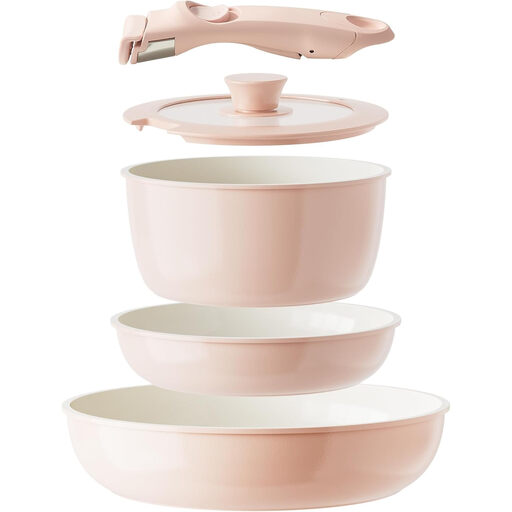
The ideal user: Perfect for small kitchens, studios, or anyone who hates clutter. The detachable handle is the key: the pieces stack perfectly, freeing up to 75% of your cupboard space.
This set tackles the storage problem head-on. Its detachable handle system and stackable design are engineered for a hassle-free daily routine.
Its ceramic coating is guaranteed free of PFAS, PTFE, and PFOA. In terms of versatility, it checks all the boxes: all hobs (including induction), oven (without the handle), refrigerator, and easy cleaning.
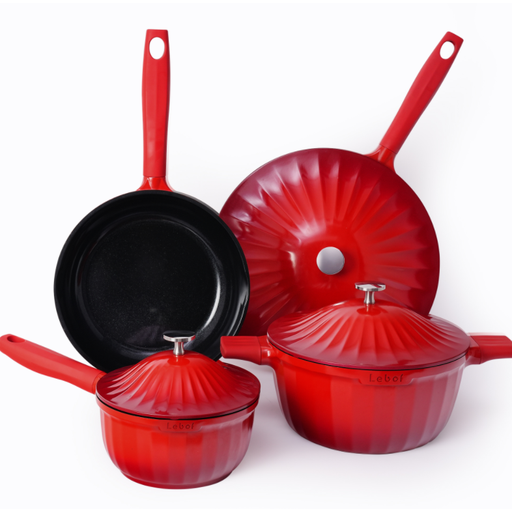
The ideal user: Ideal for families and anyone who puts health at the heart of their concerns. This comprehensive set ensures healthy everyday cooking without compromise.
It sidesteps the trap of coatings with opaque compositions. Its certification as PFAS, PFOA, and PTFE-free provides peace of mind for worry-free cooking.
Its die-cast aluminium structure and titanium-reinforced ceramic coating ensure rapid and even heating. Bonus: the handles stay cool, and the domed lids optimise steam circulation.
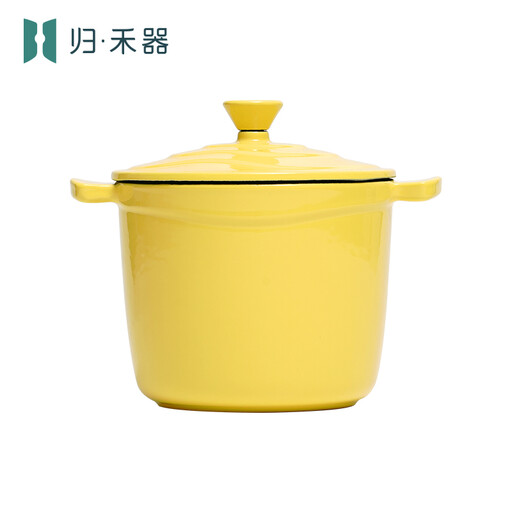
The ideal user: Essential for single-person households, students, or for preparing a sauce, a side dish, or baby food. Its compact size means you don't have to pull out the heavy-duty cookware for small quantities.
This mini casserole is the antithesis of the "do-it-all" set that does nothing well. It brilliantly meets a specific need often overlooked by standard cookware sets.
Its enamelled cast iron design offers exceptional heat retention, ideal for gentle and even cooking. It is naturally compatible with all hobs, including induction.
Discover our full selection of products that meet our criteria for performance, durability, and safety.
The foolproof method is the magnet test. Take a magnet from your fridge and place it on the bottom of your pan or pot. If it sticks firmly, it's compatible! Alternatively, look for the induction symbol (a horizontal coil) engraved on the base of the utensil.
Yes, new-generation ceramic coatings have made huge strides. A quality model, often reinforced with titanium, offers comparable durability and non-stick performance. The secret to its longevity? Avoid metal utensils, abrasive sponges, and thermal shock (like running a hot pan under cold water).
Yes, and it's an excellent idea! Cast iron is a ferrous material, making it naturally compatible. The combination of an enamelled cast iron Dutch oven and an induction hob is perfect: the hob's precision combined with the cast iron's heat retention gives you absolute control over slow-cooked dishes. The only condition is that the base of the Dutch oven must be perfectly flat to ensure optimal contact.