
Livraison le jour même ou le lendemain

Qualité garantie

Débloquez vos offres de bienvenue: Livraison GRATUITE | Jusqu'à -80 % | 30 jours d'essai gratuits à JoyPlus
Téléchargez l'application
Navigating the jungle of cookware can feel like an uphill battle, especially when switching to induction. The gap between tempting marketing promises, actual performance, and safety can be huge. As the Head of Product Selection at Joybuy, my mission is to break down the technical specs to help you identify the criteria that truly make a difference. Follow this guide to avoid common pitfalls and make an informed choice for your kitchen.
Before you even start comparing models, let's review the common disappointments that turn a promising purchase into a costly regret.
To get it right, focus on a few essential technical points. These are the true guarantors of quality and longevity for your healthy cookware.
The secret to induction is magnetism. The base of your cookware must be perfectly flat and made of a ferromagnetic material.
The choice of material directly impacts cooking, maintenance, and the food safety of your meals.
Instead of an endless list, here are our top picks that meet specific needs while avoiding the pitfalls mentioned earlier.
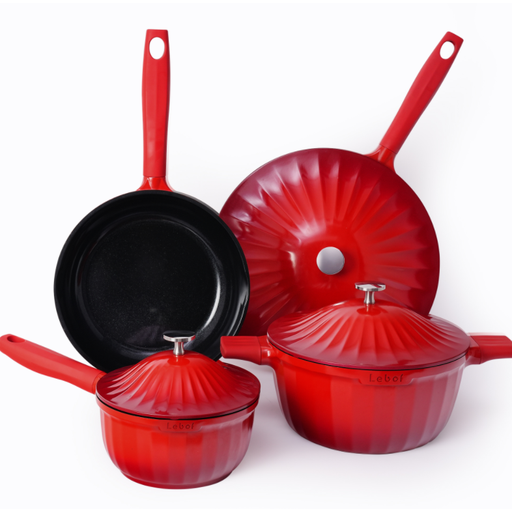
Why we love it: This set is designed for daily family life. It gets straight to the essentials with the most useful sizes (two pans, two pots, one stockpot) to handle everything from a quick pasta dish to a more elaborate meal.
No accumulation of superfluous pieces: every item has a purpose. The ceramic coating is clearly identified as PFAS-free, a crucial safety guarantee today.
Its cast aluminium with titanium construction ensures express-fast heating and even heat distribution. Ideal for mastering cooking on an induction stovetop.
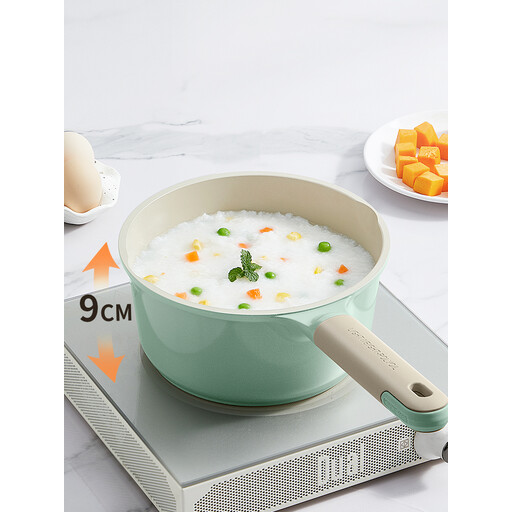
Why we love it: Perfect for small quantities, this saucepan for baby food, sauces, or warm milk is tailored for delicate preparations that demand perfect temperature control and impeccable safety.
It meets a specific need with tailored features. Its coating is guaranteed PFAS-free, a non-negotiable criterion when preparing meals for little ones.
Its small size and pouring spout make it ultra-practical for single servings and cleaning. Versatile, it's compatible with both induction and gas stovetops.
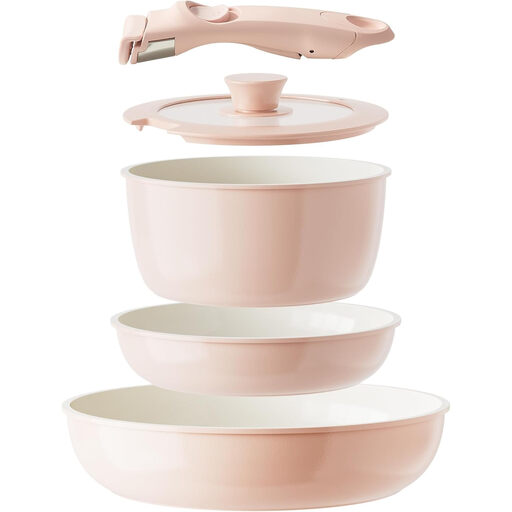
Why we love it: The ideal solution for small kitchens. Thanks to the removable handle, the pans and pot stack perfectly for maximum space-saving in your cabinets.
It checks the box for an ultra-compact set. Its versatility is stunning: the pieces go from the stovetop to the oven, then to the fridge, and even transform into serving dishes for the table.
The removable handle is a game-changer for both use and storage. Its ceramic coating is also guaranteed PTFE/PFOA/PFAS-free, for cooking with peace of mind.
We have curated a complete selection of products that strictly adhere to our selection criteria and current safety standards.
The magnet test is still the simplest and most reliable method. Take a magnet from your fridge and place it on the bottom of your pot or pan. If it sticks firmly, you're good to go! If the attraction is weak or non-existent, the utensil will not work on an induction stovetop.
It all depends on the quality of the coating and how you care for it. To preserve it, follow a few golden rules: use wooden or silicone utensils, avoid thermal shock (never run a hot pan under cold water), and wash it by hand with a soft sponge, even if it's dishwasher-safe. With these precautions, a quality coating can remain effective for several years.
Absolutely. Food-grade stainless steel (18/10 grade) is one of the safest materials available. It is completely inert: it doesn't release any substances, alter the taste of food, or have any coating that could degrade. It is the ultimate choice for durability and healthy cookware.