
Livraison le jour même ou le lendemain

Qualité garantie

Débloquez vos offres de bienvenue: Livraison GRATUITE | Jusqu'à -80 % | 30 jours d'essai gratuits à JoyPlus
Téléchargez l'application
An induction-compatible stainless steel frying pan can be used to sear meat, sauté vegetables, cook eggs or prepare a sauce. However, product descriptions sometimes combine stainless steel, non-stick coating and multi-layer construction, which can create misleading expectations.
Before you buy, there are three common pitfalls to watch out for:
The term 304 stainless steel frying pan refers to a type of steel commonly used for food-contact cookware. It is valued for its resistance to corrosion and, when used on its own, for its uncoated surface. PURECOOK Tri-Ply models combine two layers of stainless steel with an aluminium core to distribute heat more effectively.
316 stainless steel also appears on some frying pans, such as the COOKER KING x B.DUCK models. However, the grade of steel alone is not enough to assess the overall quality. You should also look at the thickness, base construction, handle attachment and the stated compatibility with different types of hob.
A multi-layer construction can be particularly useful for everyday cooking, combining the strength of stainless steel with the conductivity of aluminium. However, an uncoated stainless steel frying pan does not behave like a non-stick frying pan. To reduce sticking, preheat it gradually, add the cooking fat, then add the food once it has reached the right temperature.
Hybrid models, such as the Naturepan, combine a textured surface with coated areas. Its product description mentions a reinforced ceramic coating and compatibility with wooden, silicone or nylon utensils. This design aims to make it easier to release food while retaining good searing performance.
A ceramic frying pan, like a non-stick frying pan, still requires careful temperature control. Avoid leaving it to heat empty for a long time, exposing it to sudden changes in temperature or using abrasive sponges. Even when dishwasher use is permitted, hand-washing with a mild detergent will help preserve the surface for longer.
By contrast, a carbon steel frying pan does not necessarily have an artificial coating. It develops a patina over time, but requires seasoning, thorough drying and a light coating of oil for protection. It is therefore not the right choice for anyone who wants to put their frying pan in the dishwasher after every meal.
A frying pan with a lid is useful for simmering, finishing the cooking process or reducing splashes. The 28 cm Naturepan Deep Sauté Pan comes with a matching lid. The product description states that the lid must be removed before using the pan in the oven, and that the stated maximum temperature for the pan is 230 °C.
Remember to check the diameter of the base as well. For example, the 28 cm Naturepan has a stated base diameter of 19.4 cm, while its deep version has a 17 cm base. This measurement should be compared with the diameter of the cooking zone on your induction hob.
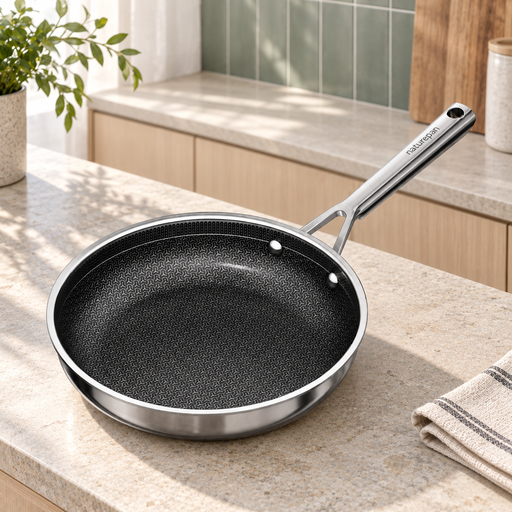
Why it suits this profile: Its 24 cm diameter is ideal for smaller kitchens and everyday cooking for one or two people. It is stated to be compatible with induction, gas, electric and ceramic hobs.
Compatibility with several types of hob is clearly detailed, and the precautions relating to the coating are clearly stated.
Hybrid surface, multi-layer body, 24 cm diameter and stated dishwasher-safe cleaning.
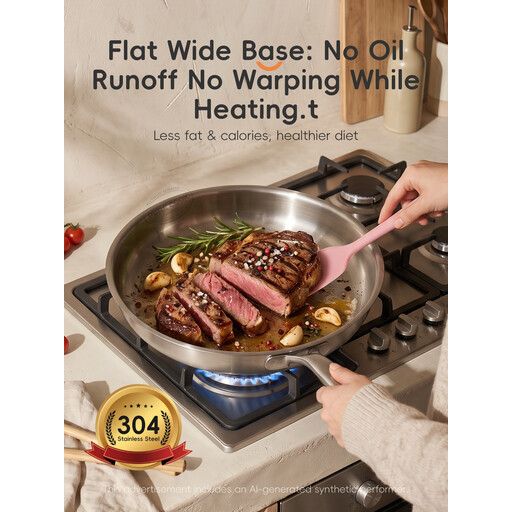
Why it suits this profile: Its three-layer structure, made from 304 stainless steel and aluminium, is designed for users looking for an uncoated frying pan in a family-friendly size.
The product description distinguishes between the material, multi-layer construction and compatible hob types, rather than simply relying on the phrase “suitable for all hobs”.
304 stainless steel, aluminium core, stated induction compatibility and 28 cm diameter.
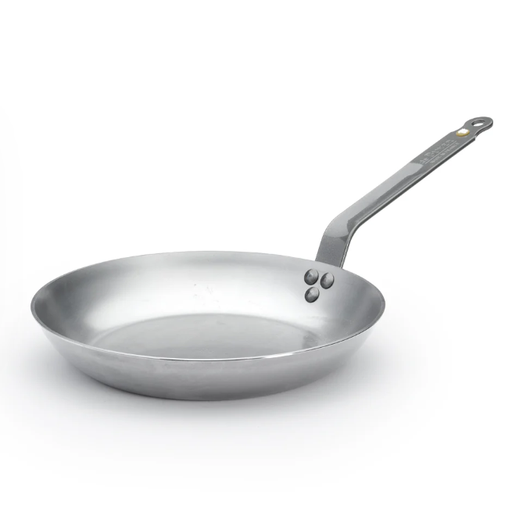
Why it suits this profile: This carbon steel frying pan is suitable for high-heat cooking and for anyone willing to maintain it regularly to build up a natural patina.
The product description specifies that it has no artificial coating, should be hand-washed and needs to be dried and oiled after use.
Steel made from 99 % iron and 1 % carbon, induction-compatible and suitable for high-temperature cooking.
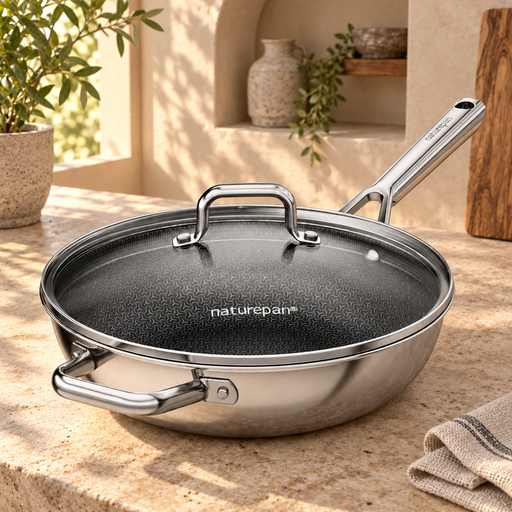
Why it suits this profile: Its 7.8 cm depth and included lid make it easier to prepare casseroles, sauces and generous portions.
The lid and depth are clearly specified, while the limits for oven and microwave use are also stated.
Compatible with induction, gas, electric and ceramic hobs, with a matching lid and oven use up to 230 °C without the lid.
We have put together a complete, real-time updated list of products that meet these strict selection criteria, as well as European safety regulations.
With an induction-compatible stainless steel frying pan, allow the surface to cool before washing it to prevent thermal shock. Use a soft sponge and a neutral detergent. With uncoated stainless steel, slight discolouration or cooking marks may appear without affecting its use. A ceramic coating requires more careful handling.
A few habits can help limit wear:
No. Look for an explicit statement confirming induction compatibility and, if necessary, check that the base is ferromagnetic. The phrase “suitable for all hobs” should be detailed enough to confirm compatibility with induction, gas, electric and ceramic hobs.
The 28 cm size is generally suitable for everyday family meals while remaining easy to handle. A 32 cm frying pan provides more cooking surface for several portions, but requires a large cooking zone and suitable storage space. Also measure the actual diameter of the base, rather than just the stated diameter of the upper rim.
It depends on the material, construction and care. An uncoated stainless steel frying pan cannot lose its non-stick layer, but it does require a different cooking technique. A non-stick or ceramic frying pan makes cooking and cleaning easier, provided you avoid overheating, metal utensils and abrasive products.