
当日/次日达

品质保障

开启新人专享福利: 全场免邮 | 低至 2 折 | 免费试用 30 天 JoyPlus 会员
下载 Joybuy
An induction-compatible non-stick wok lets you stir-fry vegetables, prepare noodles, simmer a sauce or sear meat. However, some models disappoint quickly: the coating becomes damaged, the base heats unevenly or the handle is not oven-safe. To avoid unpleasant surprises, do not rely solely on the phrase ‘suitable for all hobs’. Pay attention to the wok’s construction, its genuinely usable diameter and the care instructions.
A 30 cm wok does not necessarily have a 30 cm base. The stated diameter generally refers to the upper rim, while the surface in contact with the hob may be considerably smaller. On an induction hob, this difference affects the wok’s stability and the distribution of heat.
For a family, a diameter of between 28 and 32 cm generally offers a good balance between capacity and ease of handling. However, make sure that the magnetic base covers enough of your hob’s cooking zone.
A honeycomb or reinforced surface can limit direct contact between utensils and the coating. It does not, however, protect the wok from knocks, knives or abrasive sponges. Even a model described as a scratch-resistant wok should be handled with care.
With a conventional non-stick coating, opt for wooden, silicone or nylon spatulas. In an uncoated stainless steel wok, metal utensils are generally better tolerated, but cooking requires greater precision to prevent food from sticking.
‘Induction-compatible’ does not automatically mean ‘oven-safe’. The handle, lid and silicone or plastic components may limit the maximum temperature. Similarly, a wok advertised as dishwasher-safe may come with a recommendation to wash it by hand to preserve its coating.
Always check the product details: maximum temperature, whether the lid must be removed, recommended utensils and cleaning method.
Multi-layer models combining stainless steel with an aluminium core aim to offer induction compatibility alongside more even heat distribution. For everyday use, this is often an appealing compromise.
A ceramic coating can make cleaning easier and allow you to cook with less oil. However, the claim PFOA-free wok should be checked in the product details: on its own, it is not enough to conclude that the wok offers better performance or any medical benefit.
Honeycomb surfaces, sometimes described as a ‘beehive’ design, can reduce direct contact with the coated section. Their lifespan nevertheless depends on the temperature used, the utensils and the cleaning method. Avoid heating an empty wok for a long time and allow it to cool before running it under water.
A wok with a lid opens up more recipe options: covered cooking, simmering, steaming or retaining moisture. A glass lid lets you monitor your food without lifting it, but beware of thermal shock.
For a student or someone living alone, a compact model may be perfectly adequate. To prepare a vegetable and noodle stir-fry for several people, a 28 to 32 cm bowl will be more comfortable. Also consider the weight once the wok is full: a large model can quickly become difficult to move.
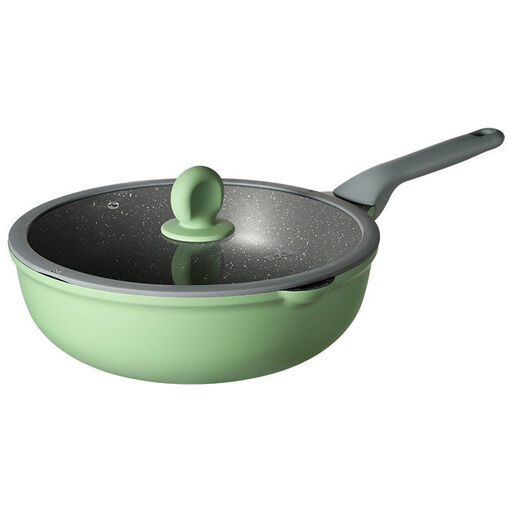
Why this choice suits this profile : its 32 cm format is suitable for family meals, while its aluminium construction makes it compatible with induction, gas, electric and ceramic hobs, according to the product details.
Compatibility with several hob types is clearly stated. However, to preserve the coating, the manufacturer recommends hand washing and using non-metal utensils.
32 cm diameter, maifanite-style coating and stated compatibility with induction, gas, electric and ceramic hobs.
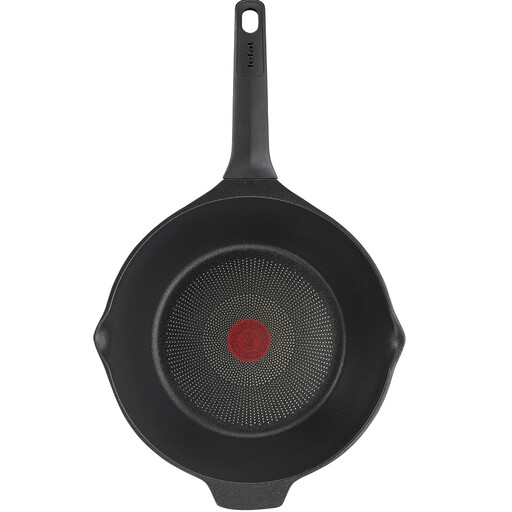
Why this choice suits this profile : this 28 cm wok combines cast aluminium, a temperature indicator and a non-stick coating. Its manageable size is ideal for everyday cooking.
The product details specify compatibility with induction, gas, electric and ceramic hobs, as well as a maximum oven-use limit. Hand washing is still recommended to extend the coating’s lifespan.
28 cm diameter, Thermo-Signal indicator and a coating stated as PFOA-free in the product details.

Why this choice suits this profile : its three-layer construction, 30 cm diameter and glass lid meet the needs of households that regularly prepare stir-fries, covered dishes and slow-cooked meals.
The product details provide compatibility information for induction, gas, electric and ceramic hobs. They also specify that hand washing is recommended: stated durability does not mean that a few precautions can be ignored.
Multi-layer 304 stainless steel, honeycomb ceramic interior, glass lid and 30 cm format.
We have brought together a complete, real-time updated selection of products that meet these demanding criteria and European safety regulations.
To preserve the performance of an induction-compatible kitchen utensil, a few simple habits can make all the difference:
A cast iron wok should be dried immediately and regularly maintained with a thin film of oil. After intense heating, a stainless steel wok may develop white or iridescent marks; these generally disappear with a suitable cleaner or a mildly acidic solution, following the manufacturer’s recommendations.
Not necessarily. Check for a magnetic base and an explicit indication of compatibility with induction, gas, electric and ceramic hobs. For halogen or infrared hobs, ask the manufacturer for confirmation if the product details provide no specific information.
A 28 to 32 cm model is generally suitable for preparing several portions of vegetables, noodles or meat. Also measure the induction zone and consider the wok’s weight once it is full. A larger diameter is only worthwhile if the hob can heat it evenly.
It depends on how often the wok is used, the temperature and the utensils chosen. Excessive heat, abrasive cleaning or repeated knocks will accelerate wear. If the surface starts to flake or shows visible damage, replace the wok in accordance with the manufacturer’s recommendations.