
Livraison le jour même ou le lendemain

Qualité garantie

Débloquez vos offres de bienvenue: Livraison GRATUITE | Jusqu'à -80 % | 30 jours d'essai gratuits à JoyPlus
Téléchargez l'application
Choosing a new frying pan can often be a headache, especially when you're looking for the ideal induction ceramic model: one that's high-performing, durable, and healthy. Faced with a jungle of marketing claims, it's hard to know where to turn. This guide is here to separate fact from fiction and give you all the keys to making an informed decision that suits both your cooking style and your budget.
Before diving into the technical details, let's review the common misconceptions and misleading marketing claims that too often lead to disappointment.
To ensure you choose a pan that will last, three parameters need to be examined closely.
The core of an induction ceramic pan's performance lies in its combination of materials.
A good pan should be able to adapt to all your culinary needs.
The diameter is an obvious criterion, but the shape is just as important.
To illustrate these criteria in practice, here are a few models that meet different needs.
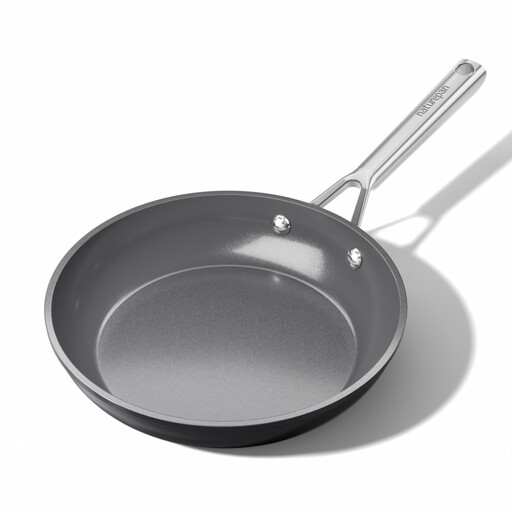
Why it's a great choice: With its 24 cm diameter, this pan is the perfect all-rounder for couples or small families. It's large enough for a complete meal but remains easy to handle and store.
Its coating is explicitly PTFE/PFOA/PFAS-free, going beyond the basic "PFOA-free" claim. The titanium and diamond reinforcement is designed to improve its durability against daily wear and tear.
Versatility: The stainless steel handle allows it to be used in the oven up to 260°C, perfect for browning a dish. It's compatible with all hobs, including induction.
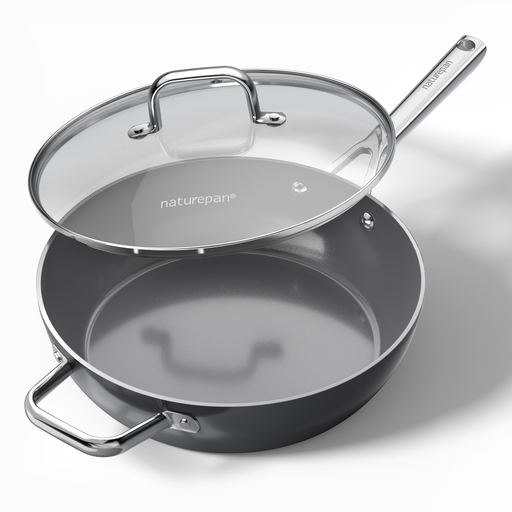
Why it's a great choice: Perfect for families, this 28 cm sauté pan with its high sides and lid allows you to cook slow-cooked dishes, curries, or pasta sauces for 4 to 6 people without any splashing.
More than just a pan, its sauté shape and lid make it a versatile tool that prevents you from having to buy multiple items. Its PFAS-free composition is clearly stated.
Large Capacity and Control: The high sides and lid allow for braising and simmering, locking in moisture and flavours. Being oven-safe up to 260°C offers great flexibility.
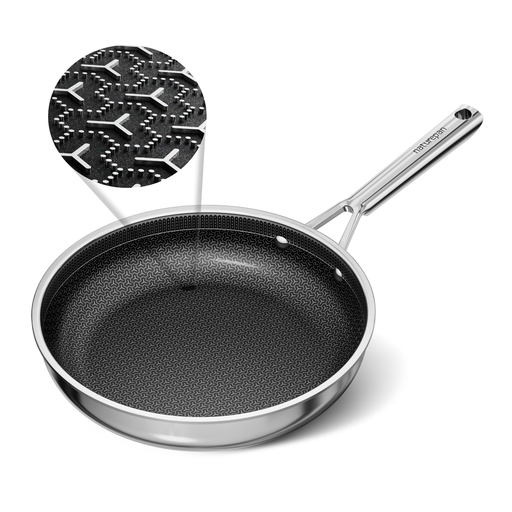
Why it's a great choice: For those who want to sear meat like in a stainless steel pan but with the ease of non-stick. The hybrid technology is designed for high-temperature cooking and caramelisation.
It doesn't promise the absolute glide of a 100% smooth pan, but a smart compromise. It tackles the durability issue of coatings by protecting the ceramic with a raised stainless steel structure.
Hybrid Technology: The hexagonal pattern combines stainless steel peaks for a perfect sear and non-stick ceramic "valleys" to ensure food releases easily. Its 5-ply construction ensures uniform heating.
We have selected a full range of products that meet our criteria for quality, durability, and health safety.
What is the lifespan of a ceramic pan? It all depends on the quality of the coating and how you care for it. A good model, used over moderate heat with wooden or silicone utensils and washed by hand, will retain its non-stick properties for several years. The golden rule: avoid thermal shock (never run a hot pan under cold water)!
How do I care for a ceramic-coated pan to keep it non-stick? Washing by hand with a soft sponge and washing-up liquid is the best solution, even if the pan is listed as dishwasher-safe (as the detergents are often too aggressive). Never use metal utensils or scouring pads. Finally, avoid overheating it when empty.
Is a ceramic pan really healthier? Yes, provided you choose a ceramic coating certified PFAS, PFOA, and PTFE-free. Unlike older coatings, this one won't risk releasing toxic compounds if accidentally overheated. It's also an ally for healthier cooking, as it allows you to use less oil and fat.