
Livraison le jour même ou le lendemain

Qualité garantie

Débloquez vos offres de bienvenue: Livraison GRATUITE | Jusqu'à -80 % | 30 jours d'essai gratuits à JoyPlus
Téléchargez l'application
An induction-compatible ceramic nonstick frying pan can make everyday meals easier, provided you do not rely solely on the words “nonstick” or on a glossy finish. The diameter, base construction and care instructions all have a direct impact on cooking performance and the pan’s lifespan.
Whether you live in an apartment with an induction hob, cook for the whole family or prepare meals with very little oil, here are the key points to check before buying, along with recommended models for different cooking needs.
Most pans described as “ceramic” are actually made with an aluminium or stainless-steel body covered with a ceramic coating. This design keeps the pan lighter and makes it easier to release food, but it is not a pan made entirely from ceramic.
The technical specifications should therefore distinguish between the body material, the coating and the base construction. An induction-compatible aluminium pan, for example, must have a suitable base to work on an induction hob.
A surface reinforced with diamond and titanium particles may be designed to withstand everyday use more effectively. It can still be scratched by metal utensils or overly abrasive cleaning.
To protect the coating, use wooden, silicone or plastic utensils, bring the pan up to temperature gradually and avoid leaving it empty over high heat.
A dishwasher-safe pan is more convenient for everyday use, but repeated high-temperature cycles and detergents can accelerate coating wear. Some models allow dishwasher cleaning while still recommending hand washing.
Also check the maximum oven temperature, whether the lid must be removed and whether using the pan in a microwave is prohibited.
The stated diameter generally refers to the upper rim rather than the surface actually in contact with the hob. The base diameter is therefore essential for induction compatibility and even heat distribution.
A large pan placed on a small cooking zone may heat unevenly. Conversely, using a smaller model on a suitably sized zone provides better temperature control.
An all-hob-compatible frying pan will generally work on induction, gas, electric hobs and ceramic glass surfaces. It is nevertheless essential to check the exact list provided by the manufacturer, particularly for halogen or infrared hobs.
Aluminium conducts heat quickly, but it must be paired with a specific base to work on induction. A hybrid stainless-steel pan may combine several layers of stainless steel with a conductive aluminium core. This construction promotes more even heat distribution while providing a more structured cooking surface.
The models presented here feature a ceramic coating reinforced with diamond and titanium particles. Some product specifications also describe a PFAS-, PTFE- and PFOA-free nonstick frying pan. This information reflects the declared characteristics of the relevant products and does not constitute a medical claim.
To cook with very little oil, add a small amount of fat while the pan is still cold or slightly warm, then use low to medium heat. Excessive temperatures can damage the nonstick surface more quickly, even when it is advertised as reinforced.
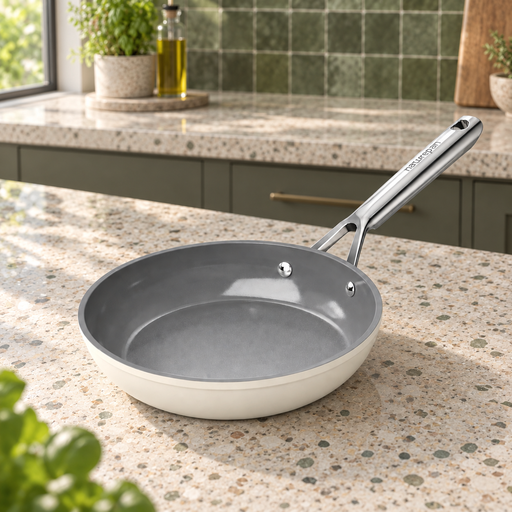
Why it suits this profile: Its compact size is ideal for one person, a student or a couple preparing small portions on an induction hob.
The specifications identify an aluminium body, an induction-compatible base and a ceramic coating reinforced with diamond and titanium particles. The stated base diameter is 15.8 cm.
20 cm format, stainless-steel handle and stated compatibility with induction, gas, electric hobs and ceramic glass surfaces. The specifications state that it can be used in the oven up to 260 °C and is dishwasher-safe.
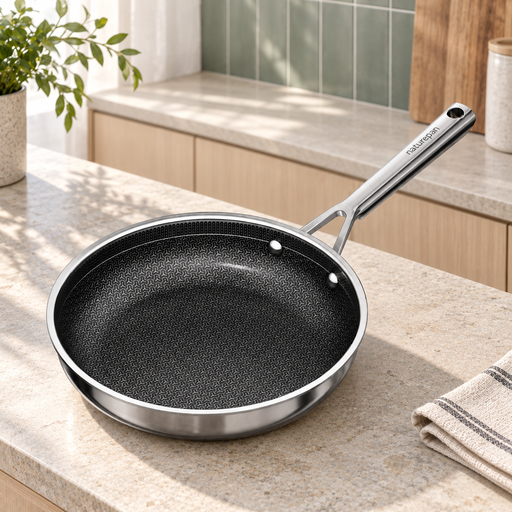
Why it suits this profile: This model is designed for households seeking a multilayer construction and a surface suited to everyday cooking for two or three people.
The engraved hexagonal surface alternates between exposed stainless-steel ridges and coated areas. However, it should not be used with metal utensils.
Multilayer stainless-steel body with a conductive aluminium core, ceramic coating reinforced with diamond and titanium, and stated compatibility with induction, gas, electric hobs and ceramic glass surfaces.
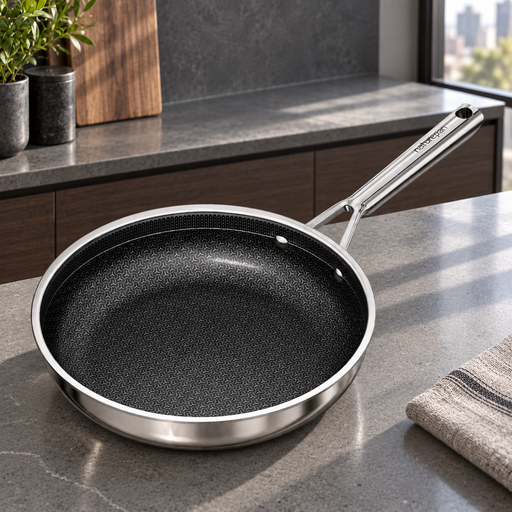
Why it suits this profile: Its 28 cm diameter is ideal for families and cooks who regularly prepare stir-fried vegetables, fish or several portions at once.
The stated base measures 19.4 cm, making it possible to check whether it suits the induction zone. The specifications also state that the lid must be removed before placing the pan in the oven.
28 cm cooking surface, multilayer stainless-steel construction and aluminium core. Compatible with induction, gas, electric hobs and ceramic glass surfaces, with a stated maximum oven temperature of 230 °C.
Explore an up-to-date selection of frying pans that meet these composition, compatibility and care criteria.
A frying pan’s lifespan depends on its coating, but also on how it is heated and cleaned. To minimise wear:
The 24 and 28 cm hybrid models are advertised as dishwasher-safe, but hand washing is recommended to preserve their surface. According to its specifications, the 24 cm grey aluminium version is fully dishwasher-safe and can be used in the oven up to 260 °C. Always check the instructions specific to the model you choose.
Yes, provided it is advertised as compatible with multiple heat sources. The models presented here are stated to work on induction, gas, electric hobs and ceramic glass surfaces. For a halogen or infrared hob, check compatibility with the manufacturer.
A 24 cm ceramic frying pan will generally suit portions for two to three people. The 20 cm model is better suited to smaller quantities, while the 28 cm format provides more room for family-sized meals.
The nonstick coating makes it easier to release food and is suitable for low-oil cooking, particularly for eggs, fish and vegetables. However, the amount required depends on the recipe, temperature and condition of the coating. It is better to follow the usage instructions than to eliminate fat altogether.