
Same-day & Next-day Delivery

Quality Guaranteed

Unlock Your Welcome Offers: FREE Delivery | Up to 80% OFF | Free 30-day JoyPlus trial
Download the APP
An induction-compatible 304 stainless steel frying pan can last for many years, provided you check its construction, cooking surface and intended use. Between promises of « non-stick cooking », coatings presented as universal and sometimes vague information about dishwasher use, it is easy to choose cookware that is poorly suited to your hob or cooking habits.
Here are the criteria to consider before buying a stainless steel frying pan, a stainless steel wok or a cookware set for a kitchen equipped with a gas, electric or induction hob.
304 stainless steel is a grade of stainless steel used in many kitchen utensils. It is a material, not a promise of non-stick cooking. An uncoated stainless steel frying pan can cause food to stick if it is not hot enough, if it is overheated or if the oil is added at the wrong time.
Preheating the pan and then adding a little fat will generally help reduce sticking. However, this technique takes a little practice. For cooking eggs, fish or other delicate foods, an stainless steel non-stick frying pan or a model with a ceramic surface will often be easier to use.
The all-hob frying pan label is worth checking in the technical specifications. To work on induction, the base must contain a suitable ferromagnetic section. A frying pan compatible with gas and induction will not necessarily deliver the same results on a ceramic or halogen hob.
Before ordering, check compatibility with induction hobs, the actual base diameter and any restrictions relating to oven or halogen-hob use.
A ceramic non-stick frying pan makes it easier to release food and clean the pan, but it still requires some care. Thermal shock, prolonged heating when empty and the use of metal utensils can speed up surface wear.
The « dishwasher-safe » label does not mean that every cycle will perfectly preserve the appearance of the coating. When durability is the priority, hand-washing with a soft sponge is often the best option.
When choosing an induction-compatible 304 stainless steel frying pan, prioritise models whose construction is clearly described: an encapsulated base, triple-layer construction or multi-layer design. In a three-layer frying pan, aluminium is sandwiched between layers of stainless steel to distribute heat more evenly. This does not remove the need to adjust the power, but it can help limit hot spots.
The « 304 » designation should also specify which part it refers to: the interior, the base or the entire construction. On coated models, make sure you distinguish between the stainless steel and the ceramic or non-stick coating.
A deep frying pan with a lid is better suited to slow-cooked dishes, sauces and recipes that produce fewer splashes. Remember to measure the handle length and the space available in your cupboards too.
The « dishwasher-safe » and « oven-compatible » claims vary from one model to another. The lid, removable handle and silicone or Bakelite components may have different temperature limits from those of the pan body.
For example, some Naturepan models are advertised as oven-compatible up to 230 °C without the lid, while the MAXCOOK 16 cm model recommends hand-washing. These practical details matter just as much as the material when the utensil is used several times a week.
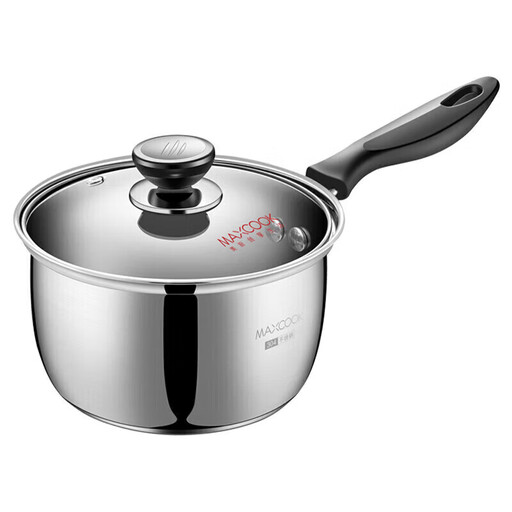
Why this choice suits this type of cook : its compact size is ideal for individual portions, sauces, milk and pasta, without requiring you to buy a large cookware set.
The product details state that it is compatible with induction, gas, electric and ceramic hobs. They also specify that hand-washing is recommended, so there is no need to assume that it is dishwasher-safe.
304 stainless steel, a composite base for more even heat distribution and an included glass lid.
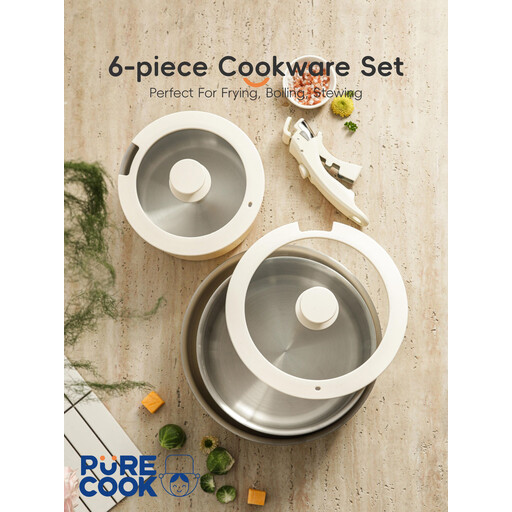
Why this choice suits this type of cook : this set includes an 18 cm milk pan, a 22 cm stockpot and a 26 cm frying pan to cover most kitchen tasks.
The product details specify the materials, ceramic exterior coating, glass lids and compatibility with all hob types. They also state that the product is free from PTFE and PFOA.
Triple-layer construction, removable handle, glass lid with silicone seal and care instructions stating that it is dishwasher-safe.
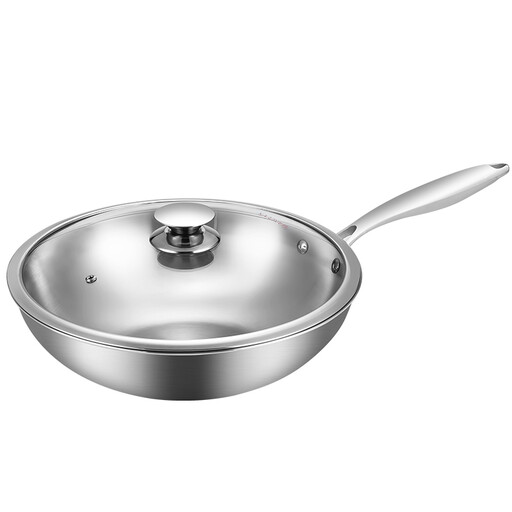
Why this choice suits this type of cook : its 28 cm diameter is ideal for stir-fries, vegetables, noodles and family meals prepared on gas or induction.
It does not present itself as a non-stick surface: the product details specify that it is uncoated and recommend preheating the pan, adding oil and cooking over a medium or low heat.
Composite base, compatibility with induction, gas, electric and ceramic hobs, plus stated dishwasher-safe cleaning.
Check the product details and look specifically for the word « induction ». A 304 stainless steel body alone is not always enough: the base must be designed to interact with the hob’s magnetic field.
It depends on the model. Some woks and frying pans are advertised as dishwasher-safe, while others require hand-washing. To protect a ceramic coating or reduce marks on stainless steel, use a soft sponge and mild detergent, then dry the utensil after washing.
Preheat the pan gradually, add a small amount of fat, then reduce the heat if necessary. Avoid turning or moving the food too soon. An uncoated stainless steel frying pan requires more control than a non-stick model, but it is perfectly suitable for searing, vegetables and everyday cooking when properly maintained.