Who is an indoor air monitor for?

To help you decide when to ventilate

In a bedroom or a room where you spend a lot of time, a clear CO₂ reading and the way it changes are more useful for this purpose than a single overall indicator. However, as Anses points out, CO₂ readings don’t tell you about every indoor pollutant.

To check the air after everyday activities

After cooking, cleaning or vacuuming, choose the measurements that match what you want to monitor, particularly particles if those are your main concern. ADEME also recommends ventilating after cleaning and vacuuming. A monitor can help you compare different situations, but it doesn’t replace this simple step.

To keep an eye on recurring humidity

Humidity and temperature readings can help you see whether a rise after a shower is temporary or keeps happening. If marks appear on the walls, France Rénov’ recommends looking for the source; a monitor can’t identify it on its own.

What should you check before choosing?

Start with the issue you want to monitor. Then check that the device displays the relevant measurement and lets you track changes over time. If readings change after an activity, first look at the source and check your ventilation before choosing an air treatment appliance.

What you want to monitor What to check Who is it for?
Air circulation Clear CO₂ measurement; display of changes or a reading history. If I spend a long time in an occupied room, I want to know when to check the ventilation rather than assume an air purifier will solve the problem. Around 27% of consumers would prioritise this.
Particles after an activity PM2.5 measurement clearly specified; the ability to compare readings before and after the activity. After cooking or vacuuming, I want to know whether the monitor tracks the particles I’m interested in, rather than trying to infer them from an overall rating. This would be the priority for around 33% of consumers.
Persistent humidity Display of relative humidity and temperature; ability to track changes over time. If condensation returns beyond the occasional shower, I want to monitor how long it lasts before considering a dehumidifier. Nearly 27% of consumers would put this need first.
Remote or long-term monitoring Reading history, alerts and features available without an app; connection requirements. When comparing several rooms or recurring episodes, I want to be able to look up readings without having to stay by the screen. Around 13% of consumers would prioritise this type of monitoring.

Mistakes to avoid

  • Relying on the air quality indicator alone

    According to Anses, colour codes can be based on different criteria, and many micro-sensors measure just one pollutant. An indicator alone therefore can’t tell you whether CO₂, particles and VOCs are all being monitored.

    Check the exact list of measurements and choose the ones that answer your question.

  • Buying an air treatment appliance after a single spike

    A temporary rise after cleaning, cooking or a shower doesn’t, on its own, reveal the cause of an ongoing problem. ADEME recommends ventilating after several of these activities. According to France Rénov’, marks caused by damp on the walls call for you to find their source.

    Compare readings before and after ventilating, and see whether the issue keeps recurring before considering an air purifier or dehumidifier.

  • Overlooking the requirements for connected features

    Displaying readings on the device and checking them on a smartphone may require different equipment.

    For the IKEA ALPSTUGA, check the power requirements. If you want to use Matter over Thread, you’ll also need a compatible Thread border router.

    For this model, the USB-C cable and charger are sold separately. Access from a smartphone via Matter over Thread may also require a compatible hub.

  • Using a monitor in humidity levels it isn’t designed for

    Airthings’ instructions state that the View Plus and View Radon should be kept below 85% relative humidity to avoid damaging their sensors.

    Before installing a monitor in a bathroom, check the operating conditions for your chosen model and keep it away from water splashes.

Brands to consider for different measurements

Airthings

According to Airthings, the View Plus measures several parameters, including CO₂, PM2.5, VOCs, humidity and temperature, so you can monitor them all with one device.

  • Airthings’ documentation details the stated specifications for certain measurements, including CO₂, as well as the display and connected monitoring features.
  • According to Airthings, CO₂ and VOC readings during the first seven days of calibration shouldn’t be considered reliable. The View Plus must be kept below 85% relative humidity.

IKEA

According to IKEA’s product details, the ALPSTUGA displays CO₂, PM2.5, temperature and humidity. It’s worth considering if you want to monitor both room occupancy and particles.

  • The screen displays readings on the device, and the model also offers Matter connectivity.
  • The USB-C cable and charger are sold separately. Checking readings on a smartphone via Matter over Thread requires a compatible Thread border router.

Netatmo

The Smart Indoor Air Quality Monitor is designed to track CO₂, humidity, temperature and noise levels, with alerts and a history in the app.

  • These features may suit you if you’re mainly interested in how CO₂ and humidity levels change in a room.
  • To monitor particles or VOCs, check that another device explicitly measures these parameters: they aren’t listed in the French product details for this model.

Beurer

Beurer air purifiers and dehumidifiers are treatment options to consider once you’ve identified the problem, rather than a starting point when choosing a monitor.

  • For some models, Beurer’s product details give appliance-specific criteria to compare, including the clean air delivery rate (CADR) and the stated coverage area for the LR 400 air purifier.
  • These specifications don’t prove that an appliance is needed, nor do they remove the need to investigate any cause related to the building or ventilation.

Joybuy products for monitoring humidity

The product below lets you monitor the temperature and humidity in a room before considering a dehumidifier. If you want to monitor CO₂, particles or VOCs, choose a device that clearly specifies the measurement you need.
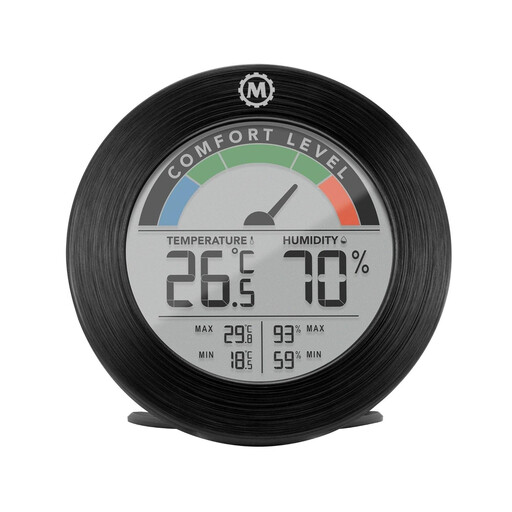
Marathon Austin wireless indoor thermometer and hygrometer

Marathon Austin wireless indoor thermometer and hygrometer

Monitor changes in a room’s humidity before deciding whether a dehumidifier is worth considering.

Measures indoor temperature and humidity, with a comfort indicator and daily minimum and maximum readings.

If you want to monitor CO₂, PM2.5 or VOCs, check that your chosen model explicitly measures them. To interpret precise differences, also check the stated units and accuracy.

View on Joybuy

Frequently asked questions

Which monitor should I choose to know when to ventilate?

Choose a monitor that explicitly measures CO₂ and lets you track changes, either on its screen or in a reading history. CO₂ readings can help you assess air circulation in an occupied room, but they don’t tell you about every pollutant in the room.

Is an air quality rating enough to choose an air purifier?

No. First identify the pollutant you want to monitor, then check the measurements the monitor takes and the filtration specifications of the air purifier you’re considering. Anses points out that colour codes can be based on different criteria and that many micro-sensors measure just one pollutant.

When should I compare readings at home?

Compare readings before and after ventilating, then see what happens after the activity you’re concerned about. ADEME recommends ventilating after cleaning and vacuuming, as well as after a shower or cooking activity that produces steam.

Does high humidity mean I need a dehumidifier?

Not on its own. Check whether the increase is temporary or persistent, and look at your ventilation and possible sources of humidity. If marks appear on the walls, France Rénov’ recommends identifying their source before relying on a household appliance.

Can a micro-sensor replace a reference measurement?

No. ADEME explains that a micro-sensor can’t be as reliable as an instrument that meets strict metrology requirements. Use it to cautiously monitor trends at home, but don’t use it to diagnose the building or draw medical conclusions.