What should you look for first?
Start by deciding where your laundry will dry and how much space you have for the appliance. Then compare capacities, spin performance and the details of the specific model.
Front-loading washing machine
Consider one if: you have enough width and clearance to open the door.
The trade-off: a large capacity is only useful if it suits your usual loads; check the overall depth too.
Top-loading washing machine
Consider one if: space is limited or you prefer to load your laundry from the top.
The trade-off: UFC-Que Choisir says top-loaders have a maximum capacity of 8 kg. Check the capacity of each model rather than assuming it based on its design.
Washer-dryer
Consider one if: you want to dry laundry in the appliance without installing a separate tumble dryer.
The trade-off: washing and drying capacities can differ. Bosch lists a 9 kg washing capacity but a 5 kg drying capacity for the WNA144V0FR.
Separate washing machine and tumble dryer
Consider them if: you dry laundry frequently and have space for a second appliance.
The trade-off: allow space for both appliances and compare the energy use, capacity, noise and cycle duration of the tumble dryer you’re considering.
| What to consider |
What to check |
What I need |
| Spin performance and drying |
Compare the spin efficiency rating on the label, then check the noise level during spinning and the settings available for your fabrics. ADEME recommends choosing an A rating for quick drying. |
I dry my laundry indoors, so I want to reduce the moisture left in the fabrics without assuming that a good spin can replace a well-ventilated room. |
| Capacity |
Compare the stated capacity in kilograms with your usual loads. Also check the load limits for the programmes you’ll use and the duration of the Eco 40-60 cycle. |
Between everyday washing and bedding, I need a drum that suits my needs without making me run extra cycles or choosing a capacity I rarely use. |
| Size |
Check the model’s width, depth and height, as well as the clearance needed to open it. Make sure you can access the appliance once it’s installed. |
If space is limited, I need to be able to install, open and load the machine without compromising on capacity more than I need to. |
| Drying cycle |
For a washer-dryer, compare the washing and wash-and-dry capacities separately. Check the energy information for the combined cycle, not just for washing. |
I’d like to dry some loads in the appliance, so I need to know whether I’ll have to split a load after washing and before drying. |
| Durability and use |
Compare the energy label, water use per cycle and durability index for the models you’re considering. According to ADEME, the index takes repairability and reliability into account; it doesn’t predict the lifespan of an individual appliance. |
I’d rather compare information about the specific models than choose based on a single energy rating or a promise of long life. |
What can you learn from the brands?
These examples show how specific models can differ; they don’t represent each brand’s entire range.
Bosch
Bosch’s French product pages distinguish between the 9 kg, 1,400 rpm front-loader WGB244A2FR and the WNA144V0FR washer-dryer, listed with a 9 kg washing capacity and a 5 kg drying capacity.
- The published capacities make it easier to compare washing-only models with washer-dryers.
- With the WNA144V0FR, a 9 kg washing load doesn’t mean it can dry 9 kg of laundry.
Electrolux
The French product page for the Electrolux EW8T3653BA lists it as a 6 kg top-loader measuring 400 mm wide.
- This model gives you a specific point of comparison for a narrow space.
- Check the dimensions and capacity of the model you’re considering: the EW8T3653BA’s specifications don’t apply to every Electrolux top-loader.
LG
LG France’s product page for the front-loading F94V41WH lists a 9 kg capacity and dimensions of 600 × 850 × 565 mm.
- The published capacity and dimensions let you compare this model with your planned loads and available space.
- These specifications don’t tell you about the performance or durability of every LG washing machine.
Washing machines available on Joybuy
This selection includes front-loading washing machines and a top-loading model. For each one, compare the capacity with your usual loads, and check the spin rating and dimensions before you choose.
 Image unavailable
Bosch WGE02407FR, 7 kg front-loader, 1,400 rpm
Compare its 7 kg capacity with your usual loads if you dry your laundry at home afterwards. This model’s B spin efficiency rating is worth comparing with the A rating ADEME recommends for quick drying. Also check the overall depth needed for installation.
View on Joybuy
 Image unavailable
Hisense WF5I8043BWF, 8 kg front-loader, 1,400 rpm
The stated 8 kg capacity could suit a household whose usual laundry loads call for that size. If you dry laundry indoors, compare its B spin efficiency rating with those of other models and measure the full space before choosing this front-loader.
View on Joybuy
 Image unavailable
Haier T Series 7 THASN276TM6-S, 7 kg top-loader, 1,200 rpm
Top-loading may suit your preferred way of loading the machine or a narrow space, as long as you check the available space and clearance to open the lid. If you’re installing it near a living area, bear in mind its stated spin noise level of 77 dB and noise rating C. Its spin efficiency rating is B.
View on Joybuy
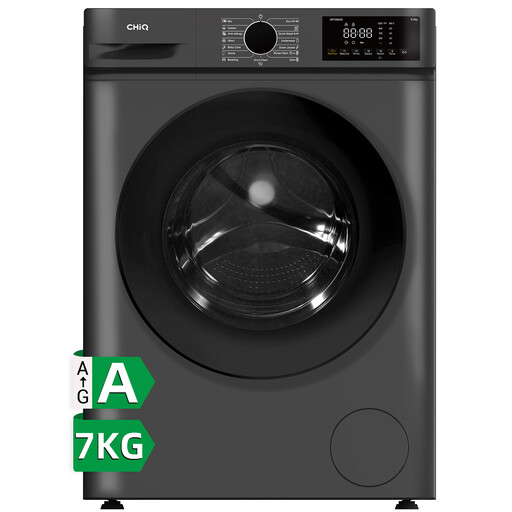 Image unavailable
CHiQ JW75883G, 7 kg front-loader, 1,200 rpm, dark grey
This front-loader has 16 programmes, including options for wool and duvets. Check the manual for the load limits of the programmes you’ll use. If you dry laundry indoors, check the spin efficiency rating and noise information on the label for the exact model before comparing machines.
View on Joybuy
 Image unavailable
Electrolux EW7FI259160V, 9 kg front-loader, 1,600 rpm
Compare the 9 kg capacity with your actual loads, particularly if you often wash bulky items. Maximum spin speed alone doesn’t tell you how effectively a machine spins: compare the relevant rating on the label and check that the stated depth of 66 cm will fit in your space.
View on Joybuy
Frequently asked questions
Does a fast spin help when you dry laundry indoors?
Yes, but spin speed in revolutions per minute shouldn’t be your only consideration. ADEME recommends choosing an A spin efficiency rating for quick drying. Also compare the appliance’s noise level and the settings available for your fabrics.
Which room should you use to dry laundry indoors?
If you need to dry laundry indoors, ADEME recommends using a large, well-ventilated room or one with an extractor fan. A washing machine’s spin cycle doesn’t replace this precaution: air-drying laundry adds moisture to the air indoors.
Can a washer-dryer dry a full washing load?
Not always: check the two capacities separately. Bosch lists a washing capacity of up to 9 kg for the WNA144V0FR, but a drying capacity of 5 kg. So a larger washing load will need to be split before drying, or some of it will need to be dried on a clothes airer.
What does a washing machine’s durability index mean?
According to ADEME, the durability index has been displayed on washing machines sold in France since April 2025. It combines repairability and reliability criteria to help you compare the models it applies to, but it doesn’t guarantee that an individual appliance won’t break down.
How should you compare a separate tumble dryer?
If you have room for one, compare the energy label, stated energy use per cycle, capacity, noise level and the duration of the eco programme for the models you’re considering. This will help you assess a separate tumble dryer for frequent use without assuming it’s right for every home.


