What sets the appliances apart?
First, decide whether you have room for a separate tumble dryer or need a combined appliance. Then compare the practical considerations that will have the biggest impact on everyday use.
| What to consider |
What to check |
Who is this important for? |
| Energy use and cycle time |
Check the model’s energy label for weighted energy consumption and the duration of the eco programme, taking its capacity into account. |
If I dry laundry often, I want to know both the energy use shown and how long a load takes. Around 33% of consumers rank energy use and cycle time as their top priorities. |
| Available space |
Measure the height, width and depth, as well as the space needed to open the door. For a washer-dryer, check the washing and drying capacities separately. |
With room for just one appliance, I need to know whether a washer-dryer can dry my loads without splitting them. Space is the main concern for around 27% of consumers. |
| Noise |
Check the noise level and its class on the model’s energy label, then read the manufacturer’s installation instructions. |
If it’s near a living area, I want to know how noisy it is before deciding where to put it. Quiet operation is the main priority for around 20% of consumers. |
| Water and maintenance |
Check the condensation tank, whether direct drainage is possible and what cleaning tasks are set out in the manual. |
If it’s not easy to connect a drain, I want to know how often to empty the tank and clean the filters. Water management and maintenance are top priorities for around 20% of consumers. |
Brands to consider
These examples can help you identify features to compare. Always check whether they’re included on the specific model you’re considering.
Bosch
Bosch’s product information for the WQG2450SFR heat pump tumble dryer lists a capacity of 9 kg, a water drain hose and a stated noise level of 64 dB(A).
- For this model, the brand also lists a self-cleaning condenser, which may be worth considering if you want to reduce manual cleaning.
- Check the connection options and which maintenance tasks are still required; these features aren’t available on every Bosch model.
Electrolux
For its EDHF2804DC heat pump model, Electrolux lists an 8 kg capacity, an energy rating of E, a noise level of 66 dB and a 5.32 L water tank.
- Its product information describes an EasyClean filter and gives you a clear idea of how the water tank is managed.
- A direct drainage kit is available as an optional extra. If you want to use one, check that it’s compatible and confirm the installation requirements.
Miele
Miele’s product information for the TEA525WP 8kg Active heat pump tumble dryer mentions a condensed water tank and an integrated drainage kit.
- The tank and filter indicators on this model can help you keep track of maintenance tasks.
- Compare its energy label details and manual with those of other models; the features of this one don’t apply across the whole range.
Appliances to compare on Joybuy
This selection includes heat pump tumble dryers for a dedicated space and washer-dryers for when washing and drying need to share one space. Compare the exact model and its installation requirements before you choose.
 Image unavailable
Hotpoint CHD84MWBSEE, 8 kg heat pump tumble dryer
Worth considering if you have space for a separate tumble dryer and want to dry loads of up to the stated 8 kg capacity. The title lists an energy rating of C. Check the model’s documentation for its dimensions, water management and installation requirements.
View on Joybuy
 Image unavailable
Comfee CD08EHP05W-HR, 8 kg heat pump tumble dryer
This separate appliance is worth considering if you’re looking for a dedicated dryer with a stated capacity of 8 kg. The title lists an energy rating of D; compare the energy use, eco cycle time, noise, dimensions and water management on the model’s energy label and in its manual. Claims about UV light are not proof of health benefits.
View on Joybuy
 Image unavailable
Samsung WD11DG6B85BEU3, 11 kg / 6 kg washer-dryer
If you want washing and drying in one appliance, this model lists a washing capacity of 11 kg and a drying capacity of 6 kg. You’ll need to reduce a full wash load before drying it. The A rating in the title applies to washing only; check the label for the wash-and-dry cycle separately and make sure you have the necessary connections.
View on Joybuy
 Image unavailable
Samsung WD10HG6U34BEU3, 10 kg / 6 kg washer-dryer
Another combined option for a single space, with a stated washing capacity of 10 kg and drying capacity of 6 kg. Check that the drying capacity suits your loads, then consult the model’s energy label for energy use and cycle time when washing and drying. The appliance needs a suitable water inlet and drain.
View on Joybuy
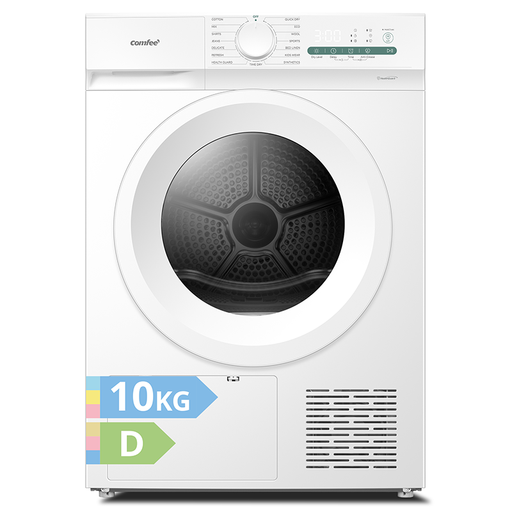 Image unavailable
Comfee CD10EHP05W-HR, heat pump tumble dryer
This model is designed for a dedicated tumble dryer space, but check its capacity before deciding whether it suits your loads: the title lists 10 kg, while the description says 8 kg. Also check the dimensions, noise, water management and energy label details for this model.
View on Joybuy
Frequently asked questions
Can a new ‘condenser’ tumble dryer be made without a heat pump?
The European Commission states that heat pump technology is required for household tumble dryers placed on the EU market from 1 July 2025. The word ‘condenser’ on its own doesn’t identify the technology, so check the model and its product information. This rule doesn’t automatically apply to washer-dryers.
What should I compare on a tumble dryer’s energy label?
For each model, compare the energy rating from A to G, weighted energy consumption, capacity, eco programme duration, noise and condensation efficiency. The European EPREL database lets you look up details of registered models.
Does a tumble dryer need to be connected to a drain?
Not necessarily. Depending on the model, condensed water is collected in a tank or can be sent to a drain. Check the manual to see whether a suitable hose is supplied, available separately or intended for the model, then make sure you can access the connection.
Can a tumble dryer replace ventilation in your home?
No. ADEME recommends removing moisture generated indoors to help reduce the risk of mould. Condensation efficiency can help you compare appliances, but it doesn’t remove the need for suitable ventilation.
What should I check for maintenance and repairs?
Check the manual for details of filter cleaning, whether the tank needs emptying and the model’s installation requirements. Also check the manufacturer’s information on spare parts and repairs. European ecodesign requirements provide for repair and maintenance information, but don’t set the terms for every individual repair.


