If you have a suitably large, well-ventilated room for an airer, start by matching your washing machine’s capacity to your loads and choosing a good spin speed. ADEME highlights the benefits of effective spinning for indoor drying, while also pointing out the moisture released by laundry drying naturally. If you do laundry frequently, a separate tumble dryer is an option if you have room for a second appliance. If there’s space for only one machine, a washer-dryer saves you from having to fit two appliances, but its drying capacity is lower than its washing capacity, as UFC-Que Choisir points out.
Who are these solutions for?
Your choice depends mainly on how much room you have to dry laundry or install an appliance, as well as how much laundry you need to dry regularly.
Households that dry laundry indoors
Without a balcony or a dedicated drying room, you’ll need to find space for an airer and consider the moisture it creates. ADEME’s Q-WASH study recommends a large, well-ventilated room or one with an extraction system.
Small homes without room for two appliances
A washer-dryer can free up floor space. Before choosing one, measure the space and access to the machine, then compare its drying capacity with the size of your usual loads.
Households with frequent or large loads of laundry
If you regularly need to dry several loads, check whether you can install a separate tumble dryer and whether its capacity matches your washing machine’s loads. UFC-Que Choisir points out that a washer-dryer dries less laundry than it can wash.
What should you check before choosing?
Start with the amount of laundry you have and the space available, then compare the drying conditions and appliance specifications.
Washing machine and airer
Worth considering: if your loads fit on the airer and you have a suitable room where the laundry can dry.
The trade-off: an airer takes up space, and laundry drying naturally releases moisture indoors, according to ADEME’s Q-WASH study.
Separate tumble dryer
Worth considering: if you have frequent loads and can install a second appliance, either alongside your washing machine or in a suitable stacked configuration.
The trade-off: you’ll need to allow for its location and power supply, as well as access to the water tank or a drain, depending on the model.
Washer-dryer
Worth considering: if there’s room for only one machine in your home and your loads fit within its stated drying capacity.
The trade-off: drying capacity is lower than washing capacity, as UFC-Que Choisir points out. So you may not be able to dry a full wash load in one go.
| Factor | What to check | What you need |
|---|
| Capacity and spin performance |
Compare the washing capacity with the size of your usual loads. For indoor or machine drying, check the spin-drying efficiency class: ADEME recommends choosing class A. |
I want to wash my usual loads without running extra cycles, then remove as much water as possible before drying. |
| Indoor drying |
Allow for the space taken up by an airer, and choose a large, well-ventilated room or one with an extraction system. ADEME’s Q-WASH study highlights the moisture released by laundry drying naturally. |
An airer will work for me if I can leave it up in a suitable room while the laundry dries. |
| Installation |
Measure the space, depth and clearance for the door. The European Commission states that vented tumble dryers need an outlet to the outside, unlike condenser models. |
I need to work out whether my home can accommodate two appliances, a suitable stacked setup or just a combined machine. |
| Drying capacity |
For a washer-dryer, check the washing and drying capacities separately. For a separate tumble dryer, compare its capacity with the loads you want to transfer to it. |
If I often wash a full load, I want to know whether it can also be dried without splitting it up. |
| Energy use and cycle time |
Compare the figures on the label for the type of appliance you’re considering. For washer-dryers, the European Commission lists washing data separately from wash-and-dry cycle data; EPREL lets you look up a model’s specifications. |
I’d rather compare water and electricity use and cycle times than assume a two-in-one appliance will automatically suit my needs better. |
What pitfalls should you avoid?
-
Looking only at a washer-dryer’s washing capacity
Its drying capacity is lower than its washing capacity, according to UFC-Que Choisir. So you may need to remove some of a washed load or dry it in several batches.
Choose based on how much laundry you want to dry in one cycle, and check both capacities for the model.
-
Making room for a tumble dryer but not its vent
The European Commission states that vented tumble dryers need an air outlet to the outside. A power socket and floor space aren’t enough to confirm that you can install one.
Check the exact type of appliance. A condenser model doesn’t need an air outlet, but check the manual for how water is collected or drained.
-
Putting an airer in just any room
ADEME’s Q-WASH study identifies laundry drying naturally as a significant source of indoor moisture.
Choose a large, well-ventilated room or one with an extraction system. If you don’t have a suitable space for your regular loads, consider another way to dry them.
-
Comparing appliances using an old energy rating
Energy label data depends on the type of appliance and the cycle being assessed. The European Commission states that tumble dryers have used an A to G scale since 1 July 2025, so an old A+++ rating can’t be compared directly with a class on this scale.
Check the label for the model you’re considering and compare energy use, cycle time and capacity on a like-for-like basis. EPREL product sheets can help you check the details.
A guide to the brands
There are no brand guides to display in this section.
Options for drying laundry
These two options suit different needs: a separate tumble dryer for machine drying, or an airer for drying laundry naturally in a suitable room.
 Image unavailable
Hotpoint CHD84MWBSEE, 8 kg white tumble dryer
A machine-drying option if you have room for a separate appliance. The product name indicates a heat pump, an 8 kg capacity and a C energy rating. Compare this capacity with your usual loads, and check the model’s dimensions and energy label details.
View on Joybuy
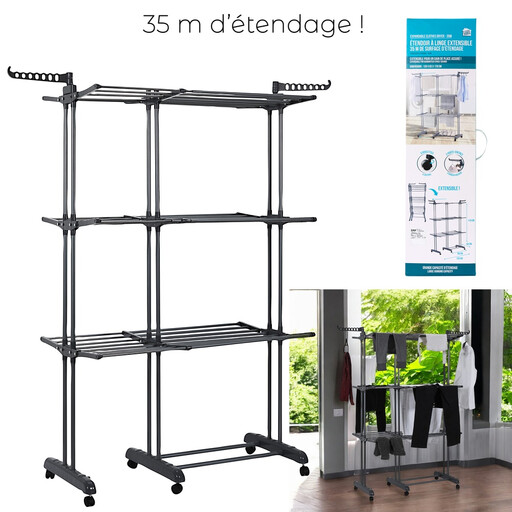 Image unavailable
Extendable 3-tier clothes airer, advertised with 35 m of drying space
An air-drying option if you can set aside a suitable room for drying your laundry. The product name states that it has three tiers and 35 m of drying space. Check its dimensions when fully extended and its maximum load, and make sure the room is well ventilated.
View on Joybuy
Frequently asked questions
Can I install a vented tumble dryer without an outlet to the outside?
No. The European Commission states that this type of tumble dryer must vent moist air outside. A condenser model doesn’t need this duct; check the manual to see how it collects or drains water.
What do I need to dry laundry on an indoor airer?
Choose a large, well-ventilated room or one with an extraction system, in line with the recommendations in ADEME’s Q-WASH study. It highlights that laundry drying naturally releases moisture into your home. Also check that you can leave the airer up without getting in the way of using the room.
Can an 8 kg washer-dryer dry the 8 kg it has just washed?
Not necessarily. The 8 kg figure may refer to washing capacity, while drying capacity is lower, as UFC-Que Choisir points out. Check both figures for the model. If the washed load is larger than its drying capacity, you’ll need to remove some laundry or dry it in batches.
What should I compare on a washer-dryer’s energy label?
Look separately at the washing data and the wash-and-dry cycle data. The European Commission lists details including efficiency classes, energy use per 100 cycles, water use per cycle, cycle time and noise. Check the corresponding capacities too, so you can compare appliances using loads similar to your own.


