Which features should you prioritise?
First work out where the appliance can go and how you’ll dry your laundry. Then compare the capacity you’ll actually need, spin performance and noise levels.
Front-loading washing machine
Consider this if: the space is suitable and you’ll continue to hang your laundry up after washing.
Bear in mind: spinning won’t eliminate the need to hang laundry up. Check the spin-drying efficiency class and noise level on the energy label.
Top-loading washing machine
Consider this if: limited width rules out some front-loading machines.
Bear in mind: you’ll need enough clearance above the machine to open the lid. And a top-loading design doesn’t guarantee any particular dimensions or spin performance across all models.
Washer-dryer
Consider this if: you don’t have enough space to hang laundry up or fit a separate tumble dryer.
Bear in mind: the washing load may exceed the capacity allowed for a wash-and-dry cycle. Compare the cycle duration and energy and water consumption too.
| What matters to you |
What to check |
Who is this for? |
| How long laundry takes to dry indoors |
Spin-drying efficiency class on the energy label; noise during the spin cycle. ADEME recommends class A if fast indoor drying is a priority. |
If my laundry needs to dry on an airer in my living areas, I want it to come out of the machine less wet. Around 33% of consumers would put reducing drying time at the top of their list of needs. |
| A capacity that suits your laundry loads |
Rated capacity in kg compared with your usual loads; energy and water consumption shown on the energy label. ADEME recommends choosing a capacity that meets your actual needs. |
If my loads are often small, a large drum may regularly be underfilled. If my loads exceed its capacity, I’ll need to run more cycles. For around 27% of consumers, matching the machine to their usual laundry loads would be the priority. |
| Space for drying |
Separate washing and wash-and-dry capacities; duration and energy and water consumption for the relevant cycles on the washer-dryer’s energy label. |
If I don’t have enough space to hang laundry up or fit a second appliance, I’d like to be able to dry a load in the same machine. Integrated drying would be the main need for around 20% of consumers. |
| Noise in your home |
Noise emissions in dB and the spin-noise class on the energy label; where you plan to put the machine. |
If the machine is near the rooms we use, spin noise could affect when I choose to do the laundry. Around 20% of consumers would make reducing this noise their main concern. |
Brands to know
There are no brand profiles to show in this section.
Joybuy models to consider
These two models suit different needs if you usually dry laundry indoors: a front-loading washing machine for washing loads that you’ll hang up afterwards, and a washer-dryer for built-in drying too. Check the specifications of your chosen model against your available space and laundry loads.
 Image unavailable
Hisense WF5I8043BWF, 8 kg washing machine
Worth considering if you wash loads suited to an 8 kg capacity and plan to hang them up afterwards. The model name indicates a maximum spin speed of 1,400 rpm and an inverter motor; this maximum speed isn’t a substitute for the spin-drying efficiency class. Check the class, noise level, dimensions and connections before deciding where to put it.
View on Joybuy
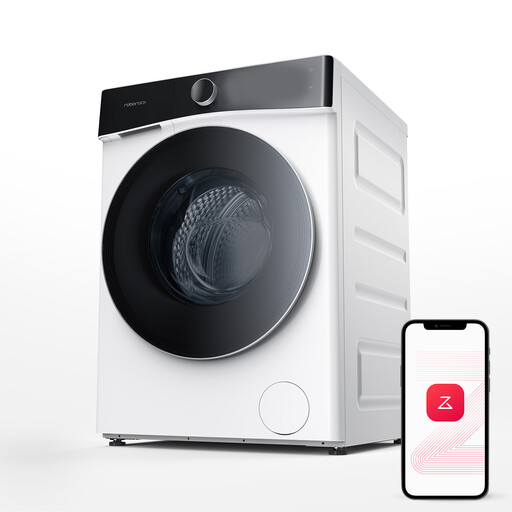 Image unavailable
Roborock Zeo Lite, 10 kg/6 kg washer-dryer
Worth considering if you want to wash and dry in one appliance because you don’t have room to hang laundry up or fit a separate tumble dryer. The stated capacity is 10 kg for washing and 6 kg for drying, so a washing load of more than 6 kg will need to be reduced before drying. The model name mentions Zeo-Cycle, app control and the LintClear system. Check the instructions and energy label for dimensions, connections, cycle duration, energy and water consumption, and noise levels for the cycles you’ll use.
View on Joybuy
Frequently asked questions
What should I look at first if I dry laundry indoors?
Check the spin-drying efficiency class first, then choose a capacity that suits your laundry loads. ADEME recommends choosing class A for spin-drying if you want to speed up indoor drying. Check the noise level too if the machine is near the rooms you use.
Can a washer-dryer dry the whole load it has just washed?
Not necessarily. Check its wash-and-dry capacity separately from its washing capacity. For example, Bosch lists a washing capacity of 9 kg and a wash-and-dry capacity of 6 kg for the WNG24402FR. If your load exceeds the latter, plan to remove some laundry before drying.
What should I check before a washing machine is delivered?
Measure the route to the machine’s intended position, the available space and the clearance needed to open it. Then check the water supply, drainage and electricity supply using the model’s instructions. Electrolux says that its installation service doesn’t include carpentry, plumbing or electrical work.
What should I check before installing a washing machine in a bathroom?
Have the location and electrical protection checked before installation. In France, the order of 3 August 2016 on electrical installations in residential buildings sets out requirements including an earth connection and protective devices that automatically cut off the power supply. Promotelec also highlights the importance of 30 mA residual-current protection and the rules for positioning appliances in bathrooms. If you’re unsure about the existing installation, ask a qualified professional to assess the project.


