If you do laundry often and have space for two appliances, pairing a washing machine with an effective spin cycle and a heat pump tumble dryer lets you dry clothes in the machine instead of hanging every load around your home. If you only have space for one appliance, a washer-dryer combines both functions, but its drying capacity may be lower than its washing capacity. If you use a clothes airer, a good spin cycle can cut drying time, but it won’t replace proper ventilation in the room.
Which option is right for you?
Households that dry clothes on an airer
If you don’t want to add another appliance, compare your washing machine’s spin efficiency and cycle noise. For laundry dried indoors, Anses recommends using a well-ventilated room. ADEME advises choosing spin efficiency class A when you need clothes to dry quickly.
Households that do laundry often and have space for two appliances
A separate tumble dryer lets you dry loads in the machine instead of hanging them around the room. If electricity use matters to you, compare heat pump models and the figures on their energy labels. Also check how much space the appliance needs and what maintenance it requires.
Small homes with space for just one appliance
A washer-dryer combines washing and drying in one appliance. Check its drying capacity separately: models in LG and Electrolux’s respective ranges have washing/drying capacities of 11/6 kg and 8/4 kg. Also measure the space needed when the door is open.
What should you compare?
Washing machine and airer
Consider this if: you can dry clothes in a well-ventilated room and are happy to wait for them to finish drying.
The trade-off: an effective spin cycle removes more water during washing, but clothes drying on an airer still release moisture into the room.
Separate tumble dryer
Consider this if: you regularly dry clothes in a machine and have space for a second appliance.
The trade-off: allow for the space it needs, access for maintenance and a noise level that suits its location.
Washer-dryer
Consider this if: one appliance needs to handle both washing and drying.
The trade-off: you may need to reduce a washed load before drying if the two capacities differ.
| Factor |
What to check |
What I need |
| Spin cycle |
Compare the spin efficiency class, then the washing machine’s capacity and noise level. ADEME recommends class A to help clothes dry more quickly indoors; the spin speed in rpm is no substitute for this rating. |
I dry clothes at home and want to reduce the time they spend damp. |
| Indoor humidity |
If you use an airer, choose a well-ventilated room, as recommended by Anses. France Rénov’ points out that excess moisture can condense on surfaces and encourage mould. |
I already have condensation at home: I need to look at ventilation and airflow, whatever appliance I choose. |
| Electricity |
Compare the energy label’s consumption figures for the cycle you use. UFC-Que Choisir highlights the lower consumption of heat pump condenser dryers compared with other drying technologies covered in its guide. |
I often use a tumble dryer and want to consider the electricity used by those cycles, not just the washing efficiency rating. |
| Space |
Measure the width, height and depth, as well as the space needed to open the door and carry out maintenance. If you plan to stack two appliances, check that the models and stacking kit are compatible. The dimensions allowed by an Electrolux kit won’t necessarily apply to every model. |
Space is limited: I need to be able to install, open and maintain the appliance once it’s in place. |
| Drying capacity |
Check the washing and drying capacities separately on a washer-dryer. For specific examples, LG lists 11/6 kg for the F164R78WSTA and Electrolux lists 8/4 kg for the EW8W3816BI. |
I want to run a wash and drying cycle without exceeding the appliance’s drying capacity. |
What should you look out for before buying?
-
Relying on rpm alone
The maximum spin speed on its own doesn’t tell you the spin efficiency class. ADEME recommends choosing class A if you need clothes to dry quickly indoors.
Check the energy label for spin efficiency, as well as energy use, the duration of the reference programme and noise. Then make sure the capacity suits your loads.
-
Expecting an appliance to solve a damp problem
France Rénov’ notes that excess moisture can encourage condensation and mould. A more effective spin cycle doesn’t remove the need to ventilate when drying clothes indoors.
If condensation or mould persists, look at ventilation and options for drying clothes in a well-ventilated room before assuming that buying an appliance will be enough to solve the problem.
-
Confusing washing and drying capacity
These capacities can differ: LG lists 11 kg for washing and 6 kg for drying on the F164R78WSTA, while Electrolux lists 8 kg and 4 kg for the EW8W3816BI.
If you plan to dry clothes straight after washing, size the load according to the drying capacity or be prepared to remove some of it first.
-
Measuring the space but forgetting the door and stacking kit
Having enough room for the appliance itself doesn’t guarantee access to the door, filters or connections. Stacking appliances also requires compatible machines and a suitable kit.
Measure the space with the appliances in use, and check that the kit is compatible with the exact models you’re buying.
A few examples from leading brands
These models illustrate different set-ups; their features don’t represent every appliance from each brand.
Bosch
The WQA23300FR is an example of a Bosch heat pump tumble dryer designed for separate installation.
- Bosch lists a capacity of 8 kg, a noise level of 62 dB(A) and dimensions of 842 × 598 × 613 mm for this model.
- Compare its depth and noise level with the space you have available.
Miele
The TEA525WP 8kg Active is an example from Miele’s range of separate heat pump tumble dryers.
- Miele lists this model with a capacity of 8 kg.
- To get an idea of how much energy it will use in your home, check the energy label figures for the model you’re considering.
LG
The F164R78WSTA is an example of an LG washer-dryer for homes with space for just one appliance.
- LG lists a washing capacity of 11 kg and a drying capacity of 6 kg for this model.
- If you want to run both cycles one after the other, size your load according to the 6 kg drying capacity, not the 11 kg washing capacity.
Electrolux
The EW8W3816BI is an example of a built-in Electrolux washer-dryer.
- Electrolux lists a washing capacity of 8 kg and a drying capacity of 4 kg for this model.
- Check the built-in dimensions and make sure its 4 kg drying capacity suits your usual loads.
Products available on Joybuy
These options cover the three ways to organise drying discussed here: a washer-dryer for a single space, two separate tumble dryers, and a washing machine for households that continue to dry clothes on an airer.
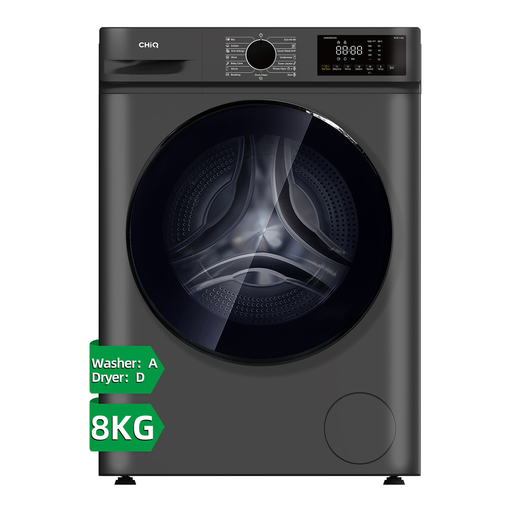 Image unavailable
CHiQ JW85882HG washer-dryer, 8/5 kg
Combines washing and drying in one appliance. The model name lists a washing capacity of 8 kg and a drying capacity of 5 kg. If you want to dry a whole load in the machine, bear in mind its lower drying capacity. Before buying, check the installation dimensions and the space needed to open the door.
View on Joybuy
 Image unavailable
Hotpoint CHD84MWBSEE heat pump tumble dryer, 8 kg
An option for drying clothes in a machine if you have space for a separate appliance. The title lists a capacity of 8 kg and a class C rating. Compare the cycle’s energy use on the energy label, and check the space needed for installation and maintenance.
View on Joybuy
 Image unavailable
Electrolux EDH1018CD GentleCare condenser tumble dryer, 8 kg
This 8 kg model lets you dry a load in the machine instead of using an indoor airer. Its name mentions the OptiSense function. Compare the cycle’s energy use on the energy label, and make sure you can open and maintain the appliance in its intended location.
View on Joybuy
 Image unavailable
Hisense WF5I8043BWF washing machine, 8 kg, 1,400 rpm
For washing clothes before drying them on an airer, without adding a tumble dryer. The title lists a capacity of 8 kg and a maximum spin speed of 1,400 rpm; check the spin efficiency class separately on the energy label. If you dry clothes at home, choose a well-ventilated room and also check the space needed when the door is open.
View on Joybuy
Frequently asked questions
Is a more effective spin cycle enough to dry clothes indoors?
Not if excess moisture in the room is also a problem. ADEME recommends spin efficiency class A to speed up indoor drying, but clothes will still be damp after washing. Anses recommends drying them outside if possible, or in a well-ventilated room if not.
When should you choose a heat pump tumble dryer?
If you have space for a separate tumble dryer and often dry clothes in a machine, electricity use is worth considering carefully. UFC-Que Choisir says that heat pump condenser models use less energy than the other tumble dryer technologies covered in its guide. Still, compare the energy labels, capacities, dimensions and noise levels of the models you’re considering.
Can a washer-dryer dry a full load of washing?
Not always: check both capacities before planning to run one cycle straight after the other. LG lists 11 kg for washing and 6 kg for drying on the F164R78WSTA; Electrolux lists 8 kg and 4 kg for the EW8W3816BI. If your load exceeds the drying capacity, you’ll need to reduce it before drying.
Can you stack any washing machine and tumble dryer?
No. Check that the exact models are compatible with the stacking kit you choose. For example, Electrolux says one of its kits is suitable for front-loading appliances with a depth of 47 to 60 cm. That doesn’t mean it will fit other models.


