For anyone in a stuffy room
You want to track how CO₂ levels change in an occupied room and adjust your airing habits, without treating the reading as a complete assessment of the sanitary quality of the air, as Anses advises.


Start by choosing the parameter that relates to what you want to monitor: CO₂ to track how stuffy an occupied room becomes, humidity to monitor a damp room, or particles and VOCs to compare changes linked to certain activities. ADEME highlights the limitations of micro-sensors, while Anses explains that a CO₂ reading alone cannot diagnose the sanitary quality of the air. If dampness persists, check the ventilation and look for the cause rather than adding more sensors.
You want to track how CO₂ levels change in an occupied room and adjust your airing habits, without treating the reading as a complete assessment of the sanitary quality of the air, as Anses advises.
You want to monitor humidity in a room and, if the problem persists, have the ventilation checked or find out what is causing it. ADEME highlights the role of ventilation in the home.
You want to observe changes in VOCs or particles after certain activities, while bearing in mind that a sensor cannot always identify the substance responsible.
First decide what you want to monitor, then check that the device displays the relevant parameter rather than just an overall index.
| What you want to monitor | What to check | Who it matters most to |
|---|---|---|
| How stuffy an occupied room becomes | Actual CO₂ readings in ppm, and a history if you want to compare different periods of occupancy. | If I want to see how stuffy an occupied room becomes, I look for readings that are easy to follow over time. Around 31 % of consumers prioritise monitoring stuffiness. |
| Unusual humidity levels | A relative humidity reading in % and the ability to compare readings from the room in question. | If a room stays damp, I want to track changes without confusing monitoring with finding the cause. Around 31 % of consumers prioritise humidity monitoring. |
| Changes linked to odours or products in use | An explicit VOC measurement and data displayed for each parameter, rather than a single index. | If I want to compare readings before and after certain activities, I check that VOCs are actually measured, without expecting the sensor to identify every substance. Around 23 % of consumers prioritise monitoring odours or volatile emissions. |
| Particles produced by certain activities | The particle fractions measured should be specified, such as PM2,5 or PM10, rather than just a general mention of “air quality”. | When I want to monitor particles associated with certain activities, I check exactly which fractions the model reports. Around 15 % of consumers prioritise particle monitoring. |
An overall index can mask the fact that the device does not measure the parameter you care about. ADEME points out that micro-sensors are not as reliable as instruments that meet strict metrological criteria.
First check which measurements are actually available — for example, CO₂, humidity, PM2,5 or VOCs — and read the data for each parameter rather than treating an index as a diagnosis.
A CO₂ sensor gives you information about how stuffy a room is, but it cannot rule out other pollutants or a suspected carbon monoxide leak. Aranet specifies that the Aranet4 HOME measures CO₂, not CO.
Check the exact name of the gas being measured. If you suspect carbon monoxide poisoning, Santé publique France advises you to ventilate immediately, turn off fuel-burning appliances if possible, leave the building and call 15, 18 or 112.
A humidity reading alone will not reveal the cause of the problem, nor is it a substitute for checking the ventilation. ADEME highlights the importance of ventilation in the home; the QUALITEL association recommends finding the cause if the dampness persists.
Check the airflow and ventilation, then use a hygrometer to monitor changes. If the problem persists, ask a professional to investigate the cause.
The SONOFF AirGuard models mentioned have different primary parameters. Airthings states that the View Plus reports PM2,5, but not PM10.
Before buying, check the full model number and the list of parameters specified for that version, including the particle fraction measured.
Netatmo’s smart indoor air quality sensor is designed to monitor a fixed room. It runs on mains power and can be tracked through the app.
The battery-powered Aranet4 HOME is designed for mobile monitoring of CO₂, temperature, humidity and pressure.
According to Airthings, the View Plus combines several parameters, including radon, PM2,5, CO₂, VOCs, humidity, temperature and pressure. It runs on batteries or via USB.
The AirGuard range includes different models, notably the SAWF-08P for CO₂ and the SAWF-07P for particles.
This selection focuses on additional monitoring of indoor humidity and how it changes throughout the day.
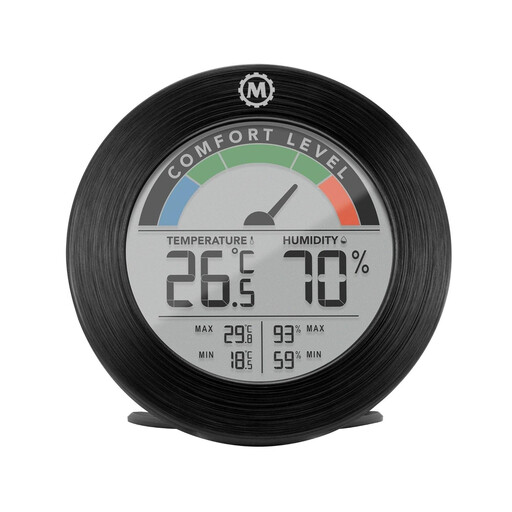 Image unavailable
Monitor the humidity in a room and compare its daily minimum and maximum readings.
Measures indoor temperature and humidity. Digital LCD display and records daily minimum and maximum readings. Battery-powered.
No. Anses describes CO₂ as an indicator of how stuffy a room is, not as the sole indicator of the sanitary quality of the air. ADEME also highlights the limitations of micro-sensors compared with reference instruments. Check which parameters are actually measured rather than treating a colour as a diagnosis.
First check that the air inlets and outlets are not blocked and that the extractor is working. A hygrometer can help you monitor changes, but if the dampness persists, the QUALITEL association recommends asking a professional to investigate the cause.
No. The ministry responsible for the environment describes mandatory indoor air quality monitoring in certain public-access buildings. This does not mean that a domestic micro-sensor provides a regulatory measurement in a home.
Do not rely on a CO₂ sensor: these are two different gases, and Aranet specifies that the Aranet4 HOME does not measure carbon monoxide. If you suspect poisoning, Santé publique France advises you to ventilate immediately, turn off fuel-burning appliances if possible, leave the building and call 15, 18 or 112.
No. The parameters vary between models. Check whether the one you are interested in, such as CO₂, VOCs, PM2,5 or PM10, is explicitly listed among the measurements. An overall index alone cannot identify every substance present.